
Hello 👋
Welcome to the Hothouse newsletter, where our theme this week is preparation, but not in the frantic, last-minute sense. The quieter kind. The strategic kind. The work before the work.
Preparing your positioning for a market that may not be right on your doorstep. Preparing your operations, your composure and authority so clients instinctively experience you as a serious professional. Preparing the way you show up, physically and emotionally, so that your presence contributes meaningfully to business success.
And also preparing internally: tracking, modelling, noticing, and gently confronting your own psychological readiness for what you say you want.
Because sustainable success rarely arrives by accident. It’s built, layer by layer, long before the visible results appear.
1. Blog
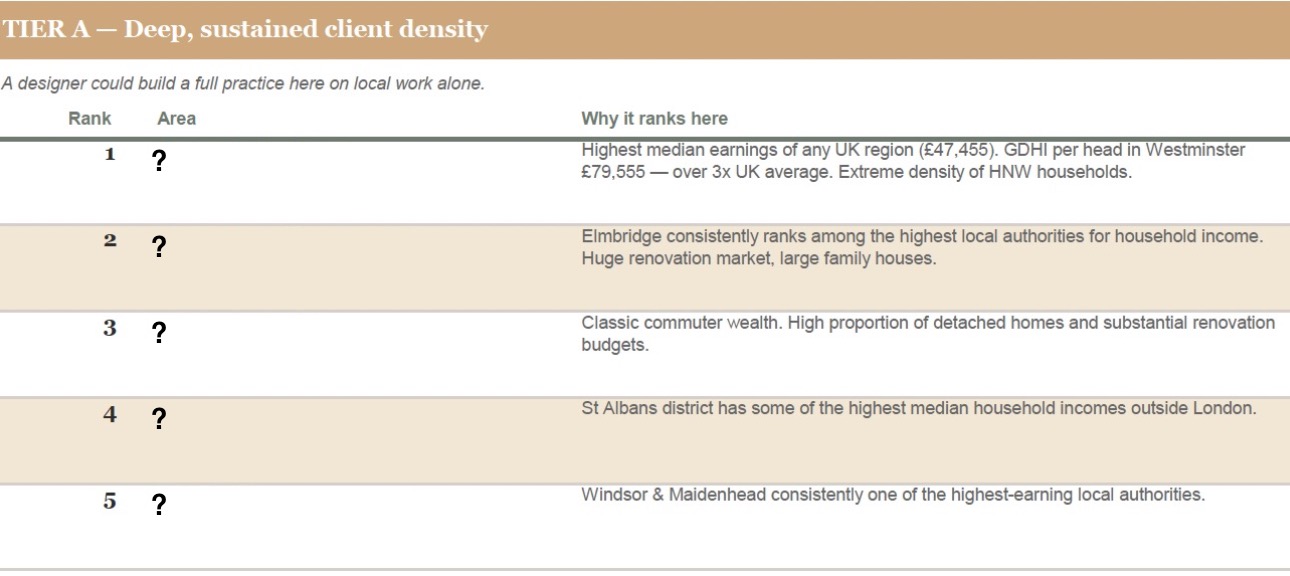
This week's blog identifies the 'Golden Zones' in the UK where concentrations of high-spending households make interior design practice commercially viable. Read the article to find out if you live in or near one of these reliably affluent areas.
But this isn't a counsel of despair. If you get your positioning right, location needn't determine your success. A specialist in Oban with a national reputation in a defined niche becomes the person clients will travel to - or willingly fly in.
In this model of specialism over location, the clients must be geographically scattered rather than clustered in one postcode. The project value must be high enough to absorb travel costs without eroding margins. The specialist knowledge required must be deep enough that generalists can't credibly compete. And the niche must be nameable, because if a potential client can't articulate what they're searching for, they'll never find you.
For example, here are some niches that meet those criteria:
- Distillery and brewery visitor experiences
- Bespoke wine cellars and tasting rooms for private clients
- Luxury narrowboat and canal boat interiors
- Equestrian facility interiors
- Liturgical and sacred space design
- Private home libraries and archive rooms
- Recording studios and private listening rooms
- Private medical and therapy rooms within homes
- High-end glamping and luxury outdoor hospitality interiors
- Historic house interpretation and period room design
In next week's blog, we'll stay close to this subject, looking at decoupled (aka passive) income, and exploring how this could help top up - or even replace - location-dependent revenues.
2. Long Read - Inspired by Alex Dauley: How Clearly Are You Communicating Your Value?
Alex Dauley wrote an Instagram post this week that landed with force. She'd been approached for a prime-time television role, only to discover that the 'designer' position amounted to cleaning, light DIY and general styling support. She turned it down, not because she couldn't do it, but because she believes those with platforms have a responsibility to represent the profession with integrity.
It's a principled stand, and it's set hares running across the industry.
Alex is right that public perception matters. When television consistently reduces interior design to scatter cushions and a lick of paint, it shapes what clients expect and, critically, what they're willing to pay. As she says: perception shapes value; value shapes fees; fees shape the sustainability of the entire profession.
But here's where I want to gently widen the lens.
I’m certain that Alex herself is rarely, if ever, mistaken for a cushion-fluffer. She has clear positioning, strong methodology, visible authority. Her clients understand precisely what they're buying. And that isn't a coincidence.
Speaking to designers, I regularly hear the same prayer: 'I want better clients with bigger budgets.' That's because they're being chiselled on price; they feel undervalued; they're exhausted by the gap between what they deliver and how they're treated. In my tier system, these are overwhelmingly Tier One and Tier Two designers – those in the startup and growing pains stages of their practice – where their business infrastructure hasn't yet caught up with their creative talent.
I understand that frustration intimately, because I lived it.
My Evangelista moment
Twenty-five years ago, I was a textbook Tier Two designer. Practising solo, having left the security of a role with an established designer. A people-pleaser. Frightened about money. Twisting myself into all manner of awkward shapes just to keep clients happy and the work coming in.
It came to a head with a project where I'd developed a fully-resolved design for a client whose family was heading overseas on sabbatical. The scheme was to be installed in their absence. As she was leaving, my client casually mentioned that a school-run friend 'with a good eye' would handle the project implementation from here. ’Oh, but she might have the odd question. Can I give her your number?'
The answer should have been: yes, at my hourly rate.
Instead, caught off-guard and desperate to please, I just said yes. Of course.
It was, predictably, a disaster. Things went wrong. And because my unqualified 'yes' had blurred the lines of responsibility, some of the blame stuck to me.
That was my rock bottom. I decided, with absolute clarity, that from that point forward I would be properly paid - properly - or I would leave the profession altogether.
I rather pity the next client who walked through the door. But the transformation was extraordinary. Because I was genuinely prepared to walk away, everything shifted. I discovered that the more I charged, the more my clients valued me. The more boundaries I held, the more respect I received. The more I presented as a strategic professional, the more I was treated as one.
The principle behind both stories
Alex's post addresses something real and important: media portrayal does matter, and those with influence should use it responsibly.
But for the vast majority of designers who will never appear on television, the question is closer to home. If the world doesn't always understand the value of what you do, how clearly and consistently are you communicating it?
Professions teach the market how to see them. Not overnight, and not through grand gestures alone, but through positioning, process, pricing, boundaries, and the thousand small signals you send every day about how seriously you take your own work.
What it looks like when this is solved
There's a reason Tier Three and Tier Four designers rarely find themselves fighting for respect. It isn't luck, and it isn't simply that they've accumulated prestigious projects. It's that, over time, they've built two things I teach in my Bootcamp course: Armour, and Self-Defence.
ARMOUR is the transformation of your business into a professional headquarters - shored up, battle-tested, and unassailable. It means your contracts, terms and insurances are rigorous and current. Your documents, systems and processes cover every eventuality, so that the client experience is seamless and unmistakably professional. Your onboarding and client education make roles, responsibilities and the full scope of your expertise explicit from the outset. And your founder presence - the way you carry yourself, hold boundaries, and command a room - inspires confidence before you've even opened a portfolio.
A designer with strong Armour doesn't need to argue for their value. The infrastructure does it for them.
SELF-DEFENCE is the companion discipline: the attitudes and practices that protect you in the moment, when something unexpected lands.
It begins with thorough preparation - including planning small, well-judged educational introductions for anything that might require a mental adjustment from your client. It includes embodied practice: developing awareness of your own emotional responses so that you can operate with composure and professionalism even when your instincts are pulling you elsewhere. It means active listening - the kind that hears what's beneath the surface of a client's objection or anxiety. It requires ongoing work on mindset and confidence, not as a one-off exercise but as a continuing practice. And it means having extraction strategies ready for when things become difficult - ways to maintain control, keep doors open, and protect the relationship without compromising your position.
A designer with strong Self-Defence doesn't get ambushed by the school-run friend with a good eye. She sees it coming. And she has the language, the composure and the contractual framework to respond with grace and absolute clarity.
The difference this makes
The frustrations that dominate Tier One and Tier Two - the price haggling, the scope creep, the clients who treat you as an optional extra in your own project - become vanishingly rare once Armour and Self-Defence are in place. These are the tools of the Tier Three transition: not a sudden leap, but a deliberate, structural shift in how you present, operate and respond that makes it clear this is a serious professional engagement, led by a serious professional.
That's the shift. Building a practice so robust and so clearly articulated that no one who encounters it could mistake what you do for fluffing cushions.
Alex is right to challenge the industry's public portrayal. But the designers I work with who've made the transition to Tier Three? They've stopped waiting for permission to be valued. They've made it structurally inevitable.
3. Webinar - Embodied Founder Presence
On Tuesday 17th at 10am, I’ll be running part two of the webinar series on Founder Presence, our subject for February.
If you wonder what Founder Presence is and means (and you might notice it referenced in the article above under both Armour, and Self-Defence) you can rewatch part one here.
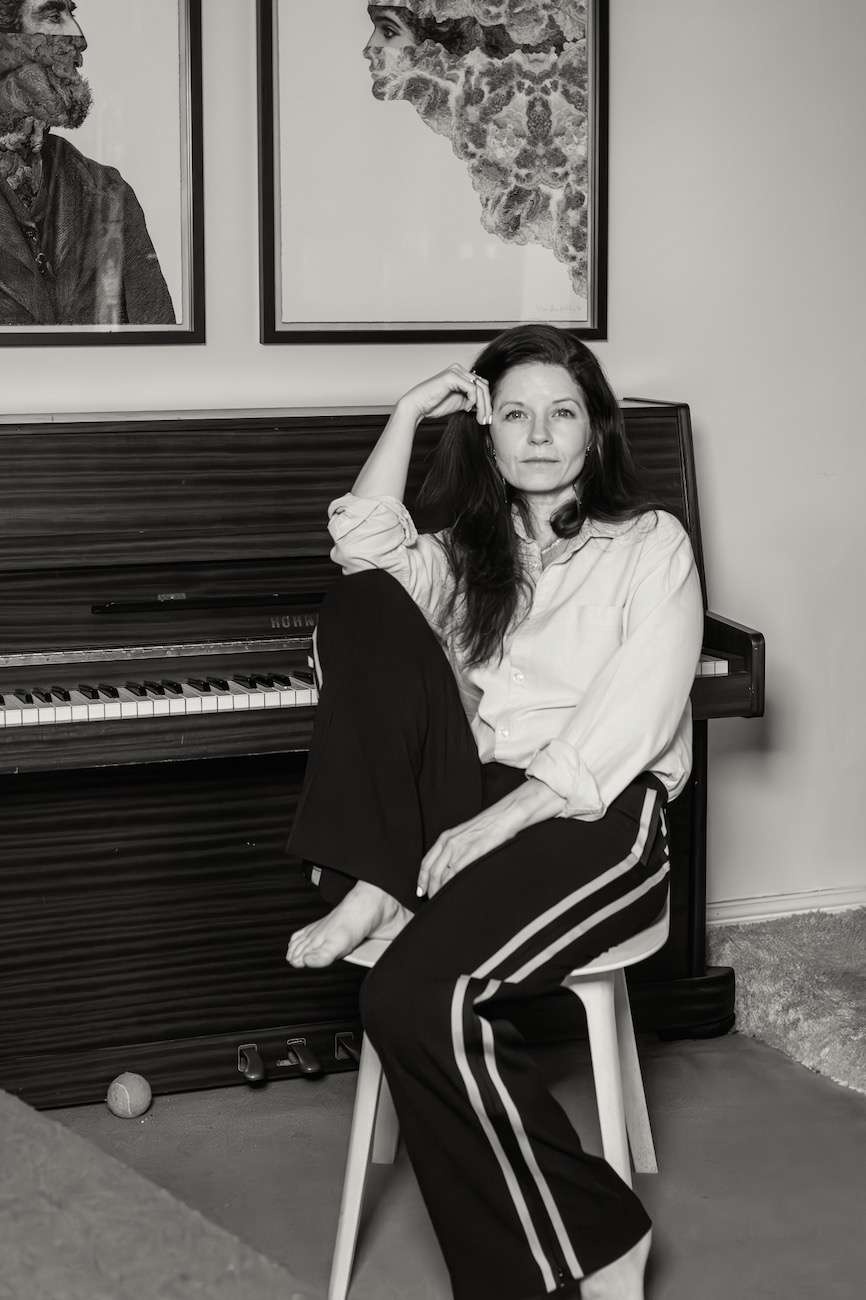
"Whether you’re speaking on camera, leading a client conversation, or stepping into a bigger room than you’re used to, I’ll help you build the capacity to be seen, without becoming someone else." Nicky Herrington
Part Two is a double-hander, I’ll be presenting alongside Nicky Herrington, voice coach and photographer, who’ll be guiding us on how we adopt a more visible presence with ease, and explaining that founder presence isn't performance or pretence. It is the deliberate choice to lead with the steadiest, most assured parts of who you already are. The goal is a curated authenticity that builds trust, feels natural, and is entirely your own.
The link to join the webinar is in the Hothouse group, under the Events tab. See you in there!
4. My Week In Hothouse
These days I rely on the data tracking spreadsheet to drive my activities: 2 posts on LinkedIn this week; face-to-camera on Insta and FB (with the data sheet at the back of my mind); I posted on Instagram only because I couldn’t bear a red number. This spreadsheet makes me tackle my social media to dos earlier in the week because otherwise there isn't time to get things done.

And when thinking about ‘worthiness’ this week, for the first time this year, I noticed a shift. The continued work of modelling the business, and focus on founder presence is doing what it's supposed to do: making growth feel less like something that might happen to me and more like something I've built towards. That distinction matters.
Some small improvements are happening over on YouTube, followers have picked up. I've been using AI to draft optimised titles and descriptions - maybe this has something to do with the uptick.
And in AI support, this week I began a (possible) transition from OpenAI's GPT-5 to Antropic's (Claude) Opus 4.6: reports of Claude's excellence are too widespread not to give it a go. I'll let you know, it certainly crunched the numbers for the blogpost with impressive power.
Meanwhile, I'm very excited about the digital marketing project I've just launched with an specialist agency. They’re giving me lots of chores, not least of which to record 24 face-to-camera videos to be used in Meta ads. For anyone watching the numbers with me, it’s going to be fascinating to see what happens to the spreadsheet once this project goes live.
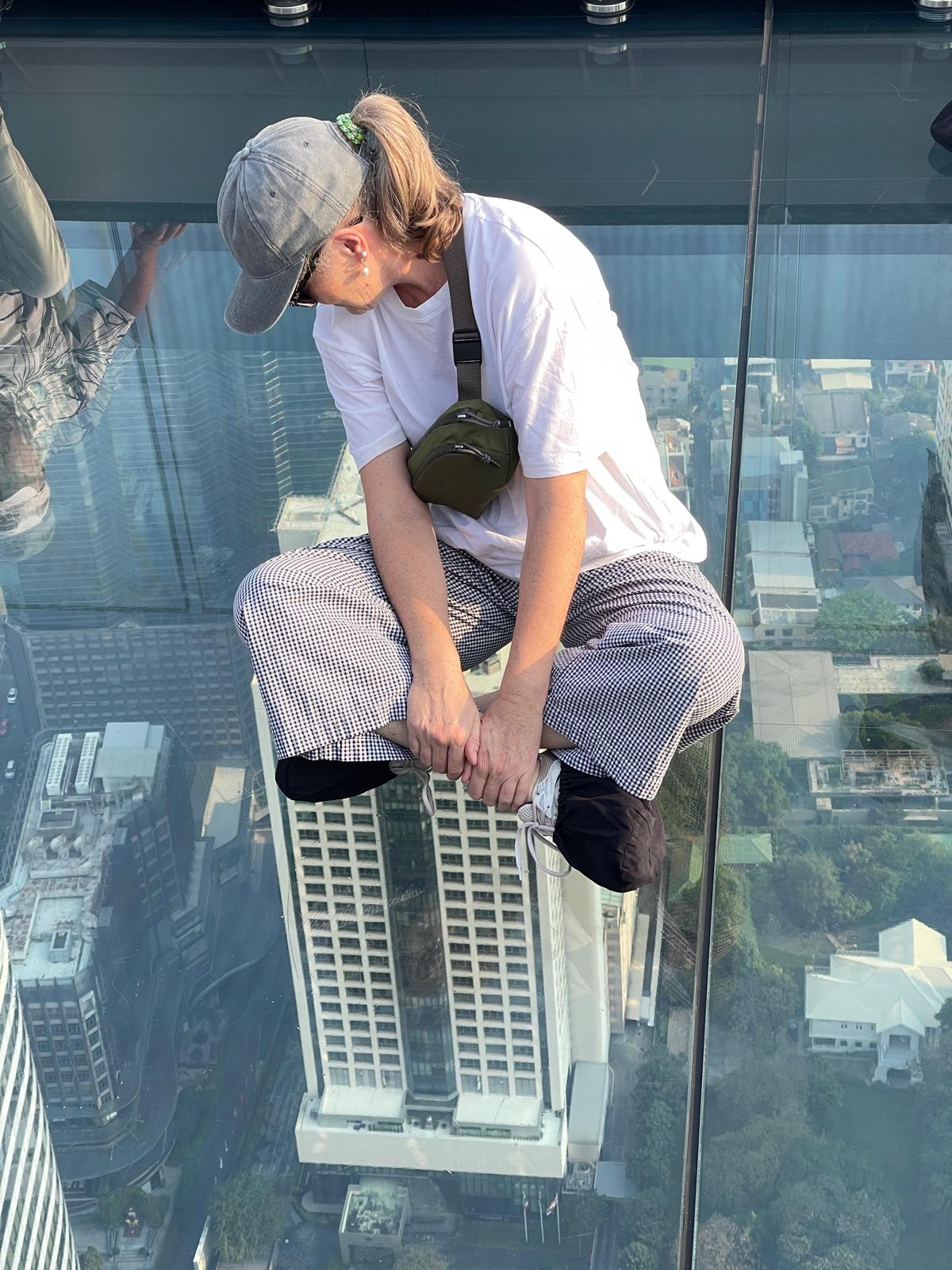
On the personal front, we have a few more weeks to go in Bangkok, and this week I managed out and about on a couple of mornings - more photos coming later on stories!
5. Bootcamp Early Bird
The discounted offer (£895 instead of the usual £980) for the live online course running 20 April-22 May will end on Thursday 19th at 6pm UK time.
If you are a Tier Two / Tier Three designer with an ambition to elevate your business - to push on up to Tier Three, or Tier four - to reignite your mojo, to plan and prepare for whatever the next 3-5 years will bring, better book Bootcamp!
6. Final Thought
What strikes me about this week's content is that every part of it asks the same question from a different angle: when the opportunity arrives, will you be ready?
Not hopeful. Not winging it. Ready.
The blog asks whether your positioning is strong enough to attract clients beyond your postcode? The long read asks whether your business infrastructure commands the respect your creative work deserves? The webinar asks whether the version of you that meets the world is one that inspires confidence? And my own week – the spreadsheet, the modelling, the quiet internal reckoning – is simply me doing the same work I'm asking of you, and - hopefully - showing that it works.
None of this is glamorous. Planning rarely is. But the designers I work with who've made the transition from reactive to resilient didn't get there by waiting for the right project to land. They got there by building a practice so thoroughly prepared that when the right project did land, it felt like the natural next step rather than a stroke of luck.
That's the work before the work. And it's the work that makes everything else possible.
Wishing you a super week,
Julia
Founder - Hothouse

Responses