
Hello 👋 and happy Fathers' Day to a tiny, but most welcome, minority of my readership.
This week a designer told me about an enquiry that arrived sounding exactly like a brief from an expert. It was only when the conversation moved to the phone that she discovered the client was a complete novice who had used AI as an intermediary.
The AI-confected gap between appearances and reality is the subject of this week's blog post, and it turns out to follow you through the entire client relationship: the brief, the contract, the concept critique, and the crushing moment, partway through a project, when a client decides they can finish the rest without you.
This all reminds me of the upheaval in interior design practice - I was there - when the internet started messing with our ability to supply at retail, and we had to engineer a new model.
In this newsletter I suggest what you can actually do about this latest wrinkle: qualifying a client's experience before you pitch your response, structuring a fee proposal so a mid-project exit doesn't cost you the work you've already done, and explicitly presenting the value that's always been there but now urgently needs framing and recognition.
After that, a complete change of register. One of my Business in a Box designers had a marketing breakthrough this week 🙌, and it gave me cause to think about the long, undocumented stretch that precedes any breakthrough, and what to do while you're still in it.
1. This Week's Blog Post - How AI interferes with your client relationships without meaning to

This week's blog traces a single problem through every stage of a project: AI writes with the same unwavering confidence whether it understands your client's situation or knows nothing about it at all, and that fluency is increasingly hard to distinguish from genuine expertise - yours or theirs.
From the brief that sounds expert but isn't, to the client who departs with early stage IP to finish the job themselves, here's where the mirage shows up, and why irritation is the wrong response to it.
2. Protecting Your Practice: Three Fixes for the Age of AI
In the past I’ve written about the most effective ways you can deploy AI assistance in your business.
Now AI-influenced changes in client behaviour mean we need to look at this from another angle: preparing our businesses for the impact of clients augmented by AI. The blog set out where AI's confident fluency interferes with the client relationship.
Here are starting suggestions for updating your systems and processes accordingly.
A. The Brief
Problem: A fluent brief can no longer be trusted as a signal of an experienced client. Onboard them as an expert when they're actually a novice, and you're heading for an avoidable meltdown later in the project.
Solution: Introduce an AI Induction at the preliminary meeting, backed up in your How We Work pack. Gently probe how much hands-on experience the client actually has, and whether any briefing material was AI-generated; not to catch them out, but to pitch your support at the right level.
Set two standing policies here so neither needs improvising later, explain both of these face-to-face, and in writing:
- during discovery: accepting now that inspiration material may well be AI-generated and will be tested against the brief and the project's real constraints;
- and, on AI generally: where it helps, where it causes delay, and what that means for fees and revisiting decisions. Once the brief is agreed, gently shut down all external input (unless meaningful new input arrives - always hear the case). Reworking a settled decision is a scope change, not a conversation. AI makes it possible to test and challenge design solutions infinitely, and for every project there are a thousand good solutions - but time is money. Confirm policies in writing, either as a footnote on the fee proposal or built into your terms.
B. Concept Stage
Problem: A client triggers a contractual break clause, departing with early concept work, exiting before paying for it in full, intending to finish the job themselves with AI. You've done the hardest, most magical part - providing the creative spark, harmonising conflicting interests, narrowing endless possibilities to one - and carried all the financial risk of the client’s early departure.
Solution: The Fee Proposal Fork (see last week’s newsletter for details). Split the fee proposal in two. The first, smaller part, presented as usual after the preliminary meeting, covers concept only, taken to an advanced level (colours, materials, form, style, joinery, a couple of hero items) and becomes the project's style bible. The second fee proposal is presented once concept is signed off, and covers design development onwards. Packaged this way, concept is a complete, priced deliverable, paid in full. The relationship can end at that gate with nothing to argue about, because the structure already settled it.
C. Client Retention
Problem: The Fork protects you if a client leaves. It does nothing to make them want to stay, that's a separate job, and it needs doing.
Solution: Make the invisible value explicit. Trade relationships, fully resolved developed design, contractor instructions that actually deliver the vision, sequencing judgement, problems foreseen before they surface, a steady hand on the tiller - this has always been part of what you bring, but we don’t always present the detail. Naming it is what turns "I could probably finish this myself" into a client who has FOMO when they consider letting you go.
The thread through all three: think of how you’d like your doctor to deal with you, mid-consultation, with a memorised AI briefing burning in your pocket. You’d want them to be confident, knowledgeable, patient with the question - but not infinitely patient. Build your own policies on that standard. Sometimes we just want to say our piece - our ego requires us to have represented our interests - but then we are really happy to be scooped up reassuringly by a human professional.
3. Kindling
Each autumn in Business in a Box I work with an intimate group of new designers to get their businesses up and running. The metaphor I see for this work is: setting a fire, complete with kindling, in a spark-rich environment.

This week, in a group accountability meeting, we had the exciting news that a designer’s kindling had caught - six months on from the end of the course. Enquiries (plural) had come in, fees had been accepted, things were finally moving after a long period of consistent application: the visible results of months of input during which the faint-hearted might have given up.
I know exactly what this feels like. When I launched Hothouse, I knew it would be counterproductive to keep looking for signs, so I decided to stay busy and allow a year of complete silence before I even questioned the strategy. It was a contract I made with myself, in the best interests of the venture.
In my case, I sensed the kindling faintly smouldering in month eight. In the final quarter of the year, there was enough activity to persuade me it wasn't a fluke.
Six to eight months without proof is a long time. It is also, it turns out, roughly how long it takes.
What makes this approach work is precisely what makes it dangerous if you apply it indiscriminately - which is the subject of the piece that follows.
Business in a Box will be back in September. It runs live online for 12 weeks. It is currently on early bird offer, and this year will also include White Label Studio as part of course materials. Find out more here.
4. Marketing Mindsets, and the Cost of Confusing Them
There are two mindsets available for sustained effort, and most of the trouble people get into when marketing comes from running the wrong one.
Marketing is a mind-game; to win the game you need to select the mindset best suited to success with your particular activity.
Mindset one: quick wins. Action and result sit close together in time. You act, you see something, the result tells you whether to continue, adjust, or stop. This mindset is built for fast-signal environments: paid advertising, sales calls, anything that returns a yes or no within days. Its discipline is responsiveness: read the signal, act on it.
Mindset two: consistent showing up. Feedback is deliberately decoupled from action. You commit to the plan before you start, on the understanding that no signal will arrive for some time, and the discipline is in refusing to treat that silence as information. This suits compounding work: reputation, referral networks, trust-building - interior design is a trust-based service, and trust takes time. Activities where the gap between input and output is long, but the eventual output is disproportionately large to any single week's effort.
When marketing fails, it's often a case of having applied the wrong mindset to the wrong activity.
Bring mindset one to slow-building work, and you'll iterate prematurely: changing your offer, your message, your entire approach every few weeks because nothing's "working," when nothing was ever going to show that quickly. The switching itself becomes the obstacle.
Bring mindset two to a fast-feedback channel, and you'll sit on an underperforming ad for months out of misplaced loyalty to "trusting the process," when the absence of result there is genuinely telling you something, and ought to prompt a change.
The skill is classification: knowing, for each activity in your practice, which feedback environment you're actually in, and setting your tolerance for silence accordingly.
5. Coming Up in Hothouse
WEBINARS: our June focus on Systems and Processes will spill over into early July, when we’ll cover procurement in detail; we will also look at where AI is most effectively used, and where it’s worth investing time in developing AI-powered processes.
Systems and Processes - Part II: Wednesday 24th June, 10am UK
Systems and Processes - Procurement: Thursday 2nd July, 12 noon UK
AI in your Systems and Processes - Hothouse Version: Tuesday 7th July, 11am UK
The AI session will be based on the CPD I ran for the BIID last week, looking at building “engines” with AI to help take on the production of many of your business’s big, set piece document packs. We will use the fee proposal as a worked example.
All links to join webinars, and all materials shared during webinars, can be found in Hothouse - the free resource hub for designers.
6. My Week in Hothouse
Back in the swing of things this week, after a period of disruption that had knocked my usual rhythm rather more than I'd have liked. Hothouse is about to welcome its 300th member 🙌, which feels like the right marker to be returning to.
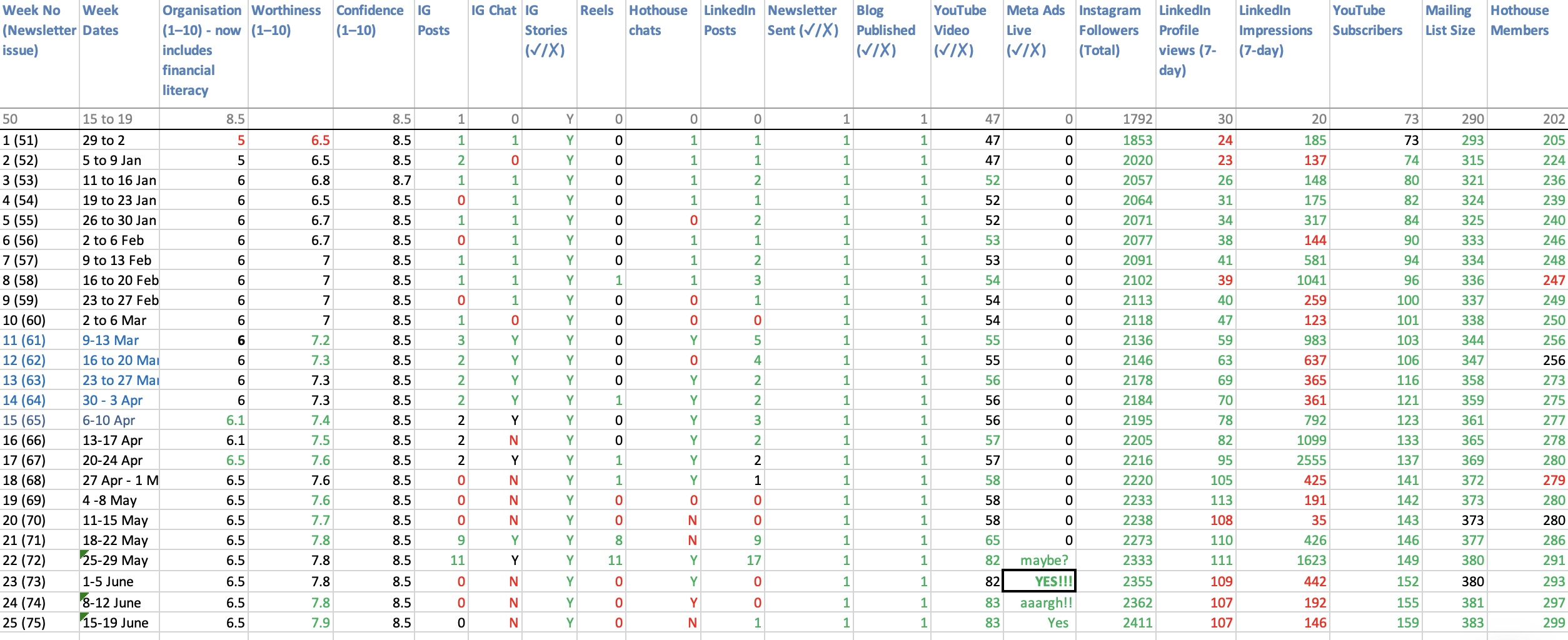
Instagram followers continue to climb, with Meta Ads clearly earning their keep, and this week had a further boost courtesy of a day spent at a Reels Rockstars workshop in the Scottish Borders. I came away with several hacks I'm looking forward to putting into practice.
Website visitors (not recorded here) by contrast, have slipped - down to under 7,000 a week from a recent high of nearly 10,000. My suspicion is that this tracks fairly directly to my LinkedIn and Instagram posting schedule, which I haven't yet picked back up since Bootcamp ended. I'm resuming both this week, and will watch the numbers to see whether the correlation holds. Website numbers are therefore a focus now, and I'll be working to build these back up again.
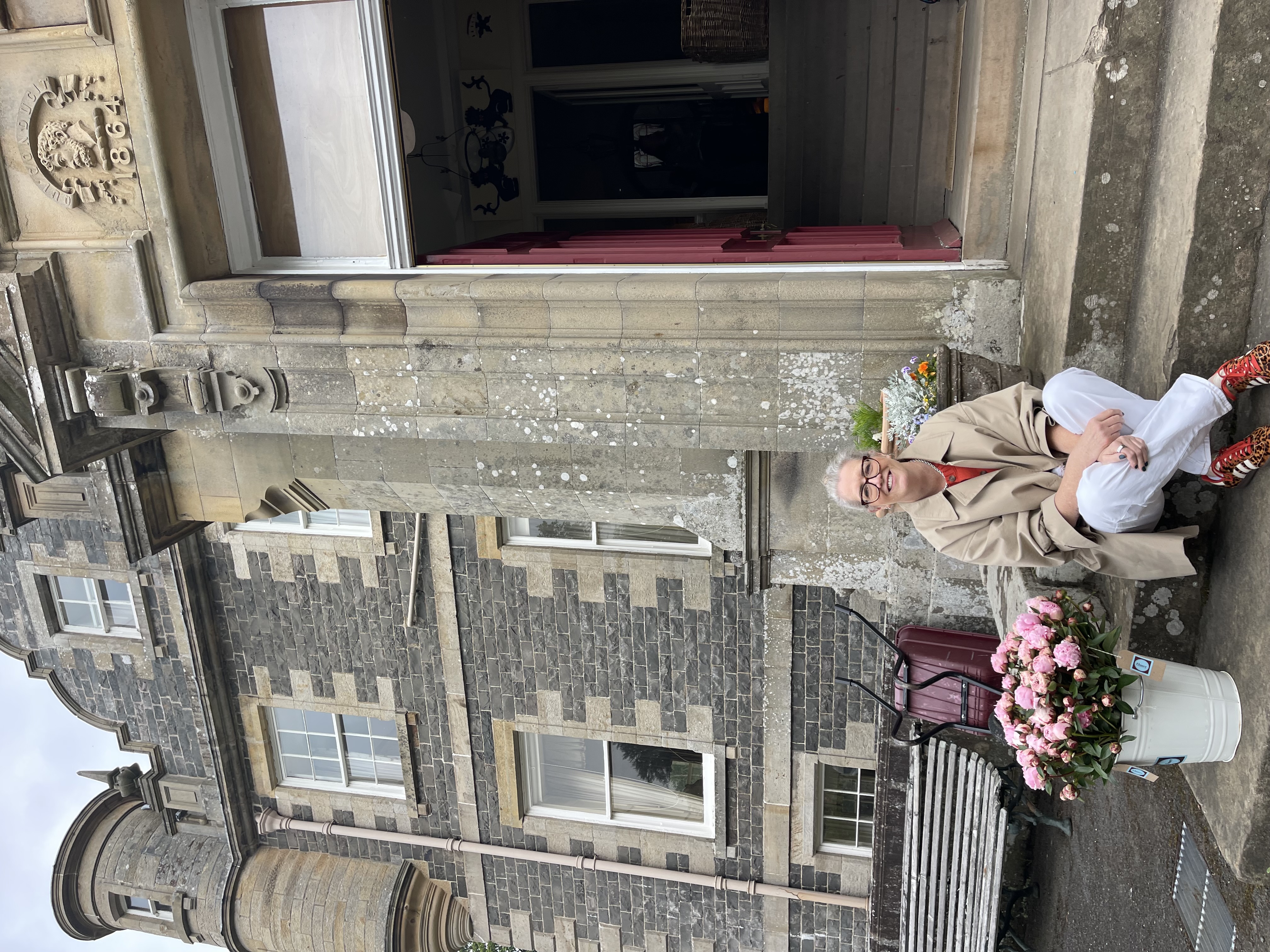
On the marketing front, I've recorded the next batch of videos for the Meta Ads agency, which should be on their way within the next day or two. And apologies for being late with the newsletter this week - today I played hookie and enjoyed a glorious afternoon visiting Open Gardens in Stockbridge, Edinburgh.

Final Thought
Every major structural shift in our industry has come with the same complaint: something is interfering with the designer's ability to be trusted at face value. The internet did it to retail. Now AI is doing it to expertise itself, manufacturing a fluency in clients (and in designers, for that matter) that looks exactly like the real thing, until it's tested.
Regular readers will know how much I love a gap: my business exists to help designers bridge the gap between where their business is and where they want it to be. Now we have gaps between appearances and reality. Is our client's fluency backed by understanding, or borrowed from a chatbot? Is this silence in my business telling me something, or is it simply month four of eight? Is this follower count the real story, or is the website traffic the one I should actually be watching?
Gaps present such opportunities when we get really interested in them, when we don't rush to judge, when we stay calm and design resilient new models and processes.
Enjoy the sun - stay cool 😎
Julia
Founder - Hothouse


Responses