
Hello 👋
There is a number that keeps appearing in my work at the moment. Three years.
It is the period that business research consistently identifies as the threshold at which a new business (or a pivoted one) begins to perform. It’s also the horizon at which big change becomes imaginable without feeling abstract. Three years out, you can dream seriously. The goal is close enough to feel real, and far enough away for the work to be worth doing properly.
This week on Instagram I talked about some of the designers I routinely find myself working with: future empty-nesters, whose children are mid-teens, who are looking at a window of three to four years before the house changes and life reconfigures. They aren't waiting for that moment to arrive. They are building towards it now: deliberately, with intention, with a clear picture of who they want to be when it gets here.
I talked too about my own three-year arc. At 57 I quit alcohol. At 58 I quit sugar. At 59 I'll pick up a personal trainer. All planned, because I have a vision of myself at 60, and I want to be that person. That's not a vague hope. It's a design project.
Which is, I suppose, the thread running through this issue. The Designed Self - the intentional curation of who you are, how you show up, and what you project. It’s not vanity, it’s strategy. It applies to your Instagram presence, to the way you walk into a client meeting, and to the arc of a business built over years rather than months.
My work this week (the blog, the Instagram content planning workshop I ran with one of my Boardroom groups, and the intensive work I have been doing with my Bespoke clients) is, at root, about the same thing: deciding, in advance, who you are going to be… and then doing the work to get there.
1. THIS WEEK'S BLOG - What Cristiano Ronaldo knows about selling.
Watch Cristiano Ronaldo standing over a penalty before he takes it. Lip readers tell us what he says to himself in that private moment before the run-up. It is not "you can do this". It is something more precise than that, and it is directly applicable to the moment you sit across from a prospective client and quote your fee.
This month's blog is about the inner game of selling: what elite sport psychology can teach interior designers about high-stakes moments, and why the mental state you arrive in matters more than anything you might say once you're there.
Read: What Cristiano Ronaldo Knows About Selling That You Don't →
2. JOIN BOOTCAMP - Last Chance for 2026!
Recipe for Success Business Bootcamp begins in just over a week, and this is the final call 📣.
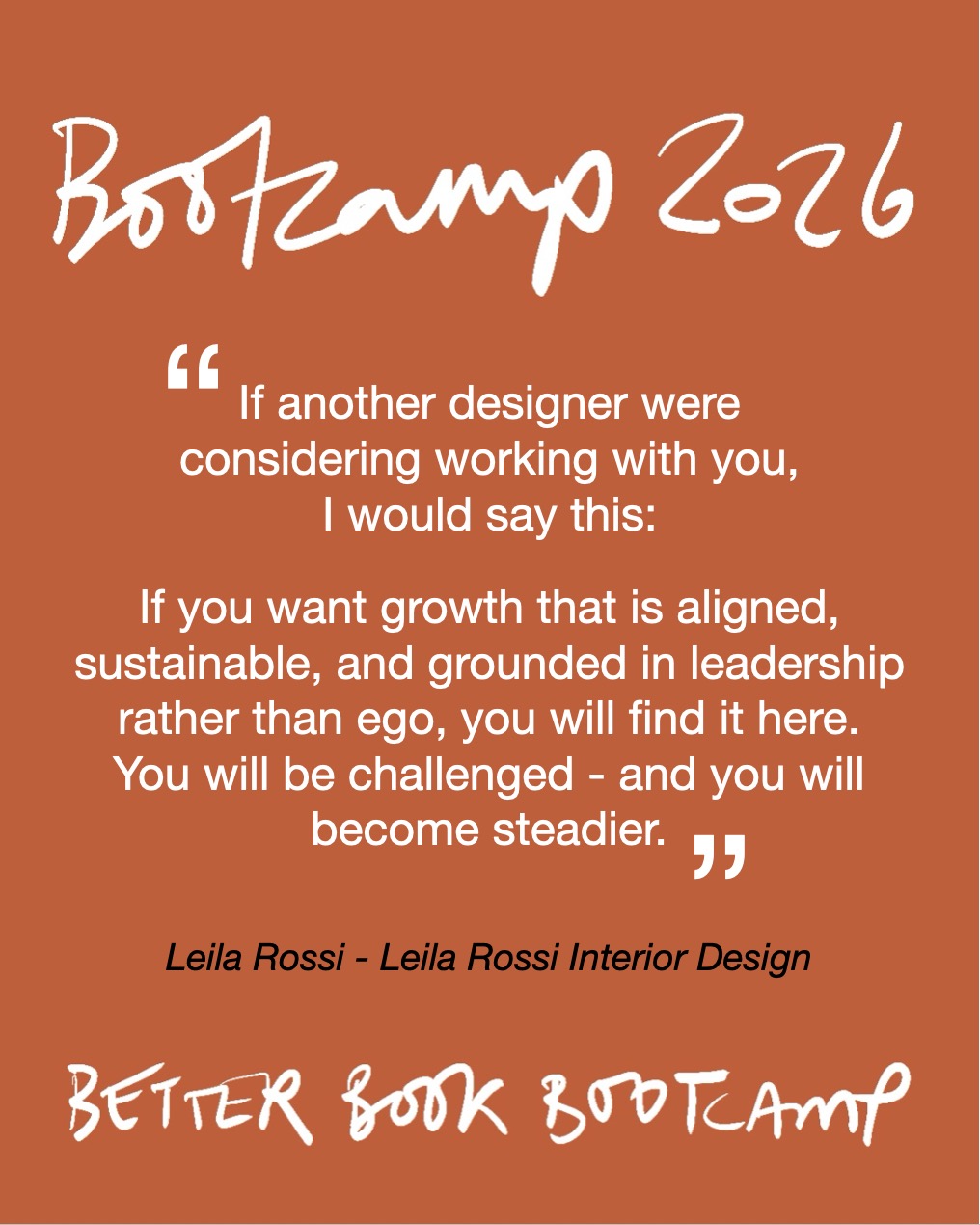
Five weeks. One small, intimate cohort. The foundational work that most designers never make time for: vision; positioning; pricing; client acquisition; and the business structures that make a practice genuinely sustainable.
All those questions you have about what to do next in your business? What you need is a plan you can follow, while you get on with the work.
Bootcamp is not a course you watch. It is a course you do - in company, with accountability, and with direct access to me throughout, we'll have an hour together every week, just the two of us. We'll work everything out.
If you have been meaning to do this, the moment is now. Or you'll have missed your chance... for at least a year.
Find out more and reserve your place →
3. LONG-READ - The Stage You Design For Someone Else
In 1959, the sociologist Erving Goffman published a book with a title that sounds more theatrical than academic: The Presentation of Self in Everyday Life. His argument was straightforward, and quietly radical: that all social life is performance. We are all, always, managing the impression we make on others - selecting what to reveal, what to conceal, and how to frame what is visible.
Goffman divided the social world into front stage and back stage. The front stage is where the performance happens: where we are visible, composed, and managed. The back stage is where we drop the performance: where the props are stored, where we are unguarded, where the gap between who we are and who we present ourselves to be is briefly permitted to show.
For most people, this framework describes behaviour. For interior designers working at the highest levels of the market, it describes the brief.
The reception rooms, the principal bedroom suite, the spaces where guests are received and life is performed, these are front stage, in Goffman's terms, and they carry a weight that goes well beyond aesthetics. What many clients are really commissioning, whether they know it or not, is the stage set for a particular performance of self: what does this room say about who I am, what I have achieved, what kind of person lives here and receives guests in this way?
This is where the theme of this week's issue - The Designed Self - and the theme of April in Hothouse - Sales and Client Acquisition - meet in an unexpected place. The designer who understands Goffman is not selling a service. They are offering to collaborate on something far more personal: the client's own self-presentation to the world. That is a different conversation entirely, requiring a different quality of listening, a different kind of discretion, and a much deeper understanding of what is actually being asked for beneath the surface of the brief. In this month’s webinars, we’ll look at how designer Matthew Williamson extracts precisely this intelligence - in broad daylight, and without ruffling a feather.
Sometimes the most sophisticated clients are unable to articulate this directly, because to do so would be to acknowledge that the performance is a performance. The designer who grasps this does not need them to. They read the front stage requirements from everything else: the references offered, the stories told, the details volunteered when no one was apparently taking notes.
Not persuasion. Translation.
4. COMING UP IN HOTHOUSE
Next week - Sales and Client Acquisition Webinar One: Theory Tuesday 14 April, 11.30am UK. The first of two webinars this month on sales and client acquisition - the theory behind why designers find selling uncomfortable, and what to do about it. Join link in Hothouse.
The week after - BIID Webinar: Making Time Work - Time Management for Interior Designers Wednesday 22nd April, 10.20am UK. I'm delivering this webinar for the British Institute of Interior Design, and I wanted to flag it now. Time management might not sound like a must-watch event, however, the values element that underpins good time management is the same element that underpins the most successful practices I know. Book with the BIID.
Note: Sales and Client Acquisition Webinar Two (Practical Application) also runs on Tuesday 28 April at 2pm UK.
The link to join the Sales webinars is in the Hothouse group - JOIN HERE.
5. MY WEEK IN HOTHOUSE
I can’t count. Last week (four weeks into my five-week challenge) I declared it over. Here is the final week’s data. A green flush!
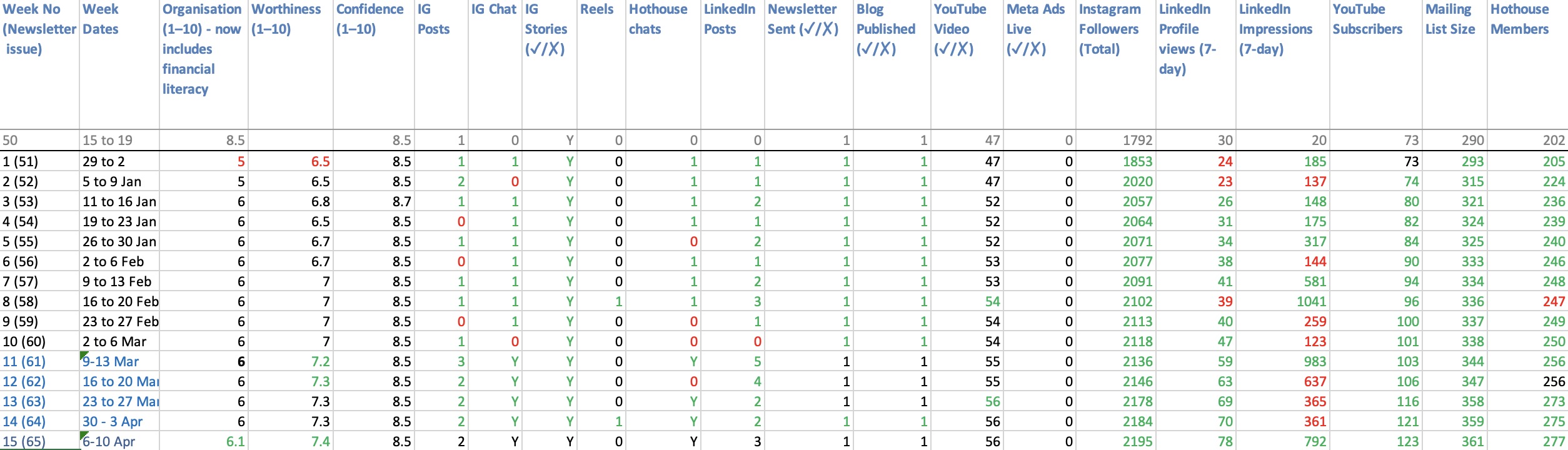
The challenge was straightforward: show up consistently on Instagram and LinkedIn, every week, without negotiation. I’m delighted to report that it did the three things I’d hoped it would: it gave me a kick in the butt; it boosted my numbers; it set some new habits that I’m maintaining. I was in a slump, now I’m out of it. Without this weekly intervention, I could easily have coasted, or slipped backwards over this five week period. Instead, things grew.
Today I’m also sharing two charts that don’t normally feature, but both are good illustrations of the power of consistent behaviour. First, a graph of my weekly website views:
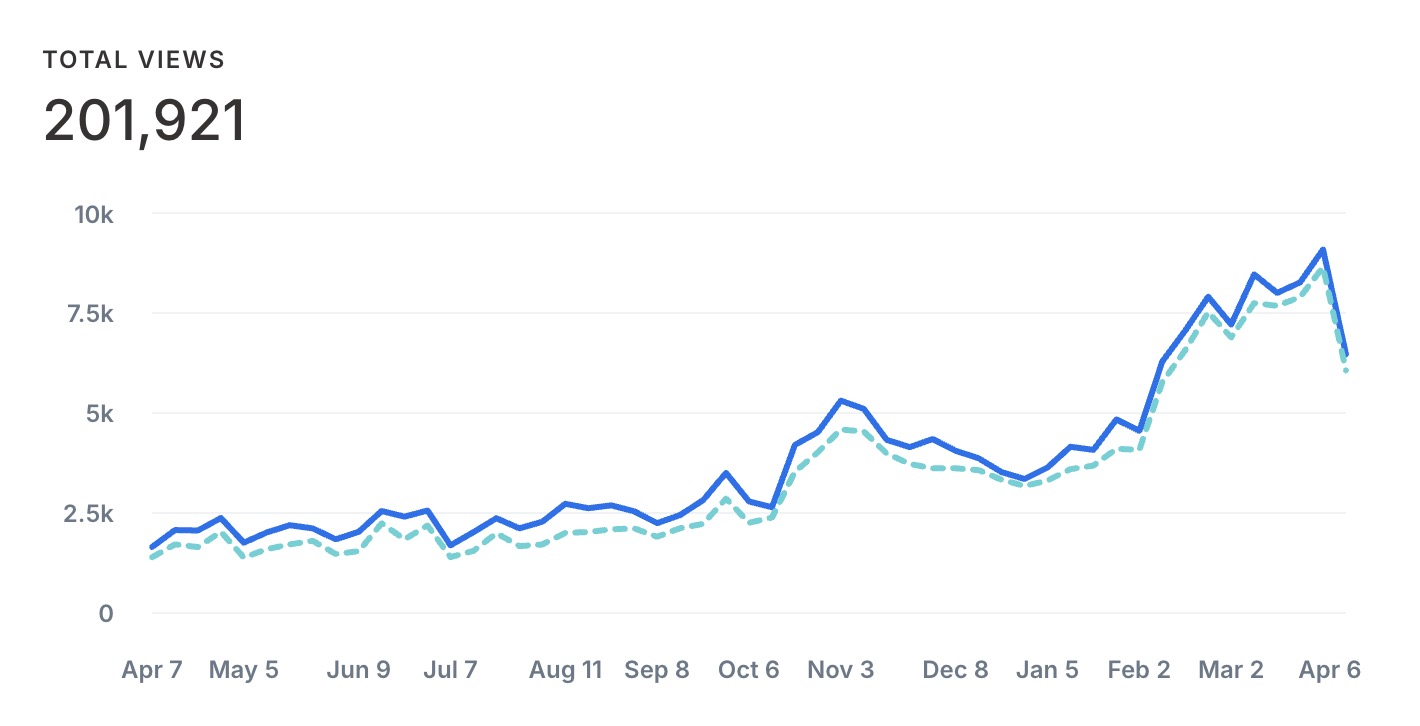
After a jump up last autumn, they ended 2025 at roughly 5,000 per week. There was a Christmas dip, but in the first quarter of 2026 they have doubled again, to just under 10,000 per week (my next goal 💪). I have not run paid advertising. What I have done is publish a blog and a newsletter, every single week, for over a year, without exception. The chart is a persuasive argument for the compounding effect of consistent content production. Note: the growth really kicked in after 10 months of slog.
The most successful designers I work with are powered by their websites.
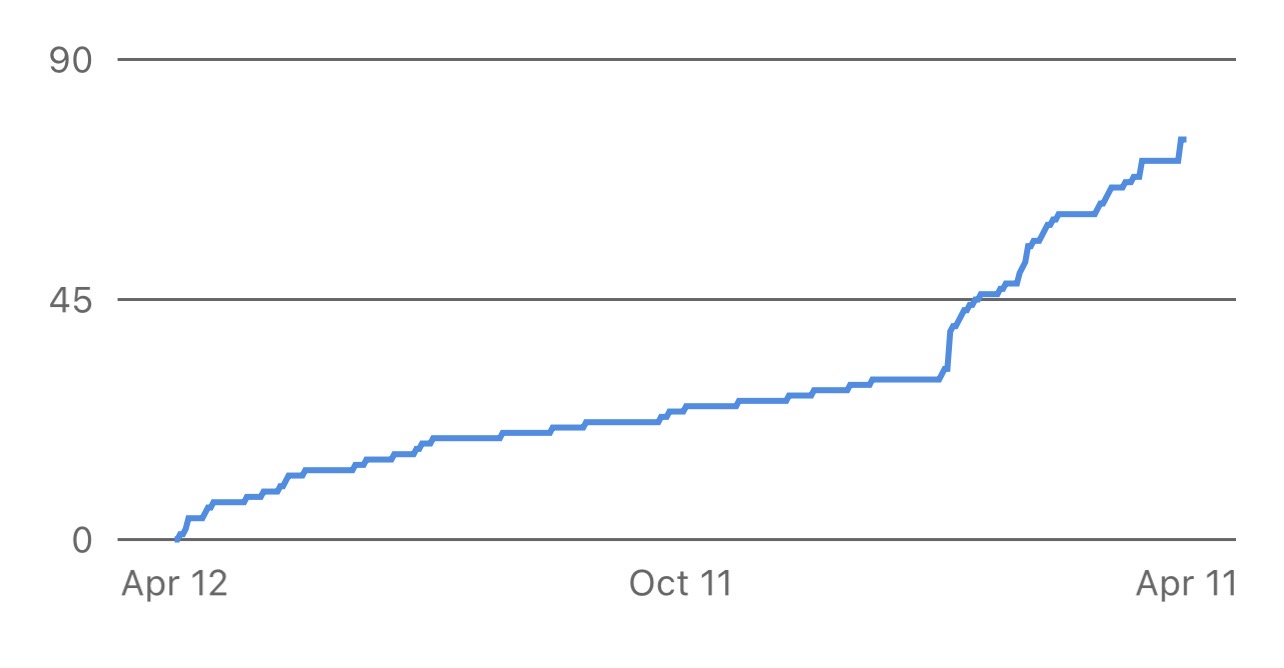
Secondly, the growth of LinkedIn followers: small numbers but an unarguable trend. Regular readers know that LinkedIn is my nemesis - until the start of this year, it was an afterthought. Well, I have driven myself to it every week this year, and look what has happened:
Forgive me now if I go a bit quiet for the next month or so, if the newsletter thins out temporarily. Bootcamp begins in just over a week. It is the most immersive thing I do, demanding for the designers who participate in it, and equally demanding for me. For the duration, I'm deliberately narrowing my other activities, so that I can give full attention to my Bootcamp cohort, my Boardroom groups, and my Bespoke clients.
Some things will be set aside temporarily. The habits, however, are established now. That was the point of the challenge.
FINAL THOUGHT
This issue has moved through two versions of the same idea.
The first is the designer as self-author: the deliberate, patient construction of a professional identity - through what you post, how you prepare, the clients you choose, the arc you set for yourself over three years rather than three months.
The second is the designer as translator: the capacity, at the highest level of practice, to read a client's unspoken (sometimes subconscious) need to be presented to the world as the person they most wish to be seen as. To hold that brief with discretion, and deliver it without ever having named it aloud.
What connects these two things is this: it’s harder to do the second if you haven’t done the first. The designer who has not thought carefully about who they are, and who they are becoming, may not have the awareness or sensitivity to hold space for someone else's self-portrait. The Designed Self is not an act of vanity. It is the foundation of the work.
Who will you be in three years’ time?
Describe this person, then set to work on managing the transition.
Have a super week,
Julia
Founder - Hothouse


Responses