
Hello 🧮
Numbers can feel like someone else's territory - the domain of accountants and people who were good at maths at school and, like most of the designers I work with, my instinct is to keep a respectful distance.
But this week, I'd like to suggest a different relationship.
Numbers, used loosely and without anxiety, are a design tool. A rough projection is not a forecast; it is a sketch. A five-year financial model is not a promise; it is a spatial plan for your business - an arrangement of elements in a composition, subject to revision, designed to reveal proportion and possibility rather than to predict the future with accuracy.
The question is not whether the numbers are right. The question is what patterns they weave: what they are telling you about the shape of things.
This week in Hothouse, we are playing fast and loose with numbers, and just enjoying what numbers (used creatively, and for fun!) can reveal.
1. This Week’s Blog: Where Does Your Time Go? A Before-and-After
As part of the blog I published this week (on fees, client psychology, and the financial viability of mid-market design practice) I sketched out an activity-by-activity breakdown of a full residential interior design project: brief to specification, spatial planning, sourcing, lighting, presentation, estimates and schedules. A complete, professional design service for a family home.
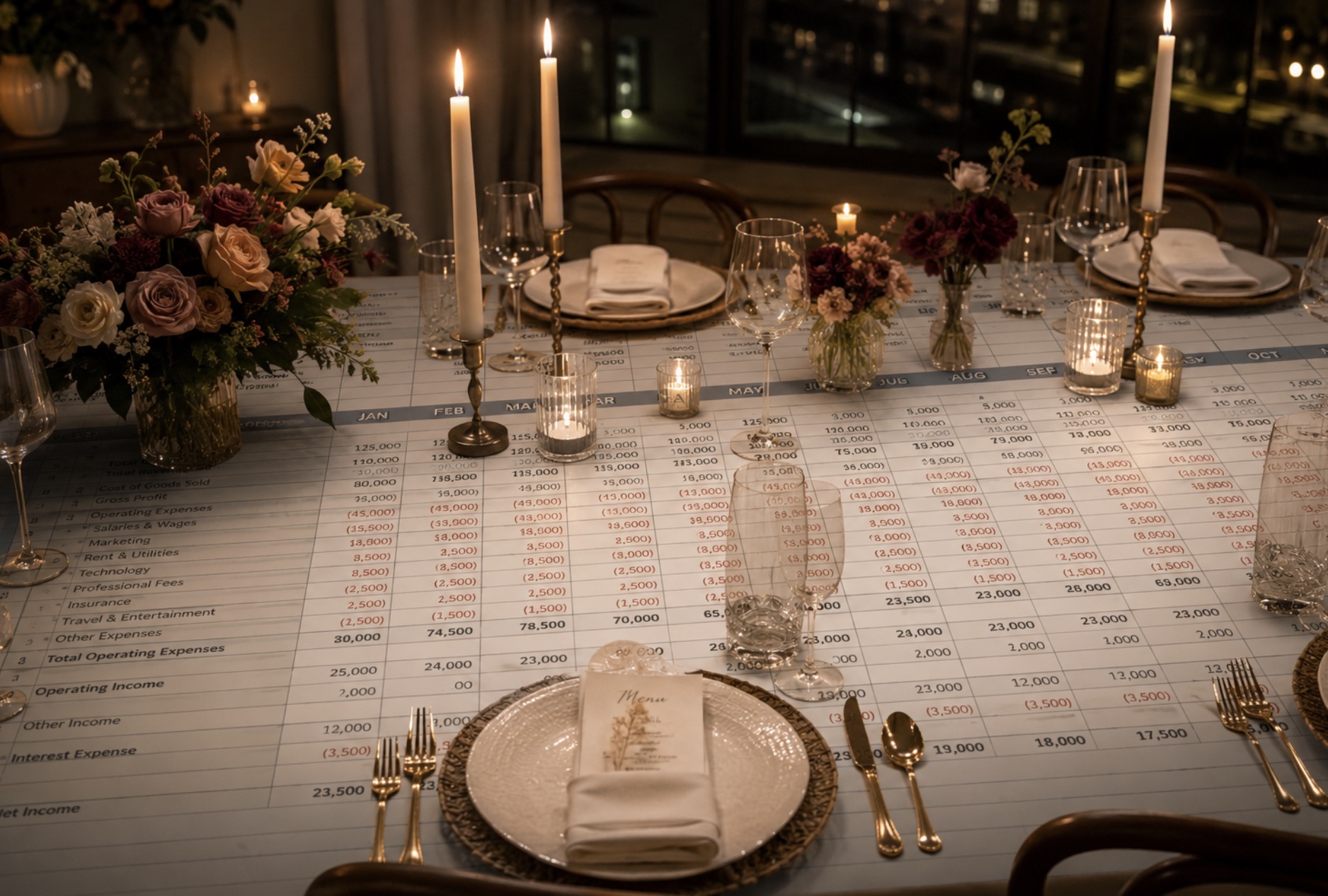
First, I mapped the hours without any AI assistance. Then I went back through every line and guesstimated where AI (as of May 2026) makes a material difference...and where it does not.
The table is in the blog. The headline figures are these:
Taking a 200-hour project, and introducing AI intelligently across the relevant activities, I estimate roughly that it falls to 148.5 hours. The saving is 51.5 hours - approx 25% of total project time, or the equivalent of nearly seven working days returned to you per project.
The distribution of that saving is more interesting than the total.
There is little difference made to taking the brief, concept development, surveying the space, the decorative scheme, client meetings, phone calls. AI saves nothing there: that is design work, and design work remains stubbornly, valuably human. Hooray!
The savings cluster in analysis, production and technical output - brief analysis, presentation materials, estimates, schedules, specifications, lighting documentation. The work that surrounds the design process, rather than constituting it.
At £100 per hour, 51.5 hours saved = £5,150 of time - per project. You can return some of that to the client as a more competitive fee, keep some of it as improved margin, and/or use the capacity to take on an additional project in the year.
These are rough numbers, but they point in a clear direction and are more useful than precise numbers you never get around to calculating. The direction is unambiguous: intelligent use of AI improves the financial arithmetic of design practice, without compromising what actually constitutes design.
Read the full analysis - including the client psychology piece and the market-derived fee anchor - in the blog.
2. Report From Bootcamp, Part I: Finding Your Number
Week three of Recipe For Success Business Bootcamp has just finished.
The central challenge this week was deceptively simple: who are you, and why should a client choose you over anyone else? Regular readers know how I fret about identikit positioning 😠: beautiful spaces, exceptional service, attention to detail. When your practice sounds like every other practice, you become a commodity, and commodities get price-shopped. The serious work this week has been to push past placeholder positioning, and find the specific, honest, defensible version of what each designer actually offers. Left to develop organically, this clarity can take years. Pressure and forced iteration are what actually produce it. That is what Bootcamp is designed to do.
From positioning, we moved into five-year financial modelling: mapping in numbers the route from where a practice is now to where it could be. What services does the practice offer today, and at what price point? What needs to change, and in what order, to drive the business upmarket?
How do different services (consultancies, blocks of time, design packs, full-service) intentionally - by design - weave in and out of the mix as the practice evolves?
Next week, positioning and financial modelling converge into a marketing plan: the right offer, to the right client, in the right place.
The unique shape of each practice is coming into view from the end of week three.
3. From Bootcamp, Part II: The Client Who Doesn't Spiral
There is a pattern in almost every consulting conversation I have about difficult clients. The designer describes the behaviour - anxious emails, second-guessing, the helpful neighbour with opinions about the paint colours, the quietly expanding scope - and frames it as a client problem.
I say this lovingly and caringly: it rarely is.
A difficult client is usually a client in a vacuum. When the client journey hasn't been mapped, the client fills the silence with their own noise. Anxiety is not a character flaw; it is a rational response to not knowing what happens next.
When you lay out the full journey intentionally - first contact through to project completion - with the right documentary support at each stage, the opportunities for the client to misbehave shrink dramatically. Not because you have controlled the client, but because you have given them no reason to be anxious.
We have also been looking at authority bias: the mechanism by which clients extend trust, take guidance, and resist the interference of well-meaning friends with strong opinions about tile choices. Authority bias is not a persuasion technique to be deployed. It is the natural consequence of a well-run studio. The deference follows from the quality of the system. You don't manufacture it; you earn it.
The client relationship is a systems problem before it is a people problem. Fix the system, and most of the people problems resolve themselves.
💥 June's Hothouse theme is Systems and Processes. More to follow soon!
Hothouse is a free resource hub for residential interior designers - it is hosted on Facebook. Join here.
4. Coming Up
I have two webinars coming up for the BIID - more information here. Both are on the subject of using AI in your interior design practice.
Webinar one - Thursday 21st May @ 10.30am - if you feel behind the curve, and haven't really started yet. From first principles
Webinar two - Thursday 18th June @ 10.30am - if you are using AI competently and wonder how it can be implemented at the level of best practice, including adopting some more complex workflows.
5. The Hothouse Black Book
Designers often ask me for recommendations: a good accountant, a reliable VA, a website developer who actually understands creative businesses, an accessible lawyer, a branding or marketing professional worth the investment. Up until now I haven’t had time to keep a list, but I’m thinking about starting.
It won’t be available immediately, we'll see, and to earn a place in the Hothouse Black Book, a professional needs to be genuinely exceptional and able to demonstrate it. Glowing testimonials from designers you'd respect. A track record that speaks for itself. The kind of person you'd recommend to your own best client without hesitation.
If you know someone who meets that bar, please do send me their details and tell me why they deserve a place. And if you are that person, I'd like to hear from you too: tell me what you do, who you do it for, and what makes you exceptional.
6. My Week in Hothouse
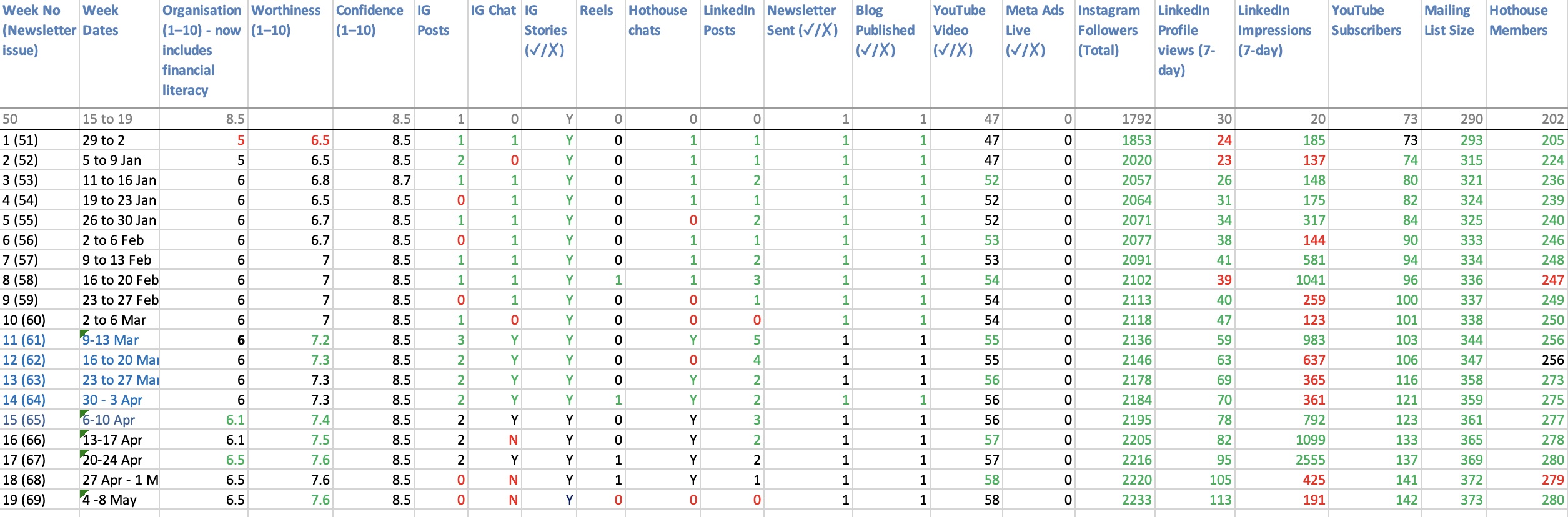
I am not going to waste your time by delaying you here. From December last year I knew that this week (and the two weeks to come) would be my busiest of the year. I knew that marketing would take the hit (rather marketing than the provision of a quality service to my valued clients). I have also restricted my diary so that new one-to-one consultancy appointments are limited. This is all temporary. The impact of this is visible in the red above. I’ll turn it green again asap, in June at the very latest.
Final Thought
This week in the blog, in one-to-ones with private clients, and working with designers in Bootcamp, we've been using numbers to think.
Not to account. Not to report. To think: about where a practice is going, what it might become, how long the journey takes and what it costs. Numbers as a creative tool, in other words.
The same instinct that lets you hold a dozen competing considerations in your head whilst designing a room - proportion, light, circulation, the client's slightly eclectic taste - is the instinct that makes a financial model legible. You are not calculating. You are noticing and composing intentional patterns.
And making patterns, as it turns out, is something you already know how to do :-)
Have a super week,
Julia
Founder - Hothouse

Responses