
Can AI Make Interior Design Viable in a Tighter Market?
May 09, 2026You present the fee proposal and your client vanishes - no reply, no feedback, just silence. The instinct is to ask whether the fee was too high. It is a reasonable question, and it could be the case, but perhaps your client’s reaction was more complex - and more predictable - than you realise.
In this blogpost we ask: what was happening inside your client's head?
We all tend to think about the proposal from our side of the table - I encourage this too. Asking: what does excellent look like? How long will excellence take? What is a fair rate for that time? These are legitimate questions, but they are the wrong starting point if your client is sitting across from you with an entirely different set of concerns, concerns that may have nothing to do with your fee at all.
This blogpost is about that other calculation. The one your client is running, perhaps unconsciously, before they have read a single line of your proposal.
The calculation nobody talks about
Most homeowners carry a persistent, low-level anxiety about spending money on their home when that money cannot be recovered. They may not form this exact thought, it tends to surface as hesitation, as requests for justification, as a vague sense that the fee feels high even when the client cannot explain why.
Let’s call it recoupment anxiety. It is the implicit question running underneath every conversation about investment in a home: will I get this back?
And it is reasonable financial behaviour. For the majority of UK households, the family home is the single largest asset they will ever hold. Decisions about spending on it are not purely aesthetic decisions. They are financial decisions, filtered (consciously or not) through the question of what happens to that investment when the house is eventually sold.
It isn’t about us, or the quality of our service, our trustworthiness, our design excellence. The client isn’t failing to appreciate the value of good design. They are doing what any financially literate person does with a significant asset: they are thinking about the return.
Why beautifying is structurally different from building
The client's anxiety has a rational foundation.
When a homeowner commissions an extension or loft conversion - a layout that adds functional space - there is at least a plausible relationship between expenditure and added value. Estate agents can point to comparable sales. The square meterage is measurable. The ROI (return on investment) calculation is imperfect, but it is at least possible.
Interior design and decoration work differently. However skilled the execution, aesthetic choices are almost entirely personal and non-transferable. A new buyer purchasing your client's home will pay for location, volume, light and structural condition. Most of the time they won’t pay a premium for someone else's taste - however refined - because they will almost certainly want to impose their own.
In practice, buyers tend to discount for decoration they would change rather than adding value for decoration they admire.
This is not a criticism of design quality. It’s simply a fact that the value created by interior design accrues almost entirely to the current occupant, as lived experience, and has close to no exit value. Your client, at some level, knows this. The recoupment anxiety is a rational response to a real asymmetry.
Understanding this reframes the designer's relationship to client hesitation entirely. It stops being an obstacle to overcome and becomes diagnostic information. A client who is running a recoupment calculation is telling you something precise about where they are financially and psychologically. We can improve the chances of converting a client by being attentive to these signals.
The tipping point: decoupling the home from the balance sheet
Not every client is in recoupment territory. There is a threshold - not a precise figure, but a recognisable zone - beyond which the home's market value ceases to be central to the owner's financial picture.
These are clients who have other assets. They are not depending on this property to fund their retirement, their children's inheritance, or their financial security. The house no longer needs to do balance-sheet work. It is freed up to simply be a home.
At this level in the market, the entire frame of the client relationship shifts. The designer is no longer asking the client to make a financial decision. They are asking them to make a quality-of-life decision.
These are psychologically very different requests, and they meet very different internal resistance.
Research into wealth psychology suggests this shift tends to occur at roughly ten times the median local household income in total investable assets - a rule of thumb rather than a hard threshold, but a useful one. And I wrote here about the geographical zones in the UK where there are clusters of prospective clients who meet or exceed this threshold.
Below this level, the home is almost certainly still doing balance-sheet work, even in households that are comfortably off by most measures. A family whose home represents the majority of their wealth has not decoupled, regardless of the property's absolute value.
The practical implication for the designer is significant. Below this threshold, a client may admire your proposal, trust you completely, and want exactly what you are offering…and still be unable to give themselves permission to proceed. Reducing your fee by ten or fifteen percent won’t resolve it, because the problem is not the number. It is the client's internal relationship with the spend.
Knowing this, we can ask ourselves a diagnostic question before we price anything: has this client decoupled their home from their balance sheet, or not? The answer shapes everything that follows.
What the market is actually telling you
If the client's psychology sets one boundary, the market sets another, and the two tend to be consistent with each other.
Designers who calculate fees based on a percentage of total project costs, reported an average fee rate of max 10% in a 2019 BIID survey (the majority said they charge between 6% to 10%). These are imprecise figures: the survey cannot tell us exactly what was included in each fee package, and the project values vary enormously. But they give us a real-world anchor.
‘Total project costs’ typically represent a fraction of the total property value. On a mid-market residential project, a reasonable working assumption might be that the total cost of renovation and decoration lies somewhere between 20% and 30% of property value. Apply 10% fees to 25% project value and you arrive at roughly 2-3% of property value as a design fee. Anecdotally, design fees running at 2% of the value of the property is an accepted rule of thumb (NB very rough and approximate - tread carefully!). This back-of-the-envelope stuff connects with real market behaviour.
So, if a property is valued at £1,000,000, our imperfect equation suggests design fees somewhere around £20,000. This represents a 10% fee charged on a project with a value of £200,000. In this model, the client has made peace with paying a total of £1,220,00 for their custom-designed million pound home.
A proposal that drifts far from this anchor isn’t necessarily wrong. But it could face not just commercial resistance but also psychological resistance, the kind that can’t be explained away by value, because - the client's difficulty is not a failure to understand; it is a failure of permission.
So, here is a really interesting question - the outside-in question: what can this market bear, and what service can I design within that constraint? - is not a compromise of standards. It is a sophisticated form of professional thinking. It is the same diagnostic approach the best designers apply to a spatial brief, now applied to their own proposition.
The 200-hour thought experiment
If the market anchor is £20,000 and your rate is £100 per hour, the entire project budget is 200 hours. Roughly five weeks of full-time work for the design of, let’s say, a 180m2 family home.
The question is not whether 200 hours is enough to do everything. It probably isn’t. The question is what a genuinely excellent, genuinely bounded service looks like when it is conceived from scratch within that constraint. Not a luxury service with things removed, but something designed specifically for this kind of client in this specific market.
I've had a go a thrashing this out in the table in the next section.
Given the time/fee constraints of the mid-market, it's likely some luxuries will have to go. The designer who decides consciously what these are - and is transparent with the client about the boundaries of the service - is in a far stronger professional position than one who discovers the constraint mid-project and starts making quiet compromises. Explicit scope is not a limitation of the offer. It is a mark of professional maturity.
If this applies to you in your local market, here's a challenge: given this constraint, what would you offer? And how would you make it genuinely excellent rather than a wee bit thin?
Help is on the way - where AI changes the equation
Where Does Your Time Actually Go? A Before-and-After Guide to AI in Interior Design Practice
For years, the question of how long a project actually takes has been answered by intuition, experience, and a degree of optimism that rarely survives contact with reality. As part of my Fees and Charging course, I developed a detailed hour-by-hour breakdown of a full residential interior design project - not as an abstract exercise, but as a working tool designers could use to price with confidence.
That breakdown assumed no AI assistance. It reflected good professional practice as it existed before AI tools became genuinely useful in a studio context.
I have now revisited every line of that breakdown and applied a conservative, honest assessment of where AI assistance (c. May 2026) makes a material difference - and where it does not.
I find these results interesting and reassuring: they give such a clear indication of where we should be applying AI in our practices, and they illustrate how - at the moment - human design skills continue to prevail.
The comparison
The baseline is a full-house decorative and spatial design service: brief to specification, including spatial planning, sourcing, scheme development, lighting design, presentation materials, estimates, schedules and all client-facing documentation. No full kitchen redesign. No schedule of works for a main contractor. A professional, complete design service for a family home.
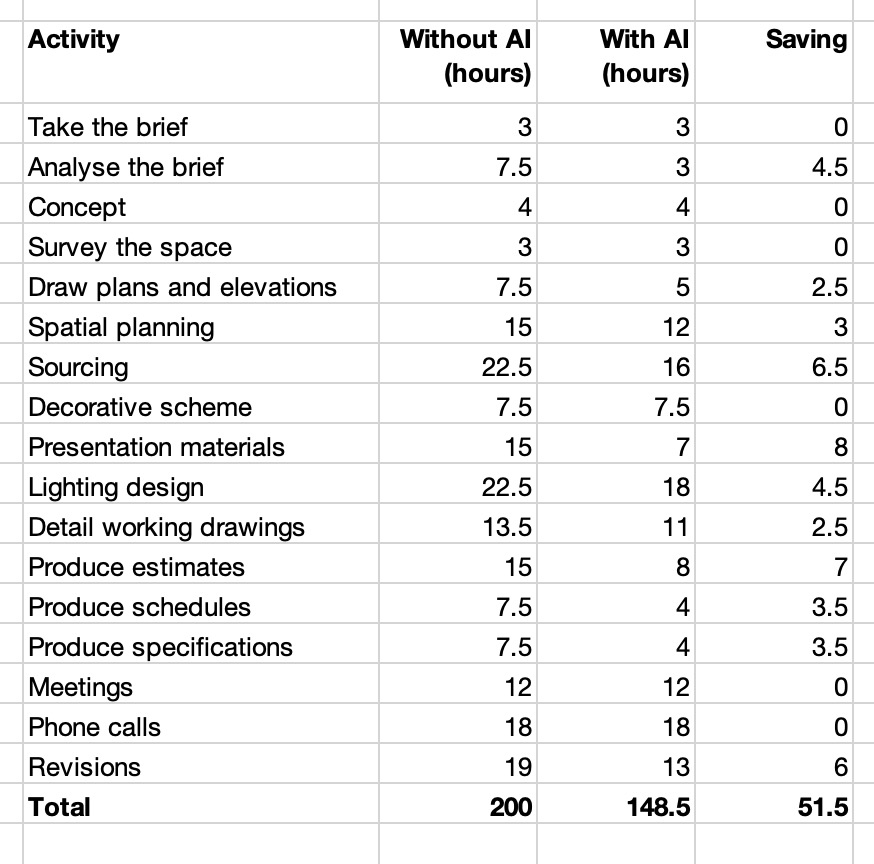
Without AI assistance, that service runs to approximately 200 hours.
What the numbers actually say
The headline saving is 51.5 hours - roughly 25% of the total project time. At a rate of £100 per hour, that represents approximately £5,000 of time returned to the designer per project. It is the equivalent of reclaiming nearly seven working days.
That is significant. But the distribution of the saving matters more than the total.
Every hour saved sits in one of three categories: analysis and documentation, production of client-facing materials, and technical output such as estimates and schedules.
Comparatively little time is saved in brief-taking, concept development, site survey, spatial planning, decorative scheme composition, client meetings or phone calls.
In other words, AI does not touch the work that constitutes design. It compresses the work that surrounds it.
The proportion shift
In the pre-AI 200-hour model, approximately 70 hours - more than a third of the total - are spent on documentation, production and administrative output. In the AI-assisted model, that falls to around 35 hours.
The designer's actual design thinking, as a proportion of hours spent, increases from roughly 65% to approximately 77% of the total. The client receives more of what they are paying for. The designer spends more time doing the work they actually trained to do.
This is the real case for AI in design practice. Not that it makes designers faster in some general sense. But that it returns creative hours that were previously consumed by process, and does so without compromising the quality of what gets produced.
What this means for fees
A 200-hour project at £100 per hour generates a fee of £20,000. The AI-assisted equivalent delivers the same scope in 151 hours. The designer now has a choice: charge the same fee and recover a 25% margin improvement, or pass some of that efficiency to the client in the form of a more competitive price without reducing the effective hourly return.
The viability argument
A 200-hour project at £100 per hour produces a fee of £20,000.
For designers working in tight markets, this may sit above the point at which clients can comfortably say yes - not because they cannot afford it in any absolute sense, but because the recoupment calculation does not resolve in the designer's favour.
For a property with a value of £500,000, the market-derived (guestimate) fee sits at roughly £10,000. A £20,000 fee is asking the client to commit twice that.
The AI-assisted version of the same service - identical in scope and quality, reduced by just over 51 hours - brings the project to 148.5 hours. At the same rate of £100 per hour, the fee is £14,850. That is still above the market anchor, but the gap has narrowed from £10,000 to roughly £5,000. More importantly, it is now within the range that a motivated, design-minded client in a mid-market location might stretch to, particularly if the service is well-scoped and clearly presented.
And, maybe by being creative in the scoping your signature design process to serve your local market, you can find ways to further narrow the gap without lowering your rate.
This is not a race to the bottom. The designer has not compromised their service, diluted their judgement, or worked faster in any way that affects quality. They have stopped spending a quarter of their time on work that AI can do as well or better, and redirected that saving - partly to the client in the form of a more accessible fee, and partly to themself in the form of increased capacity.
At 151 hours per project, a designer can realistically handle four to five projects in a working year alongside the non-billable demands of running a practice. At 200 hours, that figure drops to three to four. If there is revenue too from procurement, the practice earns more in aggregate, takes on more clients, and builds reputation and referral faster.
This is precisely the kind of calculation that we’ll be studying in Hothouse this month - using AI not just to do design work, but to think through the business of design with a rigour that most designers never have time to apply. Details below.
The open question
This piece has traced a chain of reasoning from the client's psychology to the market's logic to a practical constraint to a practical tool. The chain ends at an open question rather than a closed answer.
What does your 100 - 200-hour signature service look like? What does it include, what does it explicitly exclude, and how do you communicate that to a client in a way that positions it as a considered professional offer rather than a cut-down version of something better?
Hothouse is a free resource hub for residential interior designers, hosted on Facebook.
Receive my quick-to-read weekly newsletter...
Sign up for the Hothouse Newsletter: find out what's coming up, and keep up with recent webinars, blogposts, videos, and other events - all focused on excellence in interior design practice.
We hate SPAM. We will never sell your information, for any reason.
