
Hello 🏆
This week’s theme is standards and how to gauge acceptable, because benchmarking has come up twice in the last few days in different guises.
The first time it was technical. I’ve been writing the snagging material for The Interior Design Practice System, and researching the NHBC standards for finish quality, which include viewing distances, daylight, what counts as a defect, and what is simply natural material behaving naturally. It feels fantastic to release what can be a tricky interaction with a client (at just the wrong end of the project) from fear and jeopardy. And it inspired this week’s blogpost.
Also this week, several client meetings during which designers have measured their performance, pegging their level in the market. In each of these conversations we've questioned the assumption that the right direction of travel for a design business is always upward. Bigger budgets, more exacting clients, more prestige. But what does it cost to serve the top of the market? And have you already built the business you were born to lead?
Similar concepts underlie both subjects: if you don't specify standards or levels for yourself, they'll be decided for you, by someone else, usually at the least convenient moment, and you'll have no grounds to argue with it because you never took control and named your own.
Here in Hothouse, everything we do, we do with intention - we confront questions and challenges head on, and always take full responsibility.
So let's dive in.
1. On the blog this week: If you don't set the standard, your client will

A client of mine once snagged a new parquet floor after dark, with a torch held flat to the surface, and marked fifteen invisible flaws with Post-it notes. She was not being difficult - I hadn’t told her the rules. Don’t miss out on the opportunity to design snagging tolerances...lest your clients invent their own.
2. LONG-READ - Up Is NOT the Only Way
I have had several conversations this week - with clients at quite different stages - each covering some common ground: the question of a move upwards.
Larger budgets and projects, wealthier clients, more exacting briefs, better addresses - the clients I met this week had thought long and hard. They were clear-headed and deliberate about it.
But more often, when you encounter this ambition in the wild, it’s reflexive, a knee-jerk motivation, because 'top of the market' is the direction that success is assumed to lie in. I want to price that assumption properly, because it carries costs that are rarely calculated before the decision is made.
Serving the top of the market is not a prize. It is a business model, and it has a specification like any other. It requires staff, because the volume of coordination at that level cannot be carried by one person and the clients will not wait while you learn that. Staff means payroll, which is a fixed monthly obligation that cares nothing about the state of your pipeline. It requires 24/7 availability, because the clients who pay the most are frequently the ones with the least ordinary schedules. It requires you to absorb and dissipate a great deal of other people's anxiety, since the more money involved, the greater the risk, and the more fear is attached to it. A significant part of what you are being paid for is to remain the calmest person in the room while someone else's millions are at stake.
It requires contracts that are examined by people whose job is examining contracts. It raises the consequence of every error, because the cost of putting something right scales with what it cost to get it wrong. And it introduces advisers, project managers, family offices and second opinions, along with an entourage of competitors and collaborators jockeying for position. A sort of sibling rivalry, with the client in loco parentis.
That's not to put you off. Some designers want precisely those conditions, thrive in them, and should absolutely go and get them. The financial rewards of this high wire work, for those temperamentally suited, can be phenomenal. And good systems and processes, and good client handling, can manage much of it.
The warts-and-all positioning above is context to set against another set of measures, and they are the ones that actually govern a life. Margin per hour rather than value per project. How predictable next spring looks. How many people's mortgages depend on your ability to win work. Whether you can slow down in August. Your vulnerability to recession. A local practice serving the comfortable middle market, run tightly, with good systems and processes and repeat clients, can outperform a more prestigious one on every one of those measures, and it very often does. But perhaps it appears in fewer magazines.
There is a second cost to the upward assumption, and it is the more damaging one commercially. A business half-turned towards a market it does not currently serve is weaker than a business squarely facing the one it does. Ambivalence is legible. It shows in fees pitched to a client who has not appeared yet, in a portfolio arranged to suggest work you have not done, in language borrowed from a tier above your own, in the faint apology that enters your voice when you describe your projects. The people you actually serve can detect all of it, and what they also might detect is that they are not quite who you were hoping for, like your date looking over your shoulder when they should be listening to you. That is an expensive thing to communicate to somebody who is about to spend money with you.
So instead of asking: who would I like to serve? Ask:
Who do I already serve, well, profitably and repeatedly, and what would my business look like if I turned to face them proudly and without reservation?
Different fee structure, possibly. Different portfolio order. Different words. Certainly a different attitude.
One caveat, because this argument could be misconstrued. If you know perfectly well that you are under-reaching, that you are charging below what your work is worth because you are frightened to ask, or if you can't make ends meet as things stand, then none of the above is encouragement to stay where you are. Those are different problems and you will know which one you have.
Here is the possibility I would like to leave you with. It is entirely plausible that you have already built the right business. That the shape of it, the size of it and the people it serves are correct, and that the only thing missing is delight and pride in what you've built, and the willingness to say so. That is not a lesser outcome. In a profession where some designers serve their market grudgingly, it is a considerable competitive advantage, and it costs nothing to claim.
4. Coming Up in Hothouse
📆 Tuesday 18 August, 11am - New and Pivoting Designers Meeting. This Tuesday. A live get together online, to chat about current issues and plan for the coming quarter. It has been a while. All Hothouse members welcome, join Hothouse here. The link will be in the group under 'Events'.
📆 The Interior Design Practice System launch. Date TBA. The snagging protocol I have been writing this week sits inside it, along with the rest of the practice architecture. Formerly White Label Studio. Find out more here.
📆 Monday 21 September - Business in a Box opens. Twelve weeks' live group work, led by me, to get your new or pivoting business up and running by year end - first live session, 10am Tuesday 22 September. Join the group.
📆 Wednesday 23 September, 11am - Branding and Marketing Webinar, with Peter Burch of March Branding. I have seen the presentation and it is going to be good. The link to join this free, live webinar will be in the Hothouse group.
5. Coming up for the BIID
I'll be leading the following CPDs for the BIID this autumn, each is two hours long (including Q&A):
📆 Thursday 24 September, 10.30. Business Planning And Strategic Clarity For Interior Designers - it's time to plan 2027. Hit the ground running in January with a custom plan in place.
📆 Thursday 12 November, 10.30. AI Foundations For Interior Designers: Working Confidently From First Principles
📆 Thursday 19 November, 10.30. AI In Practice: How Interior Designers Are Integrating AI Into Studio Practice
📆 Wednesday 25 November, 10.30. Fees And Charging, with new materials. Now confirmed, and note that this one is a Wednesday.
Fees and Charging, and the AI sessions, tend to take care of themselves. So I'd like to repeat my plea for business planning, it answers the question I am asked constantly: how do I get better clients? Better clients lie downstream of an intentional decision about who you serve, which is this week's issue in a sentence.
6. Business in a Box - September cohort - £985
Most designers setting up do not have a design problem. They have a business with no shape. No clear description of what they offer, no fee structure they can say out loud without flinching, no documents worth sending, and no plan for where the next client is supposed to come from. They don't know where to start, so postpone in favour of something that feels more like designing, e.g. branding.
Business in a Box is twelve weeks of live group work, led by me, that takes you from a position of uncertainty to a coherent offering built on a business and marketing plan you have actually written. It is not a course you watch. It is a cohort you turn up to, with work between sessions and someone asking you where it is.
This cohort also receives The Interior Design Practice System in full, no extra charge, as part of course materials. That is the entire client-facing document suite, from first enquiry through fee proposal, onboarding and presentation, to costings, and handover, professionally written and ready to carry your own branding. Plus, all the systems, processes, and documentation you need behind the scenes to deliver a project professionally. It is the part of setting up that most people spend two years assembling badly: you will start your business holding it.
If you are in the shallows of launching, or returning to practice after a break long enough that the ground has moved, this is the twelve weeks that gets it done.
First of 12 live sessions: Tuesday 22 September at 10am.
Limited to 12 designers max.
7. My Week In Hothouse
Consultancy demand has been unusually high for several weeks. August is ordinarily the month I rely on for a little slack, and this year it has not delivered. I've taken matters into my own hands and temporarily turned off automatic meeting bookings. That is a cap rather than a distress signal: I would far rather shut the door for a month than spread myself thinly across the people already inside. [Existing clients: please message me direct if you want to book a chat]. If I were my own client, I'd advise that when demand consistently outruns capacity, the answer is not to work later into the evening. It is to look again at the structure of the offering, and at what it costs.
So: something to watch, is it a blip or a trend? And a structural question for annual planning...which I like to start early in Q4, so by December it's settled and beautifully wrapped, like a gorgeous Christmas present for the business. Watch out: I'll soon be agitating clients and Hothouse members to do the same.
Development time for The Interior Design Practice System is protected in my calendar and the September launch is on schedule. I am revelling in this work - how I wish this course had existed when I set up in business.
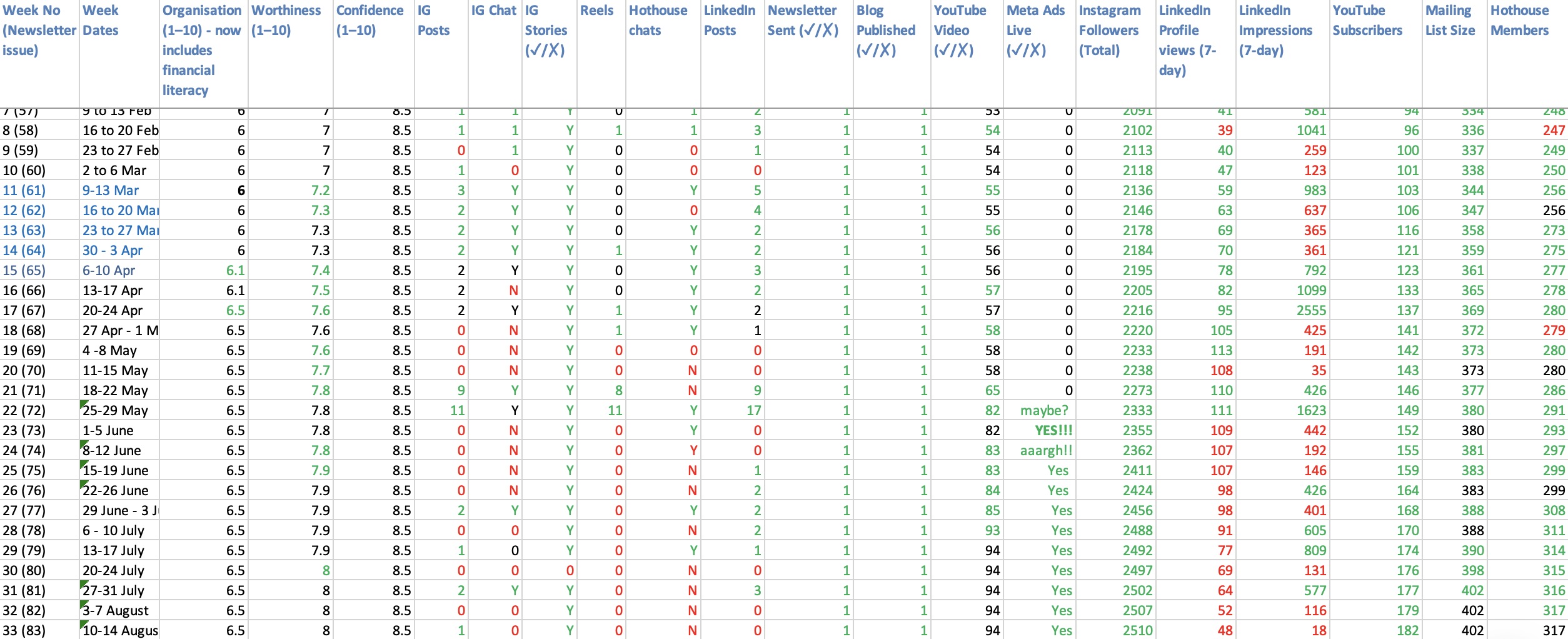
Here are the numbers, served with a large dollop of deja vu. This week's casualty was marketing (and the Hothouse group)*, and honestly, I've felt disappointed in myself. But then it occurred to me that a weekly blog and a weekly newsletter are marketing, and neither has slipped by a nanometre during a challenging few months. There is also an agency project running in the background that will produce a website refresh and new advertising in the autumn - also very demanding.
The beauty of this data system is I can see that to meet my goals: IG Chat, Reels, Hothouse Chat, and poor old LinkedIn need attention.
Stressing about social media is counter-productive, and I've snapped out of it. But, I have popped a red flag in the time management column (noted for annual planning) while I permit myself to set aside for now so I can just crack on.
*Hothouse - I'm sorry. I'll be back very soon with good stuff!
FINAL THOUGHT
Two questions this week: one about a floor, one about an entire practice. The answer to both is the same.
Decide at the start, or the decision gets made for you later. Leave the finish standard open and your client will settle it, in the dark, with a torch. Leave your market open and clients will settle it on your behalf, by rejecting you in favour of the designer who sees them and has laid out a welcome mat.
Neither answer will consider your interests. Both cost considerably more than the small amount of time required for you to take control.
Wishing you still more glorious summer to come,
Julia
Founder - Hothouse


Responses