

If you don't set the standard, your client will
Aug 15, 2026My client rang to tell me there were flaws in the new floor.
This was the replacement floor. The original - supplied by the architect - had been lifted and taken away after genuine performance failures, so it was a sensitive area. I went to site the next day. I walked the floor in stockinged feet, crouched over it, felt it, sighted along it towards the window. As far as I could see it was perfect.
Ah, she said. That's because you have to wait until after dark. Then you take a torch and cast the light obliquely across the surface, flat to it. That's the only way you can see them. I'll mark them for you.
And she did. I came back to a parquet floor spotted with roughly 15 or so Post-it notes, each with a fat Sharpie arrow jabbing at an invisible hairs-breadth imperfection.
The temptation, at that point, is to file the client under difficult and get on with your day. However, this was one of those occasions when the job teaches you a helpful lesson, the interesting thing about that torch is not that it was unreasonable. It is that it was a test, and she had been obliged to invent it for herself.
Somebody has to answer the question is this acceptable. It is one of the many vacuums that exist in the daily life of the interior designer. Voids that the client will expand to fill if you don’t. If you haven't supplied a standard, your client will supply one, and they will build it out of whatever materials they have to hand: a showroom, a previous house, a magazine, a bad experience with the last supplier, and, at eleven o'clock at night, a torch. In the absence of an agreed benchmark, the client's benchmark applies. That is not a failure of character on their part. It is a oversight on ours.
Why that one ended well
Frank the Plank returned to site and put the floor right, to their complete satisfaction, and the relationship survived it. That was not luck, and it was not charm.
Before he estimated for the work, the brief we gave him was this: when you price to supply and lay this floor, you must be prepared to be held to the highest standards. Your work must be perfection - if it isn't, we'll ask you to do it again. Make sure you accommodate that, in the product you propose and in the time you allow. From past experience, we knew where to benchmark these clients’ standards.
And he priced for this. Which meant that when the torch came out, the argument was about a floor he had been paid to make perfect, and he came back and made it perfect. Had we not clearly briefed him in advance, we would have been asking a contractor to meet a standard he had never agreed to and had not been paid for, and the answer we got would have been the answer we deserved.
The benchmark had been set once, at the only moment it could be set for free: before anyone priced anything.
The chest of drawers
The second story is one where we messed up.
We were sourcing for a large family home and took our clients to B&B Italia. In the daughter's room we needed a chest of drawers, and they chose one. They did what people do unconsciously with good furniture: ran a hand across the top, pulled each drawer out and pushed it back, walked all the way round the piece.
In the final reckoning the job came in over budget, and we agreed to re-specify some items. We found a chest online that we all agreed looked very similar and which cost a great deal less. Everyone was content, on paper.
It arrived, and the clients were not happy. Understandably so. The sample provided was from B&B Italia. Beside that object, the cheaper replacement was flimsy and with a poor finish.
We had an honest conversation about the compromise that specifying down requires. We offered to return the cheaper piece, (with a restocking charge), and to upgrade at their expense to the original choice. Quality costs what it costs. They understood, and declined, and the relationship was fine.
But the error was ours and it was upstream of the delivery. They had been handed a physical sample and had tested it thoroughly, and that sample silently became the standard. We then substituted against it without ever saying (both in person and then in writing) that the saving was a saving in quality, and you’ll see it in the finish, in the weight, in the operation.
On B&B Italia day a benchmark was set, and we didn’t recognise this.
Where the benchmark is actually set
I have spent this week writing materials on snagging to include in my new course The Interior Design Practice System (formerly White Label Studio), and what has become crystal clear is that snagging is not a back-end function at all.
It looks like one. It has a slot in the programme near the end, it has a list, it produces a flurry of emails and a bill. But by the time you are standing in a finished room with a client and a clipboard, every meaningful decision about what counts as acceptable has already been made or, quite often, not made. Snagging done well is something you did months earlier...and twice.
Here’s where snagging appears in the design process:
It appears first when you take the brief. Among the questions about how they live and what they love, there is a question about the level of finish they want,
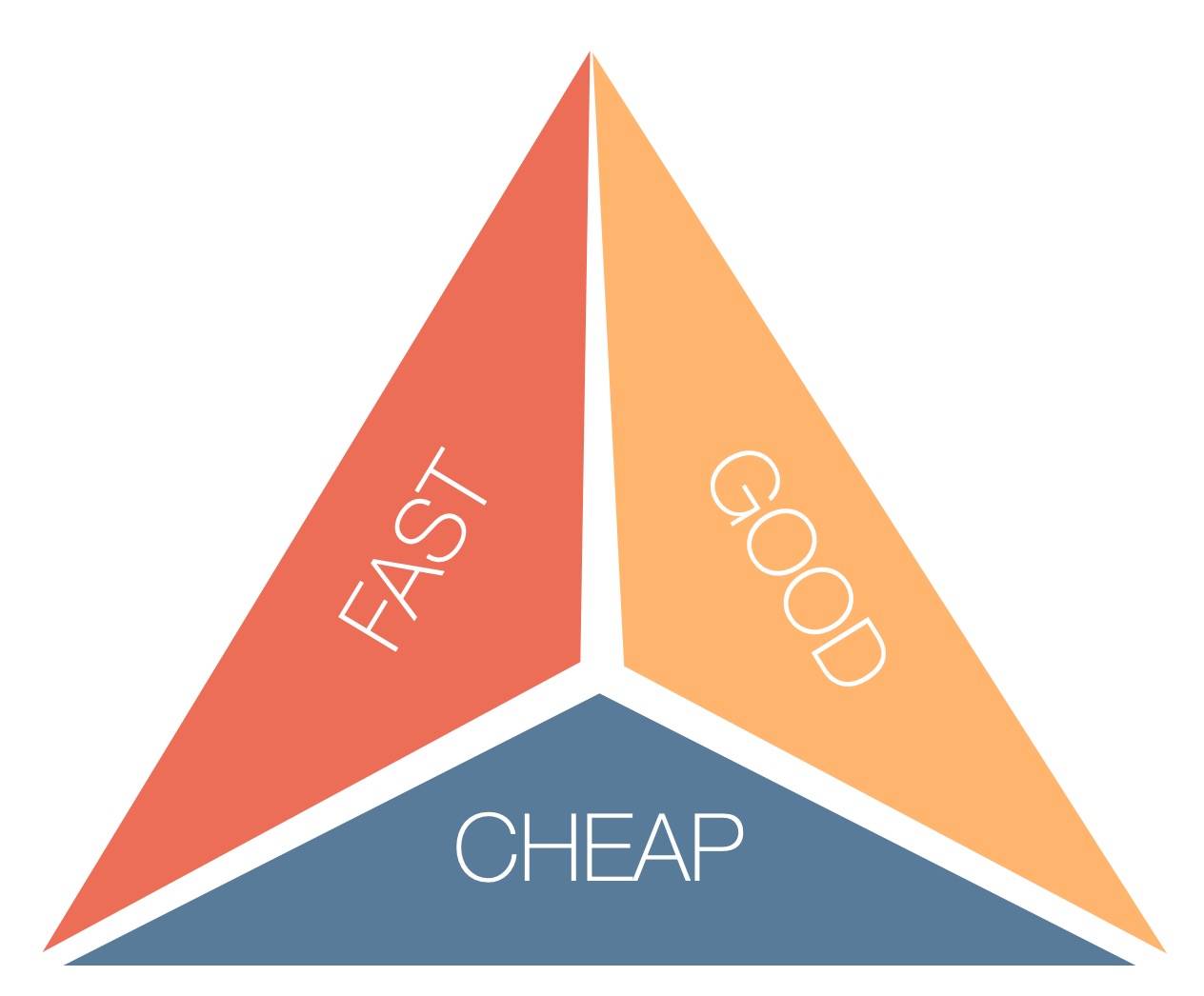
TIME:COST:QUALITY - you can only have two out of three
asked against the time, cost and quality triangle: higher quality almost always means higher price. This is also the moment to introduce, lightly, the idea that - at the end of the project - finishes will be judged under stated conditions and not under any old conditions a person might think of. Not exhaustively.
During Taking the Brief we plant the concept of snagging, we don’t recite a protocol. But if your client has their own, more rigorous test in mind, you want to know that in month one, while it can still be discussed, priced and either accommodated or abandoned, rather than in month nine, in the dark, with a torch.
It appears again at tender. When you interview prospective contractors, it is only fair to tell them what standards they will be held to, and those standards need to be reasonable. Crucially, they need the opportunity to raise their number, and/or extend the time frame, to meet them. A contractor who is told at the outset that the finish must be exceptional (and who prices accordingly) is a contractor who will come back and fix things. A contractor who discovers quality standards at handover, has effectively been asked to donate the difference, and will behave accordingly.
And it is better shown than described. Adjectives are useless here. "High standard" means nothing that can be checked. Two things do work: taking the client to see a contractor's completed projects and agreeing explicitly that this level is acceptable, or having a contractor mock up a small finished area on site so that everyone can stand in front of it and agree that this is the level. Both are excellent. Both also cost time and money, which is why they have to be designed into the process and the fee from the beginning. Introduced halfway through, a mock-up is not a quality measure, it is a symptom.
What a benchmark looks like when you have one
The point of a published standard is that it answers the question without recourse to personal preference, which is variable. It is expressed in measurements rather than adjectives, which means it can be applied by a person who is not you, and, more usefully, it can be demonstrated to a client in front of the thing being argued about.
The protocol I have been drafting follows the NHBC approach to finishes, on the basis that it is published, recognised in the trade and stated in numbers. A few examples of what that looks like in practice:
- Internal walls and ceilings are viewed from 2 metres, in natural daylight, with wall lights and uplighters switched off.
- Sanitaryware is viewed in daylight from 0.5 metres, and should show no conspicuous scratches, chips or damage.
- Joints in joinery and skirtings should present a continuous appearance from 2 metres in daylight.
- Natural variation in timber, stone, marble, leather and hide, including colour, figure, veining and movement, is not a defect.
I have another story I could tell about an expensive limestone fire surround - yes, at this stage it had been installed and decorated around - with an (I would argue) charming ammonite fossil exposed on one jamb. The client begged to differ.
A mark visible only under a raking light at 100mm is not a defect. And an inspection carried out with the uplighters on is not a valid inspection. Unless everyone involved agrees from day dot that they are.
Which is precisely why clients need to be acclimatised to the procedures coming at them, further down the line. Conditions belong in a document, agreed before tender stage, rather than existing in a vacuum that the client decides to fill.
The rest of the protocol, the five separate inspections a project actually needs, the four things that get called snagging when only two of them are, the delivery windows that expire in 48 hours, and what a snagging list entry has to contain to get fixed once rather than argued about three times, sits inside The Interior Design Practice System.
But the principle costs nothing and can be adopted this afternoon. Decide what acceptable means, before anyone prices the work. Say it to the client, say it to the contractor, and put it in writing to both.
A client with a torch is not a difficult client. A client with a torch is a client who was never given a rule, doing their level best to invent one.
Receive my quick-to-read weekly newsletter...
Sign up for the Hothouse Newsletter: find out what's coming up, and keep up with recent webinars, blogposts, videos, and other events - all focused on excellence in interior design practice.
We hate SPAM. We will never sell your information, for any reason.
