
Hello 🚗🚗🚗
Last Monday I sat at a round table at Decorex and ran the same fifteen-minute session on positioning four times over, it helped hone my thinking and this week's newsletter contains the written version.
It runs as one argument in three parts. The blog asks whose problem it is when the wrong clients keep arriving and arguing with your fees. The long read from Decorex sets out where to look for genuinely distinctive positioning, and how to tell whether you have one. Then an overdue report following last month's webinar led by Peter Burch of March Branding, on how to make that difference seen.
And if you are taking part in the Big Push, your pledge form is due on Tuesday.
1. This Week's Blogpost - The Comfortable Advice That Keeps Designers Stuck
When designers tell me what frustrates them most about their businesses, two complaints come up repeatedly: they want better clients, and they want to charge higher fees. This week's post looks at the diagnosis underneath both, and at why the comfortable one keeps you stuck.
Agency is not a personality type, something a fortunate few designers are born with and the rest must do without. It grows from repeated experience of changing an outcome. That is why the small habits in this post matter more than they first appear to: the blameless post-mortem when a pitch misfires, and the cycle of trying something, finding that it half works, adjusting and trying again. Each one is a small experience of control, and those experiences build into a settled belief that the outcome is yours to change.
So advice that tells designers it is not their fault, however kindly meant, does them a disservice. Sympathy has its place, but as a remedy it removes the very experience the learning depends on.
2. Three Identical Cars
At Decorex last week I ran a fifteen-minute session on positioning, four times over, working from good old fashioned analogue materials. Each round opened with a single photograph: three identical red cars, priced at £10,500, £12,000 and £13,000. Which would you buy?


It's why, if your business doesn't have a distinctive identity, clients turn up interested only in how much you charge. This is the Price Default.
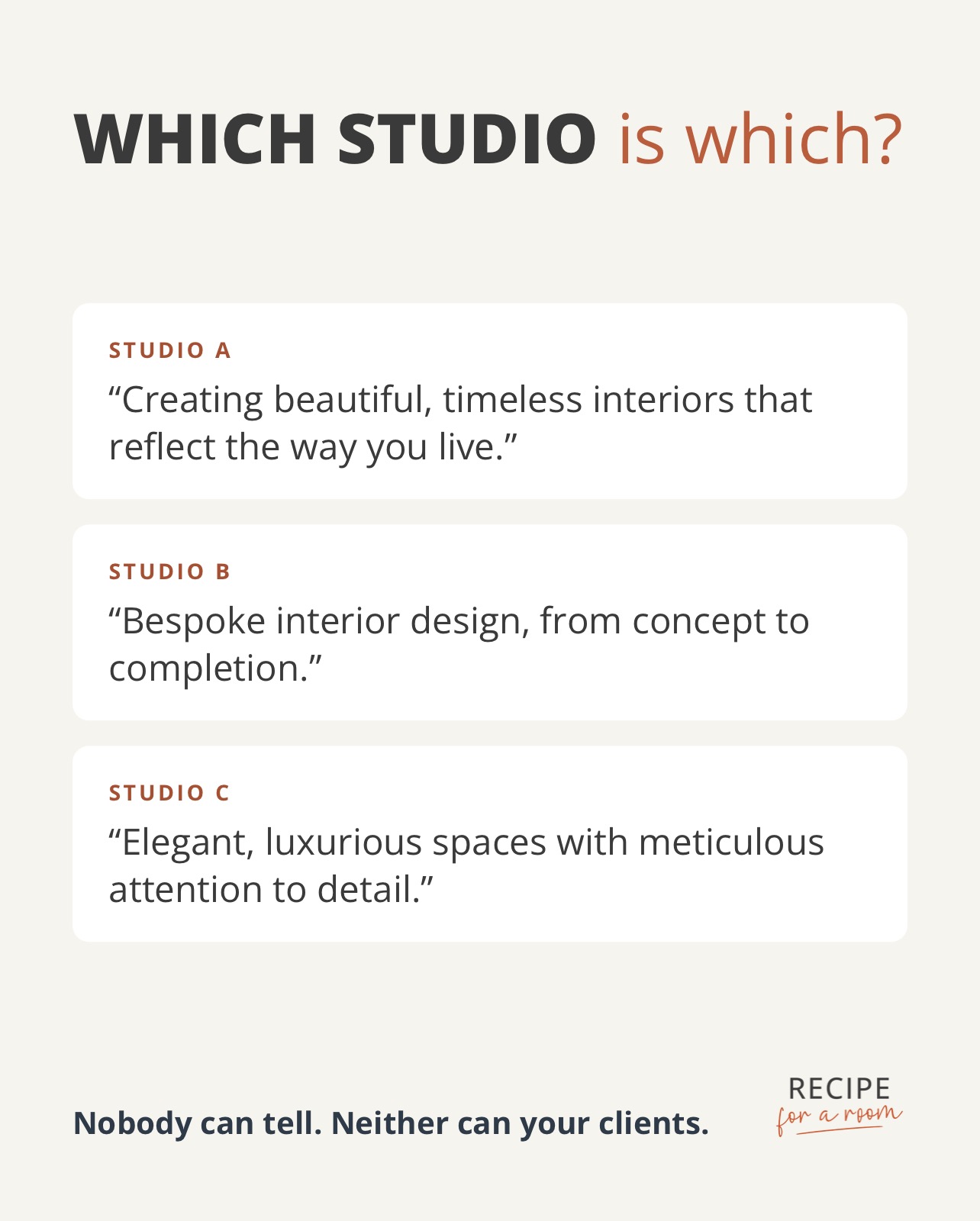
We designers overuse certain words as part of our positioning messaging: beautiful, bespoke, curated, timeless, a personal service. All true, and all cancelled out if everyone says them.
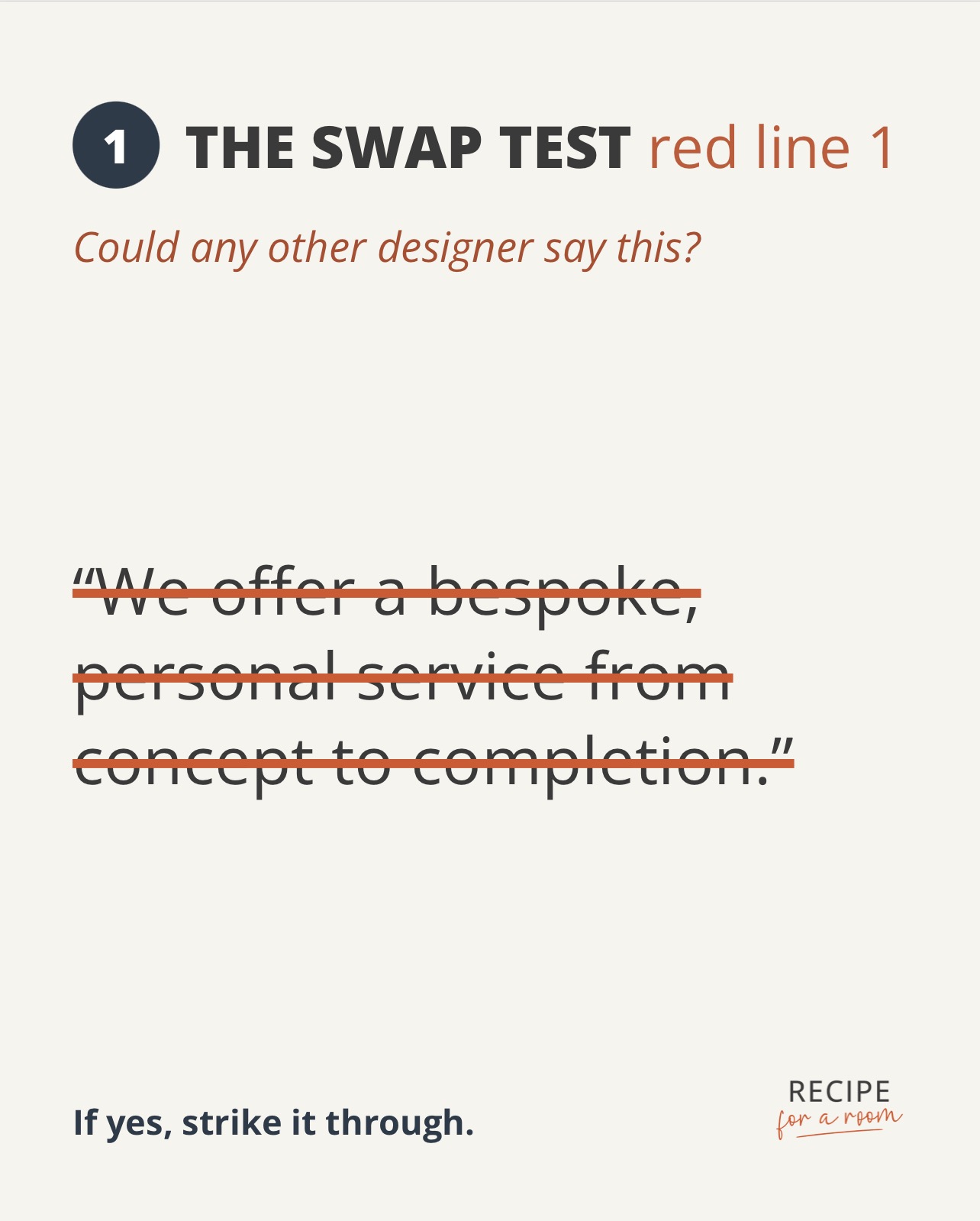
So test what you say.
First, the Swap Test: could any other designer say it, word for word? If so, strike it through.
Second, the Opposite Test: would anyone claim the reverse? Nobody designs ugly interiors, so "I design beautiful interiors" goes without saying, and therefore says nothing.
Whatever survives must then pass the Dinner Party Test: could a client repeat it to a friend over dinner, and would the friend say "I want that"?
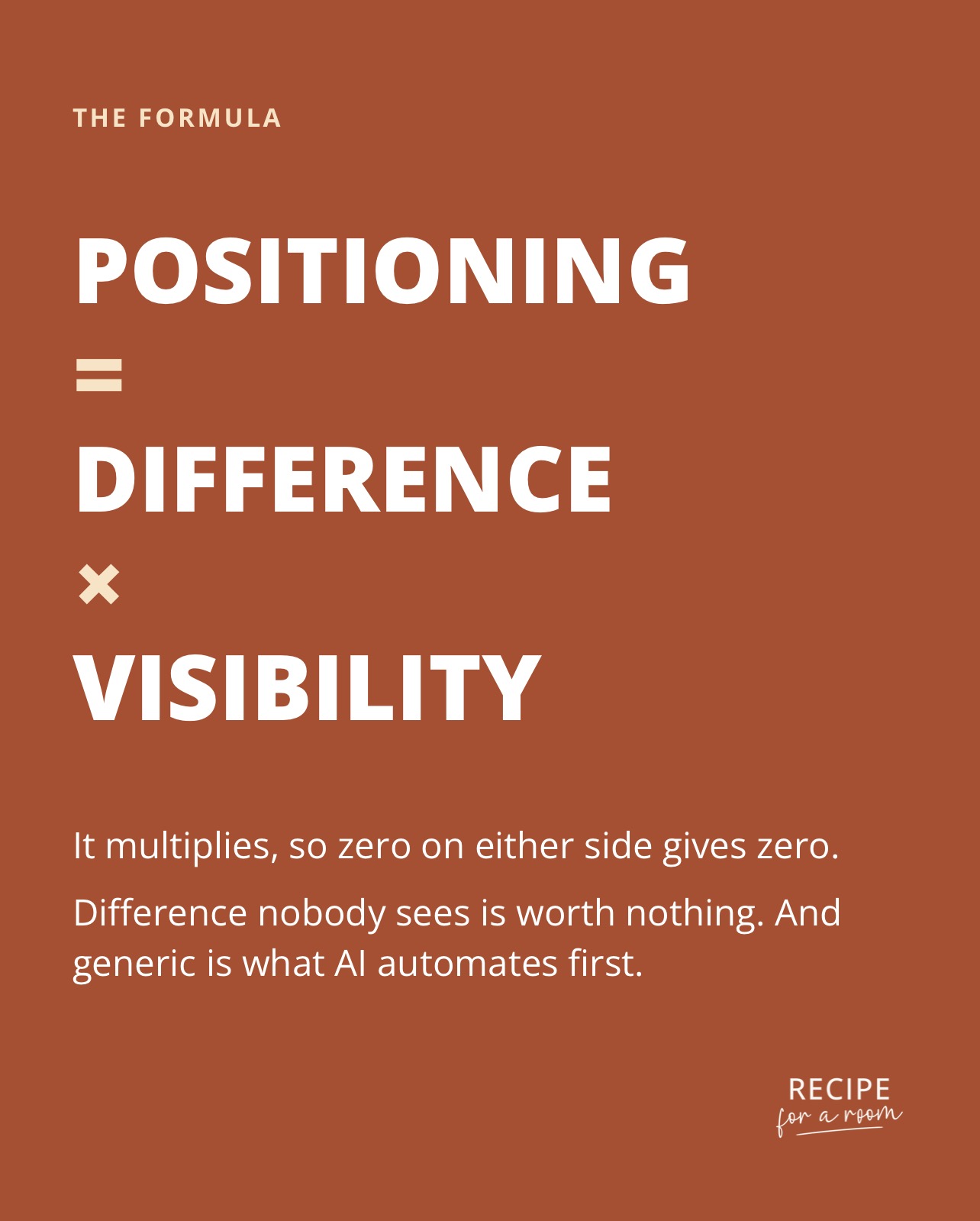
Positioning is difference multiplied by visibility. Because it multiplies, zero on either side gives zero. A difference nobody sees is worthless, and an offer with no difference is a commodity, which is precisely what AI will automate first.
Which leaves the essential question: where does a genuine difference come from? My answer is a framework I call the Axes of Differentiation, and when this slide 👇 went up, the whole table reached for their phones to photograph it. There are eight axes, in four families:
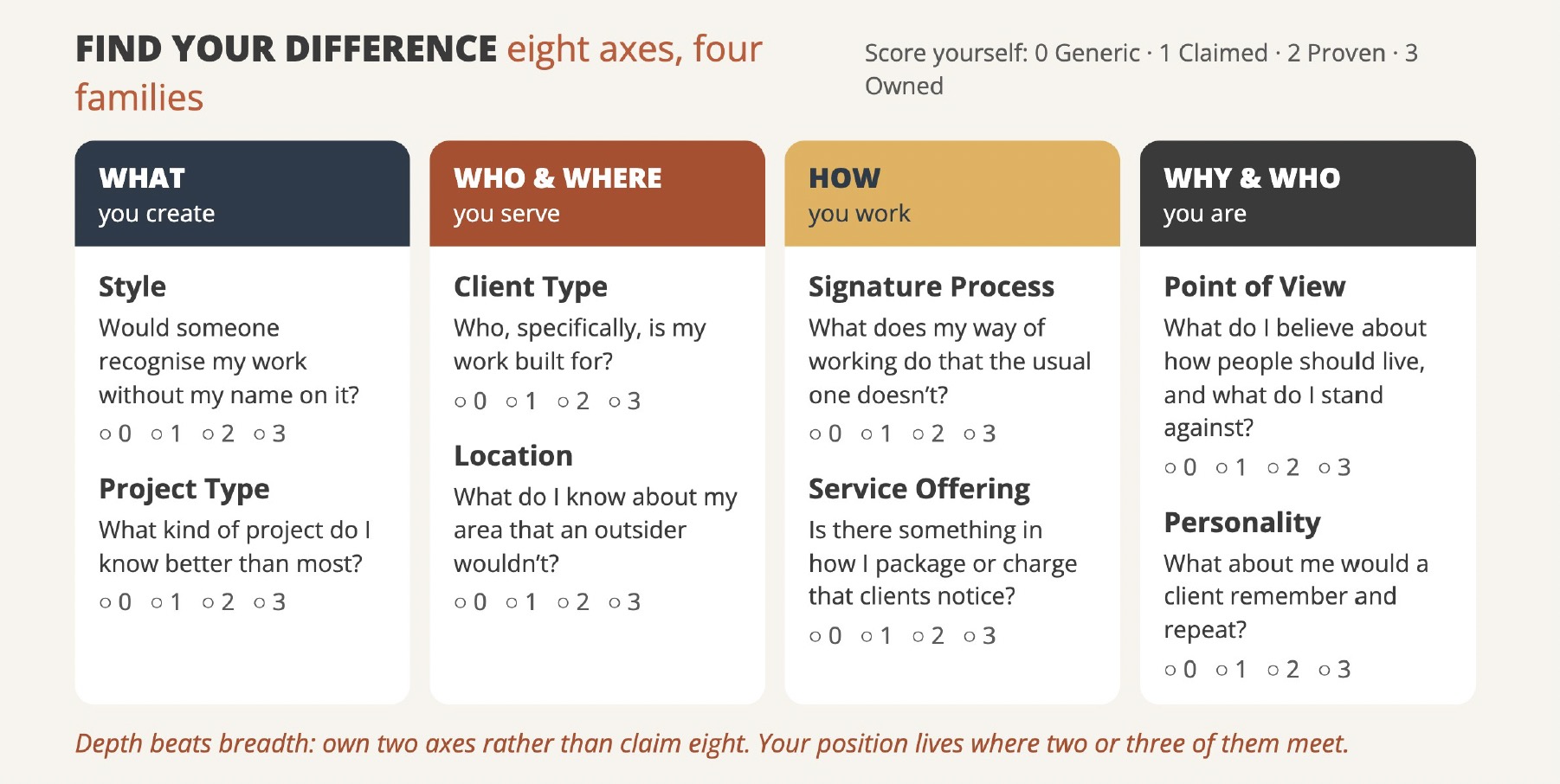
Better clients and higher fees are the result, not the starting point. Choose your axes, prove them, and make them seen.
3. Ten Things Peter Burch Wants You to Know About Your Brand
Last month Peter Burch, co-founder and creative director of March Branding, led a webinar for Hothouse. March has spent eleven years working largely in interiors, for studios and houses including Anna Spiro, Beata Heuman, Sarah Vanrenen and Turnell & Gigon. These are ten of his points.
Five for the brand
1. Your brand is what people say about you when you are not in the room (it's the Dinner Party Test, mentioned above 👆). That is Peter's definition. On that definition the logo is only one piece of evidence among many. The studios at the top of this profession tend to have what Seth Godin calls a tribe, and they are usually known for one distinct thing.
2. Be clear about what you do, and for whom. Specialism might be a style, such as Rose Uniacke's understated luxury or Matthew Williamson's colour, or it might be a sector, such as care homes or food halls. A studio seen as an authority has work come to it. A generalist has to go out and find it.
3. Start with a story, not a motif. For one heritage studio, March's discovery work turned up a pair of brass letters the two founders had found in a Paris market, and those became the logo. The obvious tropes do the opposite: a pair of scissors on a fabric house's logo, or, by extension, an armchair silhouette on yours.
4. Every touchpoint is the brand. That means heavy card, debossing and paper with some weight to it. A beautiful identity printed on cheap stock does active damage, because it tells a high-net-worth client something you did not intend. The same applies to a fee proposal.
5. When you rebrand, decide what is worth keeping. Sometimes there is a strong foundation to refine. More often the right move is to begin again. Occasionally the asset is simply your name, used plainly in place of something clever. Peter's cautionary tale is Tropicana, which dropped the orange from its carton and reinstated it within weeks after sales fell.
Five for the website
6. Let the photography carry it, and pay for it when you can. That means large images that fill the screen, with no clutter. If you have no budget yet, a phone will do, provided the lighting and styling are right. Websites rarely display images above 2,500 pixels, and a modern phone captures about twice that.
7. Design for the phone, and watch what happens. Between 60 and 65 per cent of visitors to a residential studio's site arrive on a mobile, and tablets account for about two per cent. Install Google Analytics and Search Console, and a tool such as Clarity or Hotjar, so you can see where people arrive, where they go and where they give up.
8. Show the process, and the person. Many clients have never hired a designer before. A page explaining how working with you runs, or an FAQ, settles questions like whether project management is included before anyone has to ask them. Have an about page with a good photograph as well. People hire people, not faceless brands.
9. Write down what you already know. A site made only of pictures will not rank. Each part of your working week, whether procurement, mood boards or choosing fabrics, can become a post. AI search is reducing the traffic to websites, but Peter's experience is that it removes the people asking idle questions and leaves the ones ready to buy. Content laid out as questions and answers is easier for those answer engines to find.
10. Prune the portfolio, and ask for reviews. If a project speaks to the wrong client, archive it, because a catch-all site attracts catch-all enquiries. Set up a free Google Business Profile and ask for reviews steadily, perhaps one a fortnight, rather than all at once. A steady stream builds more trust than a burst.
Peter's ten points are, in effect, the visibility half of the equation above.
4. The Big Push: Pledges Due Tuesday
It's Q4 and we are tidying up 2026 and preparing for 2027. The Big Push is our annual accountability initiative to get something significant off the to do list by year end. If you are taking part, your pledge form is due by Tuesday 20 October, and the pledge ceremony is on Thursday 22 October at 10am, live online. The form and the joining link are in the Hothouse group. If you missed the launch session, and are wondering what on earth's going on, the recording is here.
If this issue has put a positioning task at the top of your list, it may well be your pledge. E.g. running the Swap Test across your whole website; rewriting your about page; or pruning the projects that speak to the wrong client: each matters, each is within your control, and each can be finished by Friday 4 December rather than merely started.
5. Coming Up in Hothouse
📆 Tuesday 20 October. Big Push pledge forms due. The form is in the Hothouse group.
📆 Thursday 22 October, 10am. The Big Push: pledge ceremony. Live online. Link in the Hothouse group.
📆 Thursday 26 November, 10.30am. Annual review. Open to everyone, whether or not you are taking part in the Big Push.
📆 Friday 4 December. Big Push deadline.
📆 Thursday 10 December, 10am. Big Push celebration and wash-up.
📆 Designers' Boardroom, 2027. Monthly meetings with peers for year-long accountability. Places are open now. Email me to find out more.
📆 Business in a Box is under way, with the Interior Design Practice System built into the course.
Plus a couple of webinars for the BIID (AI, and Fees and Charging) bookable via their website.
6. My Week in Hothouse - Decorex 2026
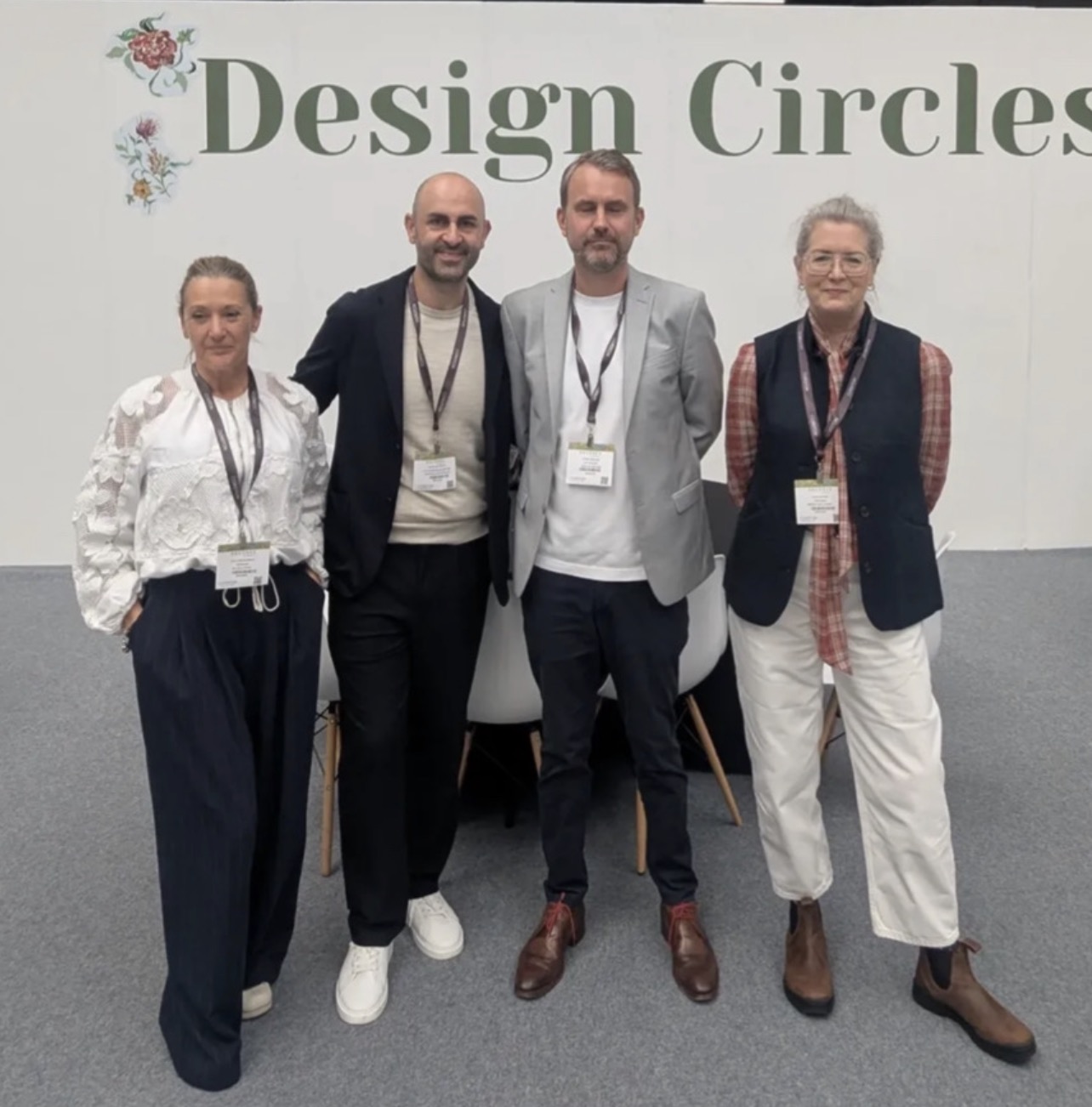
Until David del Greco (second from the left, above) invited me to speak at Decorex, I hadn't planned to visit. How lucky I was to have been given this opportunity. It was fantastic.
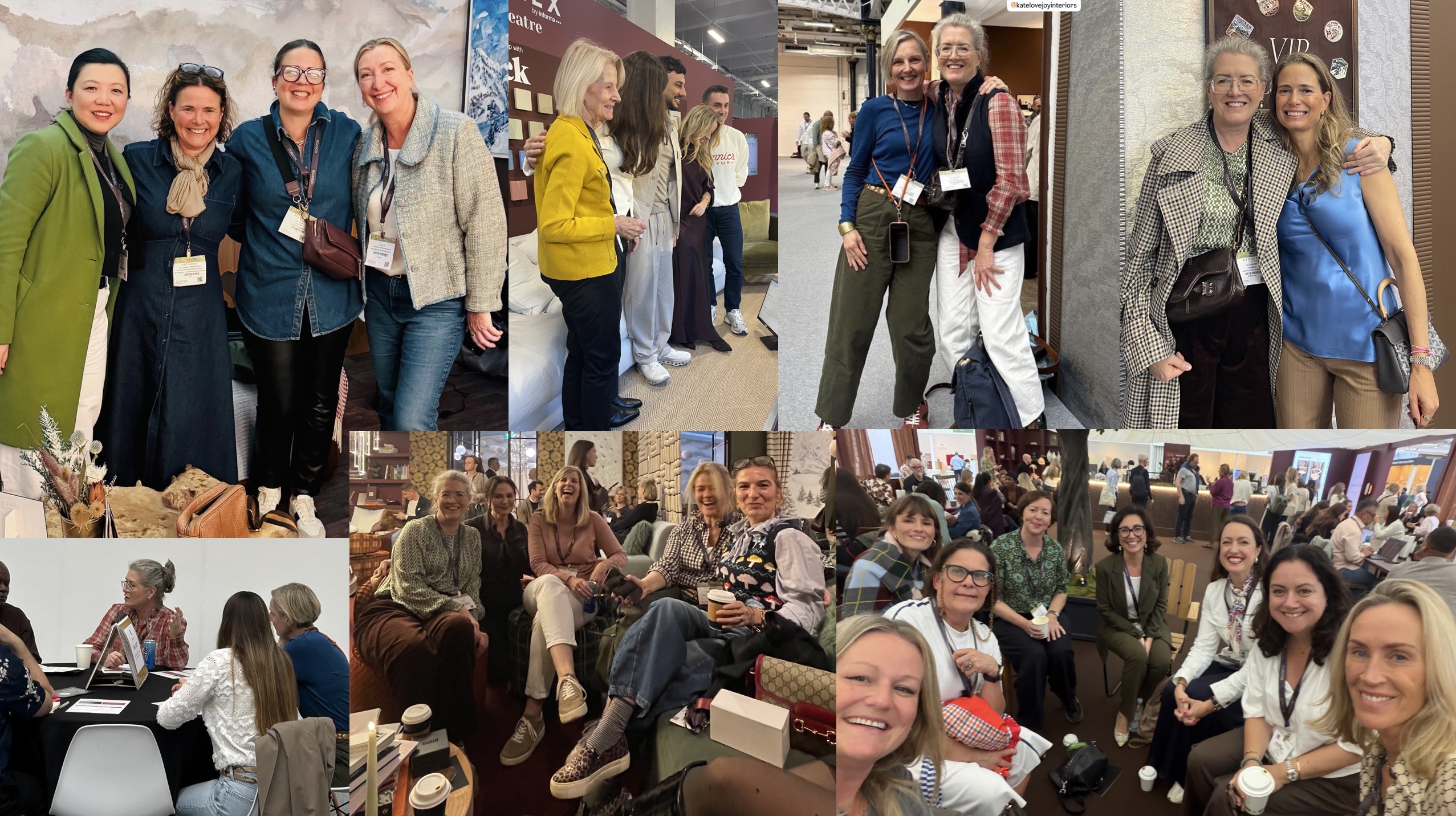
My typical online working day can be intense, Zoom is all about work and there are few light and joyful social moments - Decorex was all light and joy. I am so sorry that I missed seeing a few people I really hoped to finally meet IRL, but I caught the majority, and met many in Claudia Dorsch's triumph of a VIP lounge.
I'm delighted to report that at the end of week four all our Business in a Box designers have distinctive positioning that sets them apart. That bodes very well for the remainder of this 12 week course.
My own Big Push. I will confirm this at our meeting on Thursday - I'm thinking of something deeply uncomfortable that there is still time to chicken out of.
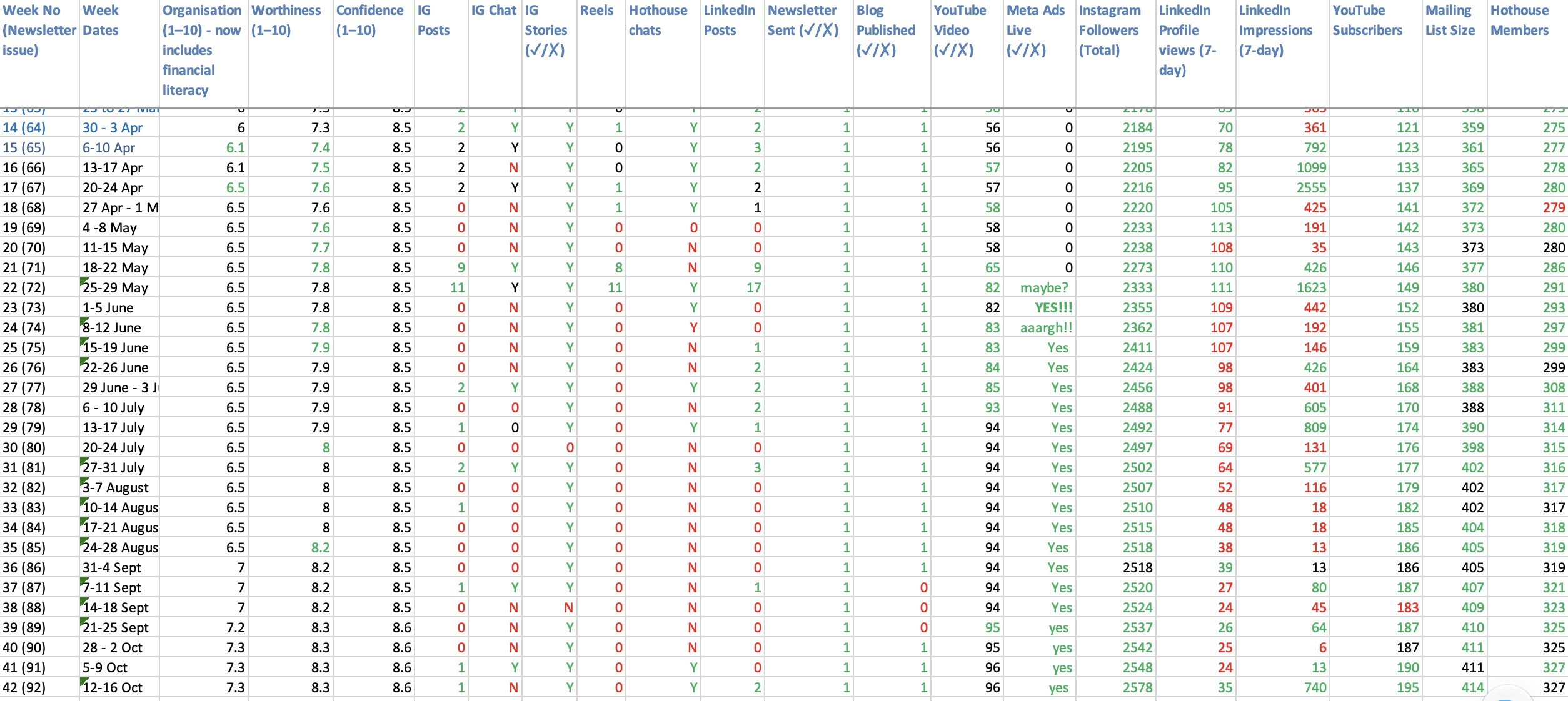
I have made it back on to Instagram - thank you to our Instagram working group, we are all back up. And on to LinkedIn. See this week's numbers below, they are trending green again:
Final Word
Better clients and higher fees are the result, not the starting point. Find the difference that is genuinely yours, prove it, and then make sure people can see it. And if you are pledging, the form is due on Tuesday.
See you next Sunday.
Julia
Founder, Hothouse

Responses