
Hello ☀️
Usually the summer is quiet, but five designers booked appointments for advice last week. Every one arrived with a version of the same question: what should I do next? Between them they left with five different answers: no two could have shared a meeting.
? One needed to be visible before there was yet a business to be visible for.
? One had a full order book, projects delivered beautifully, and a profit margin that made no sense against any of it.
? One had to settle on a direction before any tactic at all could be worth doing.
? One had more work than there were hours, and no room to install the very thing that would return the hours.
? And number five had no shortage of enquiries whatsoever, but was losing clients somewhere between interest and instruction, which is the most expensive leak in any design business, because sealing it costs almost nothing and drops straight to the bottom line.
Give any one of them the advice that was right for another and it fails...worse, they could conclude that they had failed.
That is this week's theme, and the argument of the blog below.
Advice is not true or false. It is addressed or unaddressed. Almost everything you are told on Instagram is perfectly good advice, written by someone who used it and grew with it.
The question is never whether it is good. It is whether it was written for you, at your stage, with your clients.
Free advice is only really useful when you know which bits do - and don't - apply.
1. This week on the blog - Why All the Advice Contradicts Itself

The designer who set this off put it perfectly.
“There has never been more help available, and yet running a design business has never felt more complicated!”.
She is right, and the reason is structural rather than personal. This week's blogpost sets out the three questions that let you filter any piece of advice before it costs you anything.
2. LONG READ - Would YOU get the job?
A old-favourite thought experiment came up again this week, in a Founder Presence workshop. I love this one.
Here it is:
You have been awarded an annual grant of £100,000. It is ringfenced. It cannot go on staff, software, marketing, photography or fees, and it will not pay you. It funds exactly one appointment: a figurehead to lead your design practice in public.
So, here is the job description:
Job Description: BRAND FIGUREHEAD AND PRINCIPAL VOICE
Name: Your Interior Design Practice
Reports to: The practice
Term: Twelve months, grant-funded, renewable subject to performance
Salary: £100,000 per annum
Basis: Part-time. The role is defined by output, not by hours.
Location: In public - using movement, voice and face; words and visuals
Purpose of the role
To make the practice known, understood, and asked for. Most design practices lack clear positioning and need a larger audience. This role exists to close these gaps: to be the public face and voice of the practice, to hold and state its point of view, and to turn visibility into enquiry. It is not a communications support function. As far as the public is concerned, the postholder is the practice.
Key accountabilities
1. Public voice (31%)
Publishes on a fixed schedule without exception. States a considered opinion on design questions where the industry norm is to hedge. Writes and speaks in the first person, plainly, and does not soften a position after stating it. Answers the question the audience has not yet thought to ask.
2. Visibility and profile (23%)
Builds recognition among prospective clients and their advisers. Maintains a consistent aesthetic register across every published surface, on the understanding that the feed is itself evidence of judgement. Is easy to find, easy to identify, and unmistakably a person rather than a brand.
3. Networking and relationships (23%)
Leads the practice's presence in the field: events, professional bodies, press, peers. Builds relationships that would exist without a commercial reason, and declines those that would not.
4. Enquiry generation (23%)
Converts audience into appointments. Ensures a route from public presence to a booked, paid appointment exists and is obvious. Reports on what produced enquiry and what merely produced applause.
Person specification
Essential
- Holds design opinions that can be argued with, and states them in public under their own name.
- Withstands disagreement without retreating from a position or overcorrecting into aggression.
- Publishes reliably when uninspired, unwell, busy, or unrewarded by the previous week's response.
- Explains structurally complex ideas to a lay audience without condescension or jargon.
- Presents with composure. Does not perform enthusiasm, does not fill silence, does not oversell.
- Maintains firm private boundaries without appearing evasive.
- Can be told that a piece of work did not land, and produces the next one on schedule.
Disqualifying
- Requires external validation to continue.
- Confuses being liked with being chosen.
- Waits for the portfolio, the confidence, or the right moment.
Uniform
- The postholder's appearance is a published surface and will be treated as one, it provides evidence of the practice's judgement, which the client will read whether or not it was intended to be read.
- This is not a matter of expense, fashion or beauty. It is a matter of coherence, and it is set deliberately.
- The dial: aspirational to approachable. The postholder presents as aspirational, to the degree the practice selects as optimal for developmental stage.
- The desired balance: creativity vs precision vs professionalism. These three are balanced against one another, and set according to the desired impression.
- The postholder will hold the chosen setting consistently. A register that moves week to week does not read as range. It reads as uncertainty, and uncertainty is the one thing this appointment exists to remove.
Performance will be measured by
- Consistency of publication - recorded.
- Growth in the right audience rather than the largest one - data captured.
- Number and quality of appointments booked - data captured
- Conversion of clients across the stages of design - data captured
- Growth in thought-leadership activities - data captured
I imagine you get the point…
This role is not vacant. In every practice it is already occupied, by whoever currently speaks for the business, whether or not they agreed to it and whether or not they are doing it deliberately, or even at all. In most practices that is the founder, doing it in the gaps between everything else.
The useful question is not whether you would enjoy this job. It is, on the evidence of the last three months, would you be shortlisted for it?
3. "White Label Studio" is getting a new name
The original name gave nothing away, and the right moment to correct that is before launch rather than after, so I am doing it now.
The reason? Most people I speak to haven’t heard the term "white label". Nothing about the course has changed, it still comes fully resolved and just waiting for your branding. But a name that needs explaining is not a name. It is an obstacle that needs clearing before anyone looks at the content.
So, from today it is: The Interior Design Practice System
- The whole design process, stage by stage.
- Every back-office document and spreadsheet,
- Nine client-facing packs ready for your branding, and
- Thirteen video modules teaching you exactly how and when to run it.
Since the old name was doing such a poor job of it, here is what is actually inside:
You know how to design. Almost nobody taught you how to run the project, so each one gets improvised, and improvisation is where the hours, the margin and the calm quietly leak away. The System is the answer to that, and it comes in three parts.
The back office is around fifty documents and spreadsheets, sequenced from first enquiry to handover and informed by the RIBA Plan of Work. It is plug-and-play, bring a project, open the first one, work through them in order with a client in hand, and you have run the entire project properly. Nothing left to remember, nothing invented at eleven at night.
The client-facing packs are the nine you have heard about, from How We Work through to Handover, professionally designed and ready for your business name and logo, in InDesign, Canva, and PowerPoint.
The course is thirteen modules of video lessons on exactly how to roll all of it out, stage by stage, so it becomes how your practice works rather than a folder you downloaded.
It launches in September, with a date to follow shortly. To those who have already bought it: my thanks to you, you don't need to do anything at all. Exactly the same product, same place, but with clearer signage.
4. Coming Up in Hothouse
📆 Tuesday 18 August, 11am - New and Pivoting Designers Meeting.
A live get together online, to chat about current issues and plan for the coming quarter. It has been a while. All Hothouse members welcome, join Hothouse here. The link will be in the group under 'Events'.
📆 The Interior Design Practice System launch. Date TBA. (Formerly White Label Studio, with the reason for the change is above). Find out more here.
📆 Monday 21 September - Business in a Box September cohort picks up their tools. Twelve weeks' live group work, led by me, to get your new or pivoting business up and running by year end. Join the group.
📆 Wednesday 23 September, 11am - Branding and Marketing Webinar, with Peter Burch of March Branding. I have seen the presentation and it is going to be good. The link to join this free, live webinar will be in the Hothouse group.
5. Coming up for the BIID
I'll be leading the following CPDs for the BIID in the autumn:
📆 Thursday 24 September, 10.30. Business Planning And Strategic Clarity For Interior Designers
📆 Thursday 12 November, 10.30. AI Foundations For Interior Designers: Working Confidently From First Principles
📆 Thursday 19 November, 10.30. AI In Practice: How Interior Designers Are Integrating AI Into Studio Practice
And...in late November, date to be confirmed, Fees and Charging, with new materials.
Fees and Charging, and the AI sessions tend to take care of themselves, but I'd like to put in a special plea for business planning.
This is the answer to a question I'm asked all of the time: how do I get better clients?
6. My Week In Hothouse
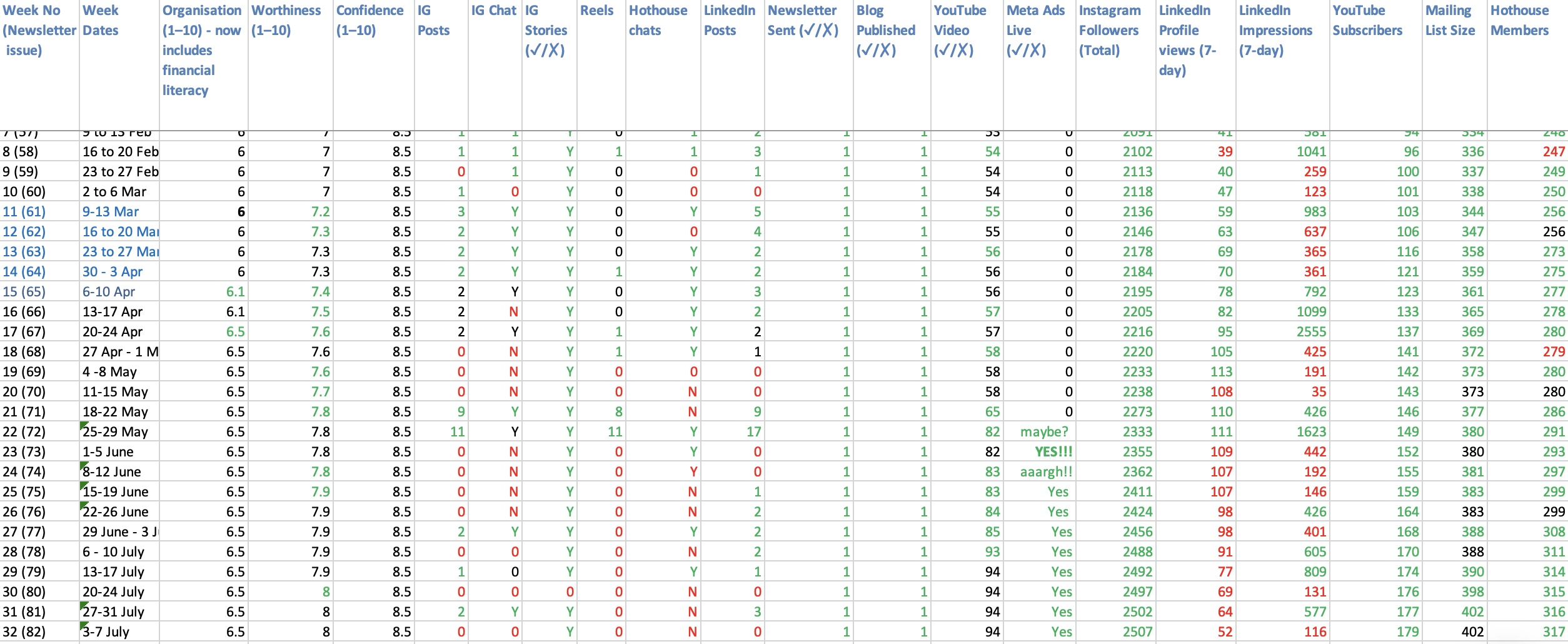
I'm used to the summer being quiet, but not this year. It's good - marketing is working, and I'm having to be intentional about where to spend my time. As ever, that's first-and-foremost with clients. Then, I have dedicated time to the development of the new course: The Interior Design Practice System, keeping that on schedule for its September launch, and ready for use in Business in a Box. Which leaves, taking a backseat for now, marketing. It's the same story I hear from my clients. Resources are limited and need to be directed according to priority. Still, reporting on this weekly helps keep it front of mind, and this coming week I plan to give it some attention.
In the quiet moments - e.g. in the supermarket, or when taking a comfort break - I've started thinking about 2027.
It is the ninth of August, I am aware of how that sounds.
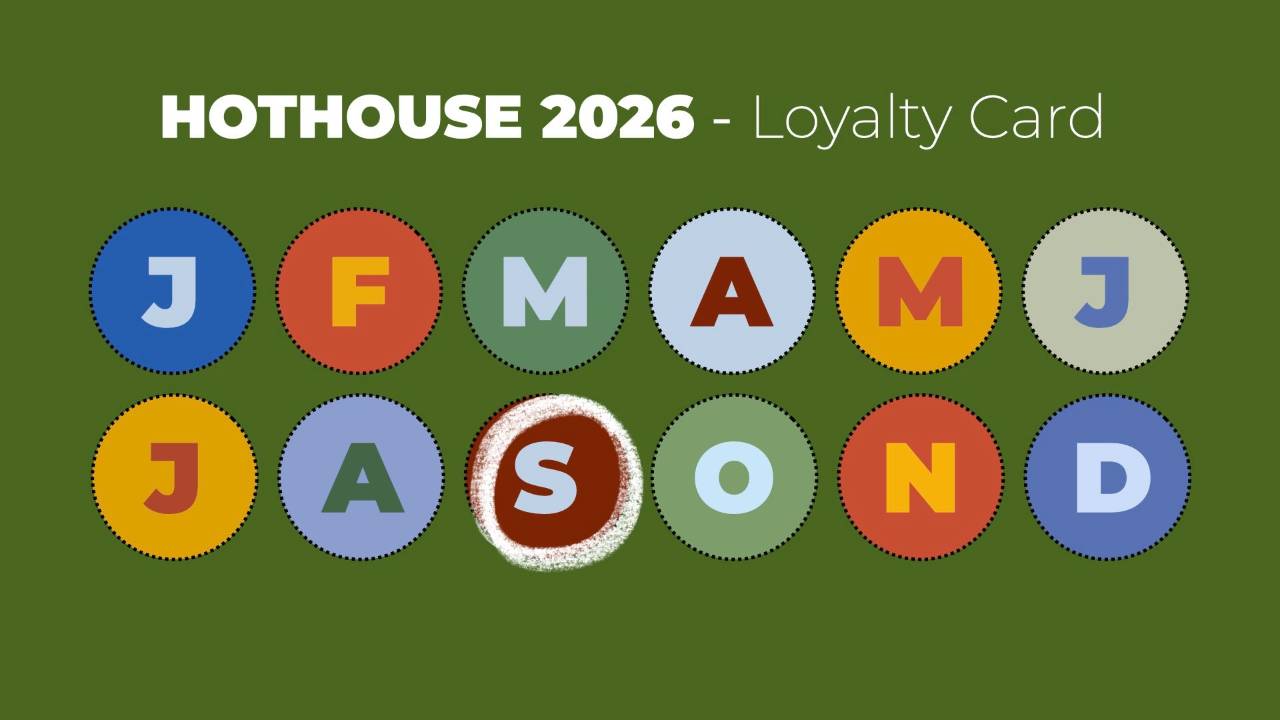
Annual planning fails for a boringly predictable reason. It never gets scheduled. I like to do mine when there's enough of year to reflect on usefully, and get it finished before 31 Dec, so that I can wave it around (like I'm drunk on business) on 1 January.
My 'thinking about it' / 'doing it' sequence has three stages.
Stage one is now. All that August asks of you is to notice that the time is approaching, to let yourself think about next year conceptually and without any obligation to be realistic, and then to put a day in the diary for Q4 and defend it against everything that will try to take it. That is the entire task. The dreaming is not indulgent, it is the part that needs months rather than hours, and it only works properly while there is still no pressure on it to be sensible.
Stage two is the planning day itself, and I would hold it as late in Q4 as you dare. Late enough that you have very nearly a whole year to reflect on, because the review is the raw material and a thin review produces a thin plan. Early enough that you are not attempting it in the fortnight before Christmas, when nobody's judgement is worth very much. Give it a full day. Not an afternoon, not the tail end of a Sunday.
Stage three is January, and it should be the easiest of the three. You arrive with the thinking already done and the decisions already taken, and you simply start. Everybody else is still deciding, and ends up making decisions that fizzle out by week two.
I'll be chatting about all of this in Hothouse in Q4: don't worry, we'll do this properly and arrive in January in the best possible shape.
Final Word
This week: the difference between advice and counsel. Advice is broadcast, and much of it is excellent. Counsel begins with a question about you.
Few people you follow know your order book, your clients, or what this year has already taken out of you. When broadcast advice tells you what you ought to be doing, it is not being unkind. It simply is not speaking to you. It is speaking to everyone, and yet we are all unique 🦄
I hope the August sun continues to shine on you,
Julia
Founder - Hothouse


Responses