

Overwhelmed with conflicting advice? Here's how to filter it.
Aug 09, 2026You should be posting Reels. You should stop posting Reels. You're not getting work because your website is wrong. You're not getting work because you don't niche. You're not getting work because you niche too hard. Raise your fees. Never discuss fees. Use this AI tool or be left behind; abandon that AI tool or look like everyone else.
An accountability group designer vented her frustration last week:
There has never been more help available, and yet running a design business has never felt more complicated.
She's right, and I've been thinking about why this is. If every time you open Instagram you are overwhelmed with conflicting business advice, the problem is not that you need better boundaries with your phone. The problem is structural, and once you see the structure, the noise gets dramatically quieter.
The advice isn't wrong, it's unaddressed.
Most of the advice you're given on Instagram is perfectly good. Written by people who used it, tested it, grew with it. And that's precisely what makes it dangerous.
Because advice is specifically right for a particular person. It carries invisible assumptions about the business it was written for: how established it is, who its clients are, what it needs next. Post it to a feed of random thousands and those assumptions vanish, leaving only the instruction, delivered with total confidence, to people it was never written for.
So when two pieces of advice conflict, you are almost never watching a disagreement about what's true. You are watching advice for two different businesses collide in one scroll. "Be selective about clients" is excellent advice for a designer with a full order book, and dreadful advice for a designer six months into their career. Both get posted with the same certainty. Neither post tells you which designer it's for. Figuring out if the advice applies, the job that really matters, has been left to you.
Which means the skill you actually need is not finding advice. It's filtering it. And you cannot filter until you've defined your own distinctive positioning.
Know your positioning
Before any piece of advice can be judged, it has to be judged against something.
Here are the three questions that do most of the work.
1. What is the developmental stage of your business? A practice about to launch, a practice in its improvised first years, and a practice with a waiting list are different organisms with different needs. So different.
Most of the loudest advice online (value pricing, client selectivity, "fire your worst clients") is devoured by pain-riddled early stage practices, but only applies to well-established businesses.
It isn't wrong; it's mis-sequenced. Follow it too early and it fails, and here's the cruelty: you will conclude that you failed. You didn't. You took medicine prescribed for a different patient. The question is never "is this good advice?" It's "has my business earned the right to use it yet?"
2. Who is your client, really? Clients hire designers for different reasons, and the difference runs deeper than budget. Some are protecting themselves: from expensive mistakes, wasted time, the renovation that goes wrong. Others are building something: a home that expresses who they are, or who they intend to become.
Psychologists call this prevention versus promotion focus, and it changes everything about how you should market.
Advice about naming pain points and solving problems works on the first client and actively repels the second, for whom that register reads as anxious and a little down-market. If your feed speaks prevention to a promotion clientele, or vice versa, no amount of consistency will fix it. You're speaking the wrong language.
3. What is your feed actually for? For some practices, Instagram is a funnel: it finds strangers and warms them into enquiries. For others, especially at the top of the market, it's a credential: clients arrive by referral and look at the feed afterwards, to confirm the recommendation. Almost all posting advice assumes you're running a funnel. If you're really maintaining a credential, then hooks, urgency and calls to action aren't just unnecessary, they undermine the thing your feed exists to prove.
Start using these three filters, and something satisfying happens: most of the conflicting advice stops conflicting. It sorts itself into for me now, for me later, and never for me. The last pile is the biggest, build an instinct for it and you can watch it float past with complete calm.
The same filter works for AI
The other bewilderment in the accountability meeting last week was tools. Which AI programs to use, which to drop, how many subscriptions a small studio actually needs, what everyone else is doing. Here again, instead of asking: "Which AI should I use?", try: "What does my business, at my stage, serving my clients, need to do faster or better?".
One designer raised a sharp example: the backlash against photorealistic AI renders. Those flawless images look like progress, but they can set a scheme in concrete far too early, fixing client expectations before the design has had its developmental ebb and flow, leaving no room for the scheme to breathe or change. Whether that's a problem depends entirely on your process and your clients. Which is the point. The tool isn't good or bad. It's addressed or unaddressed, like everything else in your feed.
Decide what you're training for
One of the group offered a really helpful analogy. Fitness advice is also endless, conflicting and individually sound. Nobody sensible tries to follow all of it. You first decide whether you're burning fat or building muscle, and that single decision filters everything: which tips are yours, which belong to someone on a different journey.
A design business works the same way. Decide what your business should be training for right now. More enquiries is one goal. Better margins is another. Calmer systems is a third. They are all legitimate but I doubt you have time to pursue all three. Pick one, take what one designer in the meeting called baby steps, and let the rest of the advice go by, for now.
Tiers of business development
With my clients, I find that acceptance of the current developmental stage of your business helps sort out focal points and filter incoming advice.
I define the stages as:
Tier One - Startup
Tier Two - Growing Pains
Tier Three - Maturity
Tier Four - Stardom
If you have a fantastic network, budget for professional branding and marketing, and no need to earn a living for a year or two, you can helicopter in with the appearance and attitude of Tier Three (minus the portfolio - you need a solution for that).
However, for the majority of designers I work with, Tier Three is accessed via Tier Two, which is accessed via Tier One, and you need to calibrate for where you are not where you're headed.
I support the most stratospheric ambition - yes please - and you are more likely to achieve this with great self-knowledge, a positive mindset, the right stage advice, and a map.
Here's a self-certification chart to help locate your business's current tier.
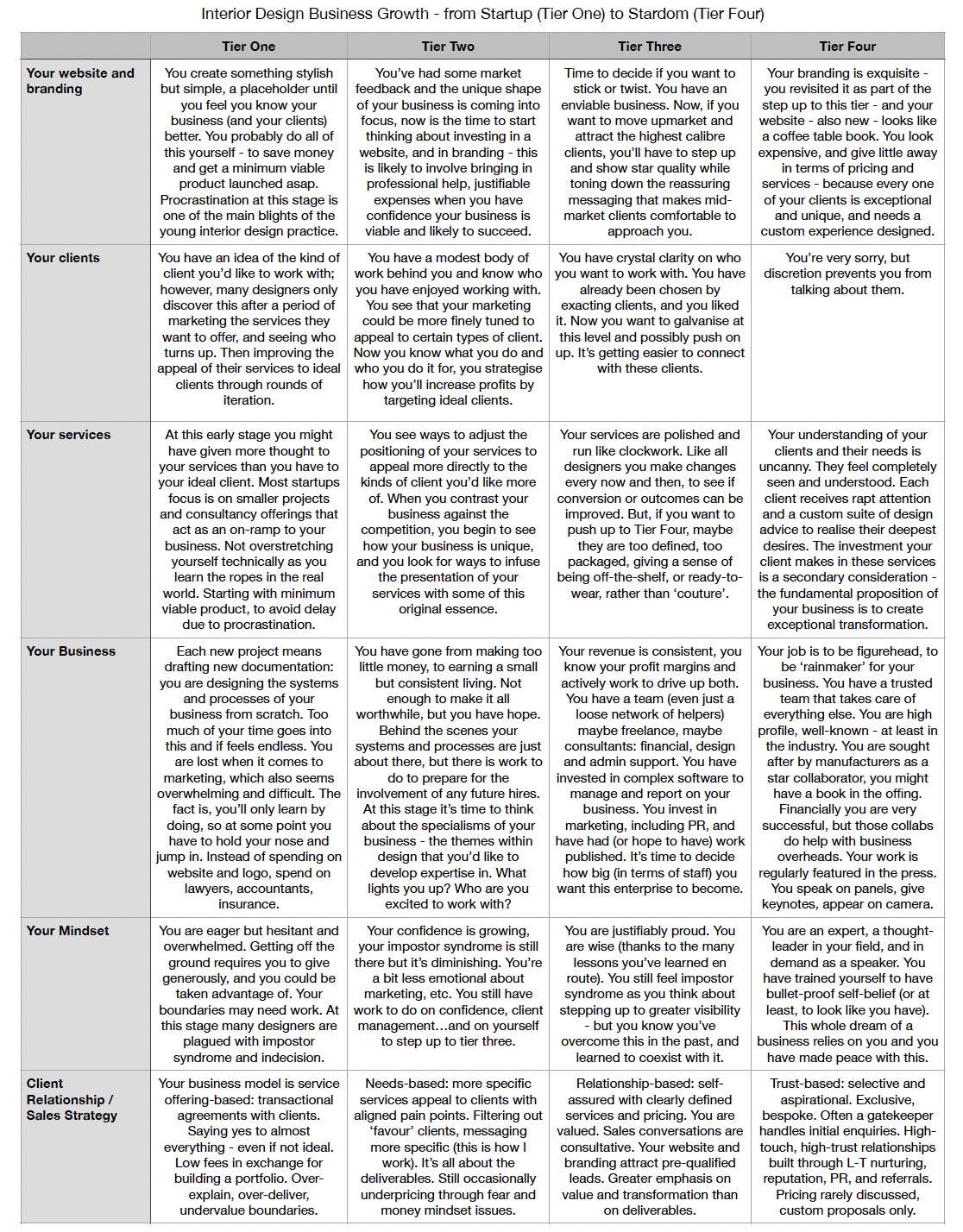
My business is three years old and I've found that its development has largely mapped to these tiers too.
It can feel disheartening or overwhelming to accept that you are just at the start of a major development project, but over time I've found this chart really motivating. Coming back after a few months of intentional focus to discover that business performance has nudged to the right gives you a real boost. When you see that you've made progress, completing the rest of the journey feels completely achievable.
There has never been more help available. That part is true, and it's good news, once you stop trying to take all of it. If you feel flooded, it's not your fault, you aren't failing to keep up. You are simply missing one piece of equipment: a clear fix on your own position. Figure that out and the noise will start filtering itself.
Receive my quick-to-read weekly newsletter...
Sign up for the Hothouse Newsletter: find out what's coming up, and keep up with recent webinars, blogposts, videos, and other events - all focused on excellence in interior design practice.
We hate SPAM. We will never sell your information, for any reason.
