
Hello 👋
This week's blog is a little different. It’s quite personal - about moving house, about a childhood home I've never quite stopped missing, and (as I make a wishlist for my next home) about lessons learned from past experiences of ‘home’, and from thirty years of thinking about interior space. It all boils down to the difference between performance and substance.
I wasn't entirely sure about publishing it. But these principles carry through - they sit at the heart of Hothouse*.
A performative business looks good. It is active on social media, has a polished website, responds to trends. A substantial business is a different object entirely. It has systems, it has discipline, it reviews itself honestly, it plays a long game. It knows that in a trust-based service industry, a new marketing initiative takes six to twelve months to produce a client, and, it is at peace with that. Calm, in other words, as a strategy.
This is the last issue of Q2, and the halfway point of the year. It's a natural moment to reflect on our intentions for 2026, and to measure what we've actually built so far.
*Hothouse is my free resource hub for practising designers - join here.
1. This Week’s Blog - A Home That Completes You
This week on the blog, I've been thinking about what makes a home worth living in - not aesthetically, but structurally. What it faces, what it enables, what it is made of, and whether it accumulates meaning over time.
2. ⚽️ Half-Time, What Does the Scoreboard Actually Say?
It’s a wrap on Q2 and H1, and time for me to stop and assess the first half. It has been a mixed bag, but this is not to apportion blame or beat myself up. It’s an emotion-free read of what actually happened in my business in the last quarter (and the first half of the year) with as much accuracy as I can muster - it’s a blameless post-mortem.
Q1 was strong. Q2 was a partial collapse, that’s the accurate word. A significant personal disruption landed in the first half of the quarter alongside Bootcamp, and the combination removed discretionary capacity almost entirely. Social media dropped to zero across several weeks. What did not drop: the newsletter, the blog, the baseline disciplines. Embedded discipline is more resilient than initiative when life contracts around you.
But (see My Week In Hothouse below) I need to nip 'drift' in the bud, and knuckle down again, and with new focus on what matters most.
If you have not yet adopted the habit of a quarterly review, here is your call to action. Without direction and intention, a business drifts - as mine did in Q2. This is where a quarterly review intervenes, providing the opportunity to refresh and reset 🙏.
It is also where business planning intersects with time management. The planning cascade…
- Annual goals
- Drive Quarterly Strategy
- Which informs Monthly Focus
- Directing the Weekly Plan
- And delivering Daily Action
…only works if you stop periodically to review and reset it. Book one day a year (annual planning); half a day each quarter; an hour each month; 15 minutes per week.
Block the time now. Be honest with the data. Measure what matters - including your feelings about your performance, the things that don't appear on a spreadsheet.
TIP: Measure these out of a maximum 10; where 0 is the worst, and 10 the absolute best. It isn't scientific, but it really helps to have data to track.
3. Feedback from the front line - What six months of intention actually produces
The purpose of Hothouse is to give interior designers the business skills, the structure, and the accountability to build practices that are excellent, sustainable, and genuinely distinctive.
Theory is one thing - but let’s stop to enjoy some results.
Across my accountability groups and one-to-one clients, here is where things actually stand at the end of Q2:
- Designers who have been tracking psychometrics - confidence, worthiness, comfort with the aspects of business that previously felt threatening - have seen meaningful, measurable movement in those scores. This is because they choose their focus, and intentionally pushed on improving - and this internal work produces external results.
- Designers who set marketing goals at the start of the year have hit them: new brand positioning live, new websites launched, founder presence established in public-facing materials. Monthly accountability did what monthly accountability does, it keeps the work moving when attention might otherwise slip.
- Designers who wanted to charge more have written more substantial fee proposals. They have won the work.
- Designers who were distracted by the competition, or anxious about social media, have narrowed their focus to excellence as they define it for their own practice. The noise has receded, their sense of fulfilment has improved.
PLEASE NOTE:
2026 still has six months left to run.
They have done all of this in six months.
If you haven’t yet decided what you are building in H2, there is still everything to play for.
4. Systems & Processes Pt II - Webinar report
On Wednesday, in the second instalment of our Systems and Processes series, we covered the back half of the residential project - from developed design through to handover - with a strong focus on the client management that runs alongside it.
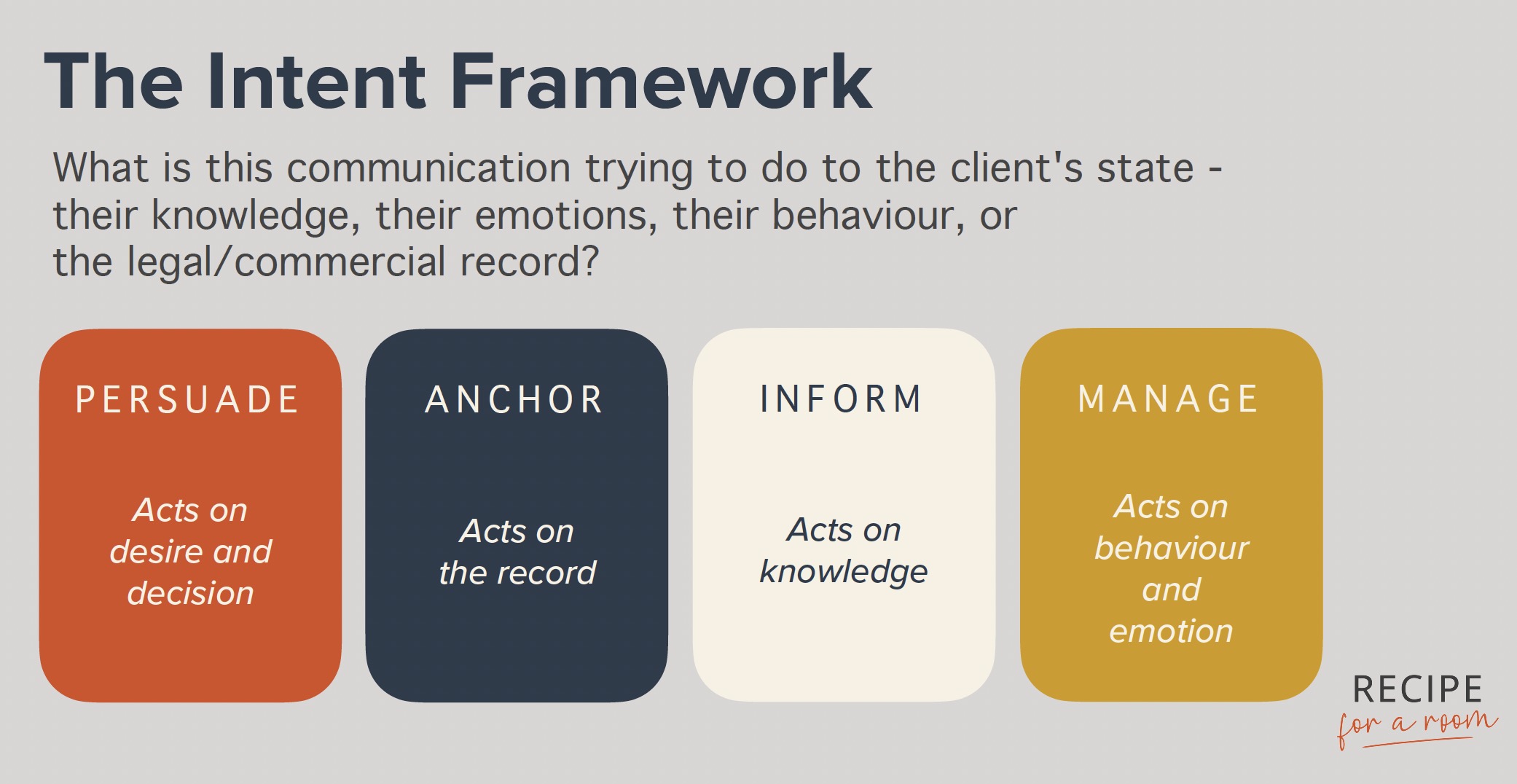
The organising concept is simple: every document you produce is doing one of four jobs: selling; anchoring; informing; or managing. Know which job it's doing, and you stay in control of the project. Lose track of that, and you become reactive.
The construction phase provoked the most discussion. Once contractors are on site, your role shifts from persuasion to navigation: holding the map while the client loses their bearings in what I call the wilderness.
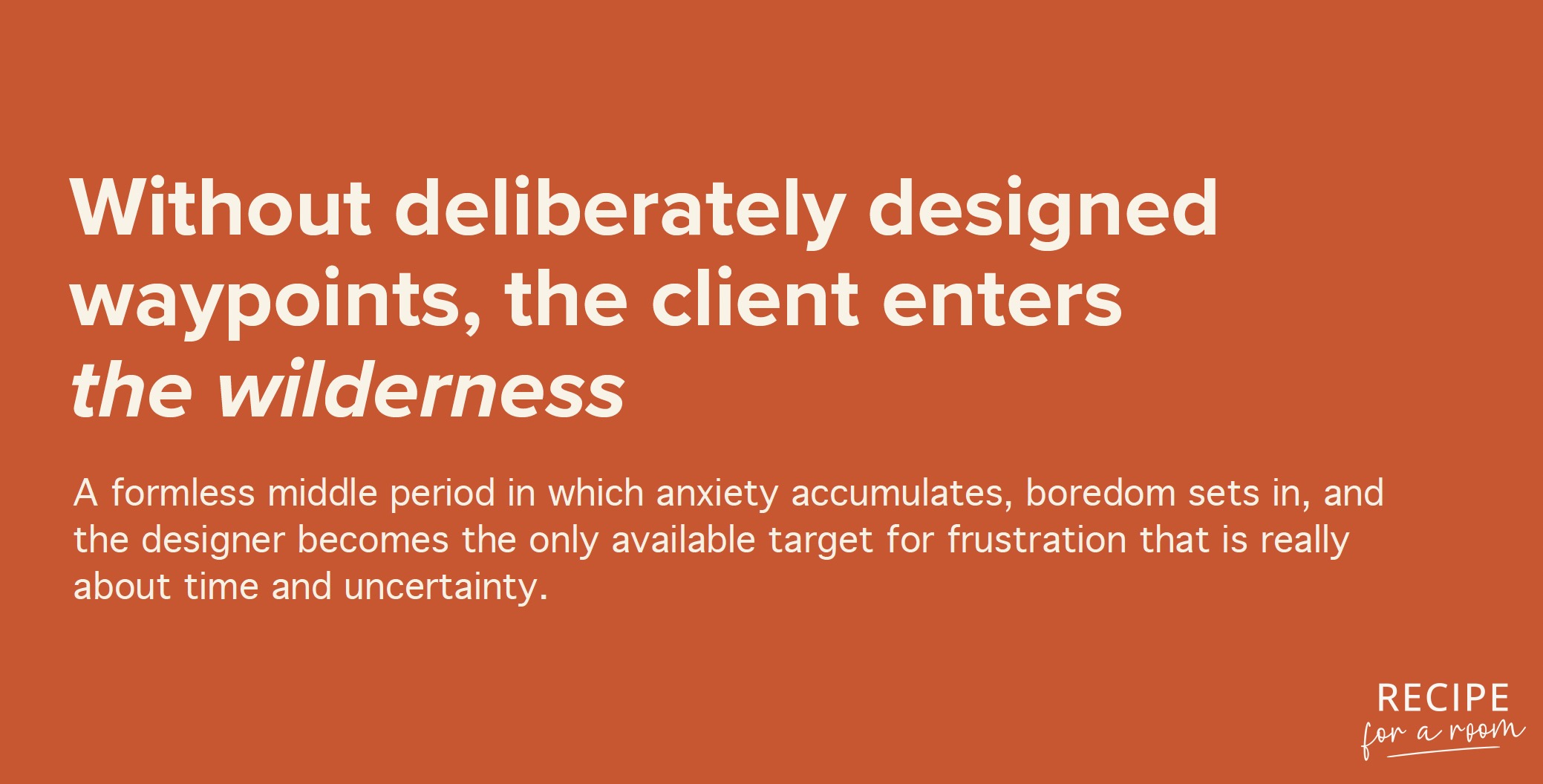
Waypoints, weekly updates at a consistent time, and active expectation management ahead of the 95% mark are the practical instruments.
The Peak-End Rule closes the loop: a client's lasting memory is shaped by the emotional peak of the project, and by how it ends. The handover is not administrative tidiness. It is the last significant act of client management - and it plays a role in whether that client refers you.
The full session is now on YouTube, along with Part I.
5. White Label Studio - Pre-Launch Closes Tuesday 30th June
Your Systems and Processes are not administrative detail. They are what a well-run practice looks like from the outside. They are your business.
White Label Studio is the complete operational system for a residential design studio: nine professionally designed, rebrandable client-facing document packs covering every stage of the residential project, supported by back-office templates, video instruction, and procurement management systems for both agent and principal models. Everything structured around RIBA stages and BIID best practice. You put your name on it and begin.
It launches in September. Until Tuesday 30 June, you can reserve your copy at £350 - £150 less than the full launch price of £500 from 1 July. This is not a deposit; it is the full pre-launch price, and it closes at midnight on Tuesday.
To be clear, the course is in development and will be delivered in September.
If the last two webinars have prompted you to think seriously about your systems, this is the logical next step.
Read more and reserve your place at £350 →
One further note: if you are considering joining the live run of Business in a Box in September - the hand-holding programme for designers who are ready to launch and want to do it properly - White Label Studio is included in your course materials. You do not need to purchase it separately.
6. Coming Up in Hothouse
Systems & Processes Part III - Procurement
Thursday 2 July, noon
Procurement is the operational heart of a residential project, a complex area of practice that needs tight control and robust systems behind it. This session extracts it from the wider workflow and gives it the dedicated attention it deserves - covering both the agent and principal models, and the documents and processes that keep a procurement programme on track.
Systems & Processes Part IV - AI in the Design Workflow
Tuesday 7 July, 11am
During the Systems and Processes series we identified a number of workflow stages where AI assistance is not only possible but genuinely useful. This session doubles back and looks at several of them in practice, using AI-generated fee proposals as a case study, setting up a Claude project to write your fee proposals for you.
This session is for designers who already use AI tools regularly. It is not an introduction to AI.
All links to join will be in the Hothouse group on Facebook.
7. My Week in Hothouse
It's end of Q2 and end of H1, so this week's entry doubles as a half-year account. As ever I’m shooting for radical ownership - absolute, unwavering responsibility for performance, as founder of my business.
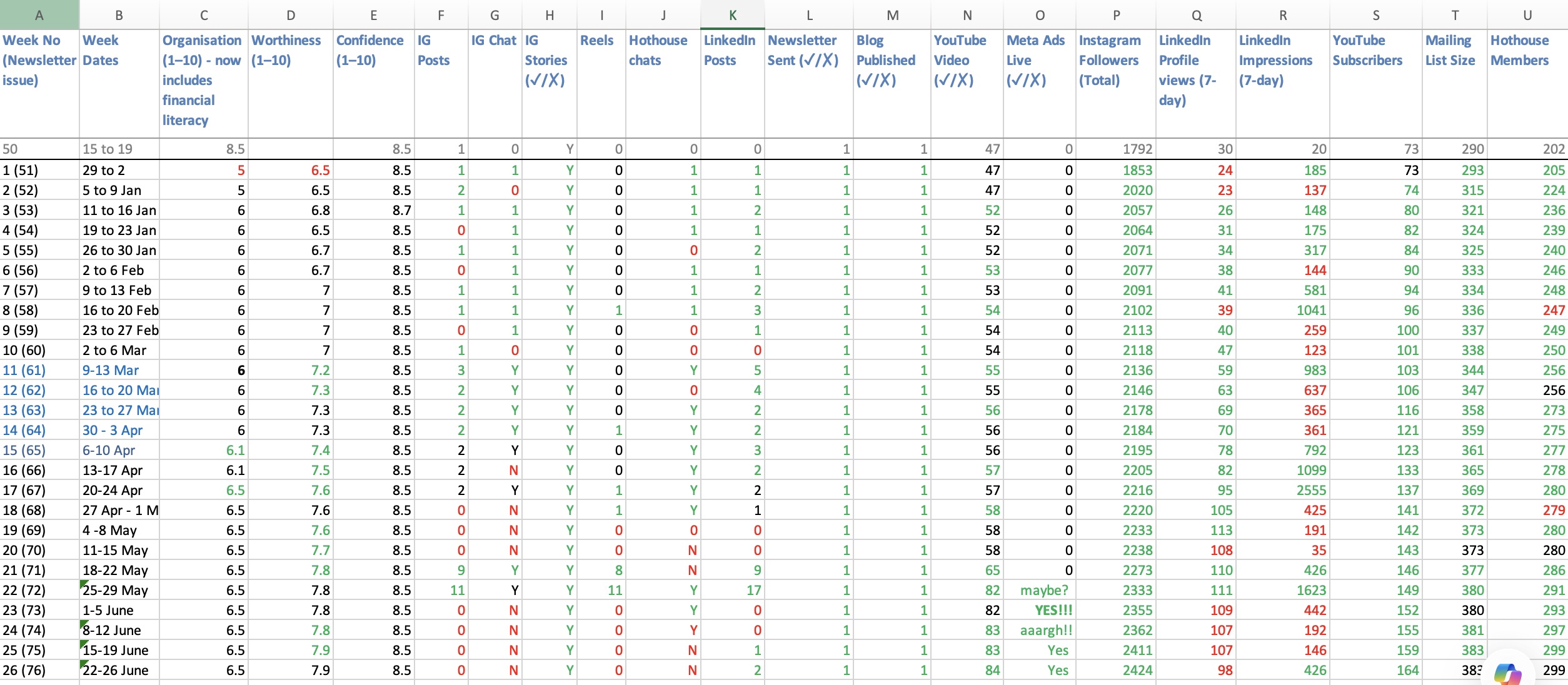
A snapshot - the headline numbers, week 50 2025 → week 25 2026:
- Hothouse members: 202 → 299 (+97)
- Instagram followers: 1,792 → 2,411 (+34.5%)
- Mailing list: 290 → 383 (+32.1%)
- YouTube subscribers: 73 → 159 (+118%)
- Newsletter published: 25/25
- Blog published: 25/25
The newsletter and blog figures are the ones I'm most pleased with, they held through the most difficult period of the year. This quarter has been genuinely hard.
The mailing list is the most important underperformance of H1. At 383 after eighteen months of this being my stated priority, the gap between intention and result is a failure. Meta Ads launched in week 23; the website overhaul is ahead. These are the right solutions, and they will happen - but they are late, and H2 needs to treat the mailing list with corresponding urgency.
In psychometric data (I track worthiness and confidence as internal conditions that either enable or inhibit business growth), worthiness has moved from 6.5 to 7.9 over 25 weeks: a slow, deliberate gradient, which is how we’d expect genuine change to show up - it is no longer a concern. Confidence has stayed flat at 8.5 all year. But above 8.5, each increment is exponentially tougher to hit. I need big business wins now to budge this number.
Website views are significantly down in the last few weeks. I'm intrigued - is this because I took my foot off the socials pedal? I have persuaded myself that, if I can prove this mechanism, it will be intelligence worth having suffered the losses to acquire. It also reminds me to crack on with the website work that will allow me richer data.
YouTube: 73 to 159 subscribers with zero active effort. The content library is good and growing as a by-product of other activities. It’s time to view this as the potential asset it is, I need to address this actively in H2.
You find me confronting the second half of the year, and inspired by my clients. I see their successes based on strategy, planning, action, accountability, consistency. We are a wonderful self-reinforcing community and - I hope you won't be offended, I include myself in this - our sum is greater than our parts.
FINAL THOUGHT
We started this issue with the difference between a home (and a business) that performs, and one that sustains. The performing version looks good. The sustaining version is built on something deeper: intention, structure, constructive use of time, and the discipline to return to reflect on performance, honestly, at regular intervals.
Q3 starts next week. A new quarter is a genuine reset - a structural opportunity to look at what the first half actually produced, decide what the second half is for, and build the cascade that will deliver it.
Join us in Hothouse to design it, declare it, deliver it.
Onwards and upwards,
Julia
Founder - Hothouse


Responses