
Nobody Misbehaves in a Well-Run Room
Mar 28, 2026A conversation has ignited across the interior design profession that is long overdue. The designer and advocate Alex Dauley has been making the case publicly that clients routinely underestimate the scope of what designers actually do - that they see colour choices and cushions where there is, in reality, structural decision-making, contractor management, and years of accumulated professional knowledge. She is right. But there is a question that sits behind that observation, and it is worth asking plainly: whose responsibility is it that clients don’t understand what they are buying?
Not the client's. They only know what they have been told or shown. If the profession has a perception problem, it is because the profession has a communication problem, and that problem does not begin with a difficult conversation about fees, or a tense moment in a presentation. It begins much earlier, runs through the entire client journey, and is rarely addressed systematically.
The answer is not necessarily more communication. Most designers already have all the touchpoints they need. What I’m advocating for is less onerous than adding to an already full workload: our job is to read what we already send, and what we already say, through the eyes of someone who does not yet understand what we do.
The map you already have
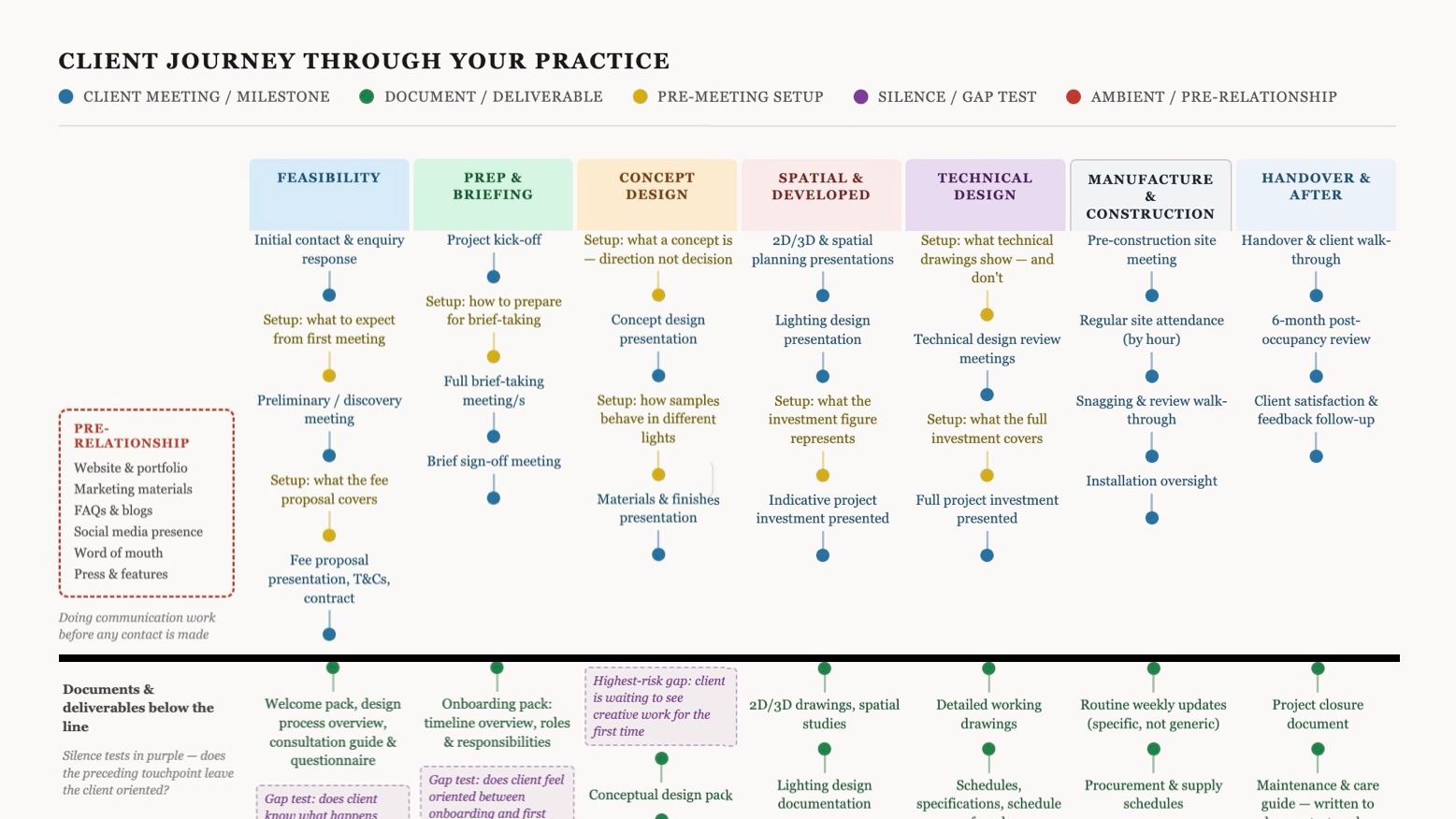
Every design practice has a client journey. A sequence of meetings, documents, presentations, and deliverables that carries a client from first contact through feasibility, briefing, concept, developed design, technical design, and into construction and handover.
Whether that journey has been mapped consciously or not (I strongly suggest the former), it exists, and at every point along it, communication is happening. In the meetings and documents themselves, in the gaps between them, and in the routine touchpoints that belong to no particular stage but run through all of them.
The audit I’m suggesting is not about adding to that map. It is about reading it honestly, through the eyes of a client who is intelligent and invested but largely unfamiliar with how a design practice works.
At every touchpoint, the question is simple:
Does this leave my client feeling located in the process, confident in my hands, and clear about what comes next?
If the answer is yes, move on. If the answer is no, it’s time to rework the touchpoint, from first principles, to ensure that in future it does its job completely.
The standard is not "have I communicated enough?" It is "does my client feel safe?" Safe to be excited. Safe to trust decisions they cannot fully evaluate. Clear enough about where they are that the inevitable silences in the process do not breed anxiety. That is the bar. It is a high one, but it is also a finite one.
What the silences are telling you
Clients do not sit waiting for the next email. They have jobs, families, and full lives, and a well-run project should occupy a proportion of their attention rather than dominate it. What they need is not constant contact. What they need is to feel, when they do think about the project, that they are in safe hands.
Silence between touchpoints is not, in itself, a problem. It becomes one only when the preceding touchpoint has left the client without sufficient orientation: when they don’t know where they are in the process, what is happening, or when they will next hear something. In that condition, silence feels like abandonment. The client begins to chase, to worry, to lose confidence in the designer's grip on the project.
If you aren’t in the habit of, for example, sending a weekly update email (regardless of whether anything has happened or not), perhaps you do need to insert more communication into the gap. An extra update, an interim email, another check-in. However, once your communications schedule is complete, gaps shouldn’t be a problem. At this point, the problem is most likely the touchpoint that preceded it: the meeting that ended without a clear statement of next steps, the document that was sent without context, the presentation that closed without telling the client what happens now. Fix that, and the silence takes care of itself.
The setup - the most neglected communication job in practice
Every high-stakes moment in the client journey has a communication job that belongs to the minutes just before it. Not a new document, not an additional meeting - often a single well-framed paragraph, spoken or written, that tells the client what they are about to see, what they are being asked to do with it, and what the designer has drawn on in creating it.
This sounds modest. Its effect is not.
I once presented a concept to a client who very specifically had asked for an all-white room. As I revealed the materials palette (including textural and tonal variation, some off-whites, warm whites, neutrals) she completely lost it, there were tears, shouting, foot-stamping. A whole meeting wasted, and - worse - a point where trust hung in the balance. A monochromatic scheme needs texture and tone in order to achieve drama, but she knew none of that when she walked in. She simply saw something different from what she had asked for, without the reasoning that made it the right answer, and she reacted accordingly. We rescheduled. I bought her a book - The White Room. We looked at the book together, and noticed how varied palettes in ‘all-white rooms’ actually are. She relaxed and approved the scheme.
The fix was not a different concept. It was a better opening to the meeting that was already scheduled - two minutes of context (of education, of demonstrating why they pay you the big bucks) before anything was shown, explaining what she was about to see and why. That is the whole intervention. Remembering that your client doesn’t know what you know, and won’t unless you tell them.
Investment presentations carry the same risk, and most designers are even less likely to set them up well, because they are anxious about them. This is precisely the problem. Anxiety about a difficult moment tends to produce avoidance of the very preparation that would defuse it.
When my mother was learning to drive, my father took her to an empty airfield to practise. In the middle of acres of tarmac there was a single brick. They both saw it. She locked onto it. As she set off directly towards it, my father wondered: would pass it to the left or the right, or aim to straddle it? She didn't. K'dunk. K'dunk. She drove straight over the brick.
The designer who approaches an investment presentation without setup, because the anxiety of the conversation has crowded out the preparation, tends to get the conversation they feared. The setup is not a new task. It is the existing meeting, addressed more roundly.
Writing the follow-up with intention
Most practices send some form of post-meeting follow-up. The question worth asking is what it is actually doing. A note that records decisions and confirms next steps is useful. A note that also reflects back what the designer understood - what the client said, what mattered to them, what shaped the thinking that will follow - does something considerably more: it tells the client they were heard.
With AI today, recording meetings (with client approval, and with clear protocols around privacy, storage, etc.) makes the production of meticulous and personal records both easy and speedy.
The brief for the project is the clearest example of this distinction. Almost every designer produces one. But how many write it as a document the client will read and recognise themselves in? A brief written as a technical internal record is a missed opportunity. The same information, written to show the client that their life, their priorities, and their particular anxieties informed every decision that follows, is one of the most powerful trust-building documents in the entire process. It costs nothing extra to produce. It requires only a shift in how it is written, and who it is written for.
One follow-up note written with genuine intention does more than several written on autopilot.
What everything else is saying
There is a category of communication that appears on no client journey map because it belongs across every item: the invoice; the out-of-office message; the email signature; the tone of the routine project update; how an unexpected call is handled. None of these might feel like communication strategy, but all of them are.
They are not opportunities to insert messaging. They are touchpoints that are already sending a message, and unless you are intentional here, that message may be quietly working against everything the formal communications are trying to establish. A practice whose proposals are warm, considered, and client-centred, but whose invoices are cold and transactional and whose routine updates read like admin, is telling two different stories about who it is. Clients may not consciously notice the dissonance, but they will feel it.
The audit question here is not "what should I add?" It is simply "is everything consistent and aligned with brand positioning?" Consistency is what makes a client feel they are dealing with a practice that has thought about them, not merely processed them.
The audit as a one-time investment
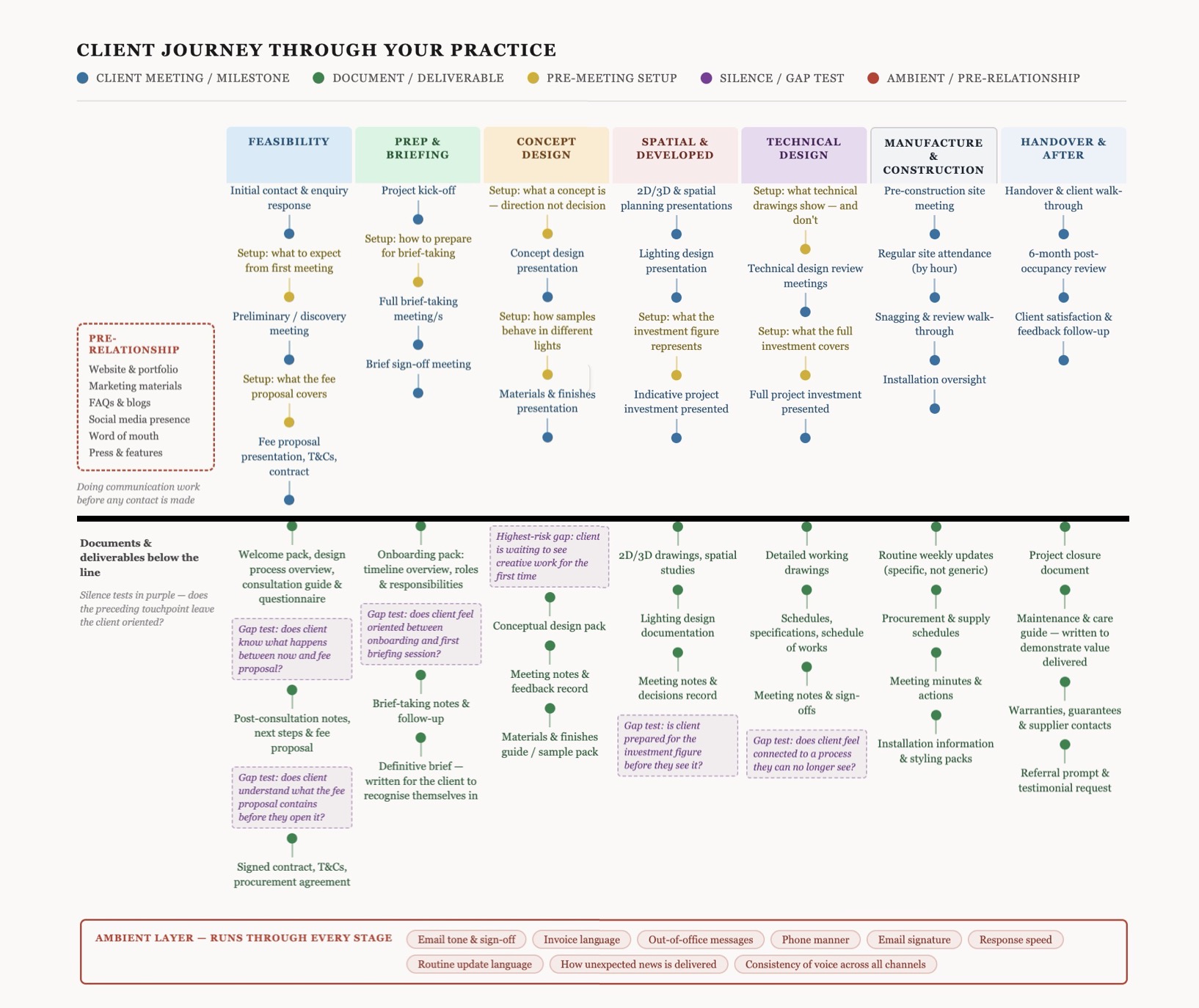
I think that every practice should review all client-facing comms at least every couple of years. This should be a single honest read of the practice as a client moves through it, followed by a small number of targeted adjustments to the touchpoints that are not yet doing their full job. Once those adjustments are in place, the system works, not because it has been made more elaborate, but because it has been made more intentional.
Coming back round to Alex Dauley's campaign. When a client fails to appreciate the scope of what you do, when they receive a presentation flatly, when they push back on your value or disengage from the process, the instinct is to look at them - at their taste, their budget anxiety, their difficulty. The more useful question is what they were given to work with before that moment arrived.
A client who feels genuinely held throughout a project, who has been oriented at every significant turn, who has never been left to decode a document alone or sit in a silence they did not understand - that client does not tend to behave badly. When they do, the client journey and the communications that run through it are the first place to look. Not as an act of self-criticism, but as a professional audit.
The map is already there. The question is: what has it been telling your clients along the way?
Receive my quick-to-read weekly newsletter...
Sign up for the Hothouse Newsletter: find out what's coming up, and keep up with recent webinars, blogposts, videos, and other events - all focused on excellence in interior design practice.
We hate SPAM. We will never sell your information, for any reason.
