
The Five New Year’s Gifts I’d Give My Interior Design Business (And Why They Matter)
Jan 10, 2026January has a particular kind of electricity, doesn’t it. A clean page. A quiet desk. That rare moment when you can see your business as a whole, rather than as a stream of incoming emails and half-finished decisions.
Most interior designers do not lack talent, taste, or work ethic. What they lack is a small handful of boring, powerful foundations that make everything else feel lighter: enquiries that do not fall through the cracks, marketing that keeps working when you are deep in a project, pricing that does not leak profit, and a simple rhythm that stops you running the studio on adrenaline.
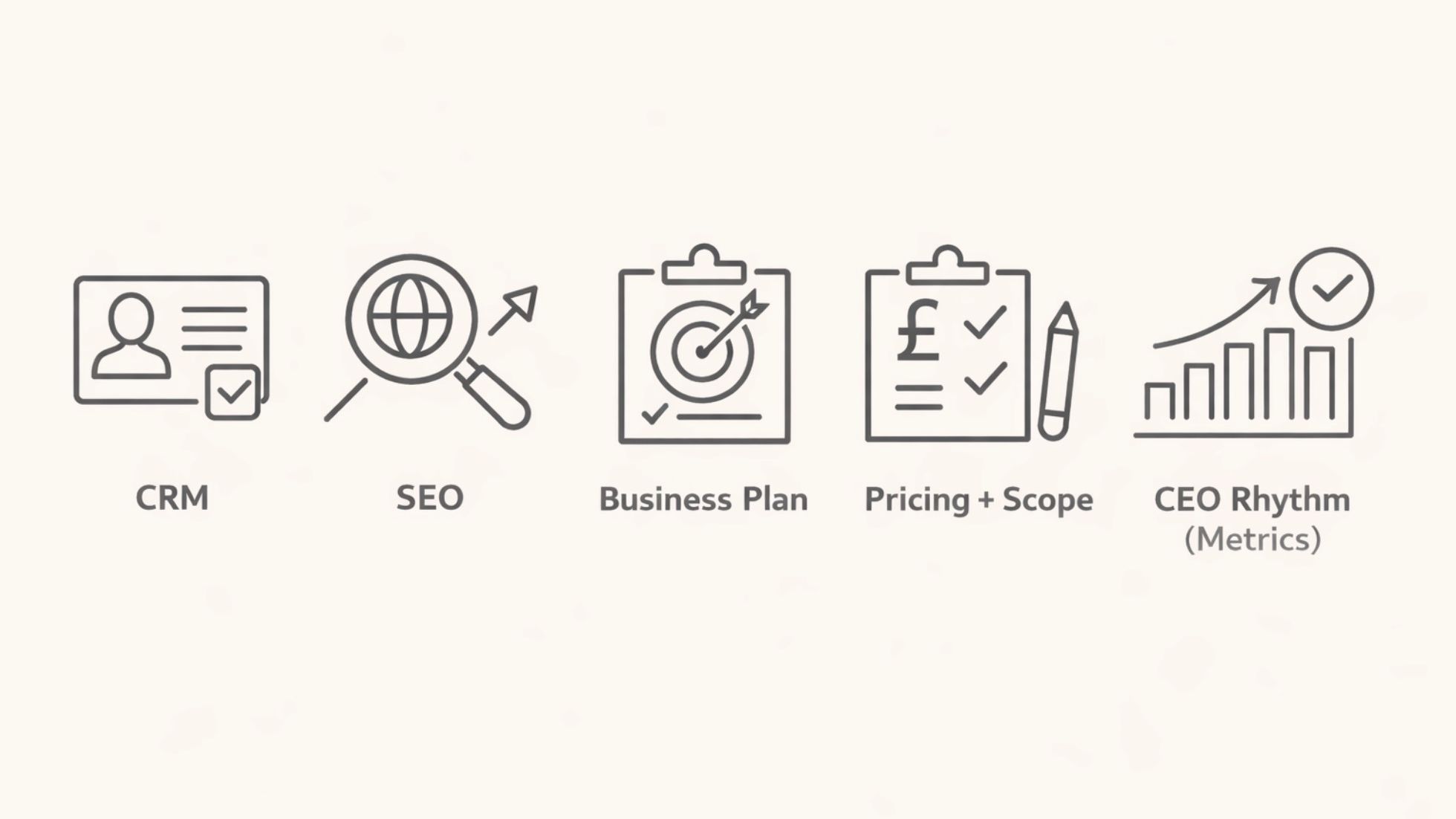
So, if I could give my interior design business five New Year’s gifts, they would not be a rebrand, a new logo, or a new planner. They would be these five practical upgrades, each one designed to buy back time, protect margin, and make growth feel less like guesswork and more like a system.
1) CRM
A CRM is the gift of certainty. It turns your pipeline from a vague hope into a visible, trackable set of relationships, and it stops warm leads quietly evaporating because you got busy. With a simple system (who they are, what they want, where they came from, what happens next, and when you’ll follow up), you create consistency: follow-ups happen on time, referrals get nurtured properly, and you can forecast work instead of waiting for it. Any business benefits because a CRM replaces “memory and good intentions” with a repeatable process that protects revenue.
NOTE (Advanced) eventually you’ll want to study your conversion rates - the percentage of clients who follow through and book your services - versus those you lose at specific points in the pipeline. The headings suggested below will allow you to harvest this data later, when you’re ready to put your business under a performance microscope. It’s so frustrating to get to a point in your business when you need data but haven’t been in the habit of collecting it.
CRM: how to set one up (without making it a “project”)
Goal: never lose a warm lead again.
- Choose one place to hold it all (Kajabi contacts, Airtable, Notion, HubSpot, even a Google Sheet or Excel or Numbers spreadsheet). One is enough.
- Create 6 simple stages: New lead → Discovery booked → Proposal sent → Won (active) → Nurture (later) → Lost.
- Add four fields you’ll actually use: lead source, project type, budget band, next action date.
- Make a follow-up cadence: 2 days after enquiry, 7 days after proposal, 30 days nurture, then quarterly check-ins.
- Build three templates: enquiry reply, “proposal follow-up”, “just checking in”.
- Weekly habit (10 mins): move leads along stages, set next action dates, send the follow-ups that are due.
- If you do only one thing: every contact gets a next action date. That’s the whole magic.
If you’d like to read more about CRM, I blogged about it here.
2) SEO
SEO is the gift of being found while you sleep. Social media is rented attention; SEO is an asset. When your website answers the questions your ideal clients are already typing into Google, you attract better-fit enquiries, with less chasing and less selling. Even modest SEO improvements compound: clearer service pages, useful blog posts, good headings, and strong local signals can quietly increase the quality of your leads over months. Any business benefits because SEO builds a steady stream of inbound interest that doesn’t depend on you showing up every day with fresh content.
Most interior designers head to Instagram for visibility, however, over time and if you do it right, your website will become the engine for generating client leads. I see this with my most successful clients.
SEO: how to get traction with the least effort
Goal: be found by people already searching for what you do - and be trusted enough to be cited and chosen.
- Start with your service pages (not your blog): clear pages for each offer (Full Service, Renovation, Decoration, Online Design) with “from” investment (for tiers 1 and 2, and probably 3 as well - read about my tiers here), typical timelines, and who it’s for.
- Write for intent, not just keywords: use the phrases clients type, but make the page answer the next questions a serious buyer has. Google AI understands your writing and doesn’t need keywords, it can judge the quality of your writing too and rewards rich content.
- Add ‘How it works’ + proof: steps, timeline, who it’s for, FAQs plus mini case studies / examples and a named author/credentials line (real experience signals).
- Create 3 “money pages”: Home, Services, Contact — with strong CTAs (calls to action - ie suggested next steps, e.g. “Book a discovery call”), and a lead-capture option (because not every search click will happen now).
- Add 5 FAQs that match real enquiries: budget, timescales, trades, procurement, fees.
- Pick 6 blog posts for the year: make them decision-support and case-study led (less generic, more you). Google rewards helpful content; AI-written is fine if it’s genuinely useful and accurate.
- Local SEO quick win: fully complete your Google Business Profile, keep it accurate, add photos, and ask your clients for reviews - make this super easy with links, etc.
- Make sure you can access analytics and keep a monthly record of page views, time spent on your website, and so on, watch your visibility grow.
- If you do only one thing: improve and expand your service pages before you write more blog posts.
3) A business plan
A business plan is the gift of direction. Not a 40-page document to impress nobody, but a crisp set of decisions: who you serve, what you sell, what you will not do, how you’ll price it, and what you’ll prioritise this quarter. It helps you say no faster, market more coherently, and spot when you’re drifting into distractions that feel productive but don’t pay. Any business benefits because a plan reduces noise, aligns effort, and gives you a yardstick for whether today’s work is actually moving you towards your target.
A business plan: how to write a useful one-page version
Goal: make clear decisions, then act on them.
- Write your ‘who’: ideal client (life stage, home type, location, values, budget reality).
- Write your ‘what’: your three core services (keep it tight), plus what you’re not offering this year.
- Write your ‘why you’: 3 proof points (experience, specialism, results, process).
- Set 3 targets for the year: revenue, average project fee, leads per month (or conversion rate).
- Choose 3 priorities for the next 90 days (e.g., pipeline, pricing, operations).
- Decide the marketing rhythm: one main channel + one support channel, and one weekly output (blog/email/post).
- Add a “stop doing” list: the distractions you will politely drop.
- If you do only one thing: pick 3 priorities for the next 90 days and measure them weekly.
All my live courses include business planning - a business plan is the foundation that answers all the questions that designers typically present with. I recommend using AI to speed up the process (and make it more creative, and more fun) you’ll find a worksheet on how to do this under the “Files” tab at the top of the Hothouse group. It’s towards the bottom of the list and is called “Using AI in Business Planning”.
4) A pricing + scope system
A pricing and scope system is the gift of profit protection. It stops the slow bleed of unpaid labour that happens when boundaries are fuzzy, deliverables aren’t defined, and “just one more thing” becomes the culture of the project. When you package your process into phases, price with intention, and make inclusions/exclusions and variations explicit, clients relax (because they know what they’re buying) and you relax (because you can manage time and money with confidence). Any business benefits because clear scope and pricing turn good work into sustainable work.
Pricing + scope system: how to protect your time and profit
Goal: stop “scope creep” quietly eating your margins.
- Package your process into phases (e.g., Discovery, Concept, Design Development, Procurement, Installation).
- For each phase, list deliverables in plain English (what the client receives).
- Write inclusions and exclusions (this is where profit is saved): number of concepts, revisions, site visits, shopping days, drawings, meetings.
- Create a variations policy: what triggers a variation, how you price it, and how it gets approved (always in writing).
- Choose a pricing method you can repeat: fixed fee per phase, with a clear payment schedule (often monthly retainers for cashflow).
- Build a “scope boundary script” for polite firmness: “Happy to do that; it falls outside the agreed scope so I’ll send a variation for approval.”
- Update your proposal template so every project starts with the same structure.
- If you do only one thing: define the number of revisions and what counts as a variation.
I highly recommend my self-directed course on Fees and Charging - which also tells you how to prepare and present your fee proposal. It’s inexpensive, content rich, created specifically for residential interior designers, and available here.
5) A weekly CEO rhythm (time + metrics)
A weekly CEO rhythm is the gift of staying in control. One protected hour a week to review your numbers (enquiries, conversions, cashflow, workload, marketing activity) and set the next most important actions keeps you out of reactive mode. It’s how you catch problems early, make small corrections instead of dramatic pivots, and build the muscle of consistency. Any business benefits because what gets reviewed gets improved — and a short, regular rhythm beats occasional “big overhauls” every time.
Weekly CEO rhythm: how to run your business in one focused hour
Goal: stay on top of the numbers and make better decisions faster.
- Pick a fixed slot (e.g., Monday 9:00–10:00) and protect it like a client meeting.
- Track just 8 numbers: enquiries, discovery calls booked, proposals sent, proposals won, cash in, cash out, workload capacity, one visibility metric (emails sent/posts published).
- Do a quick pipeline review: who needs follow-up, what’s next for each lead.
- Choose your “Top 3” actions for the week that move revenue or visibility (not busywork).
- Schedule those actions immediately into your diary.
- End with a decision: what you will not do this week.
- If you do only one thing: book the hour and keep the same dashboard each week so you can spot patterns.
If you take nothing else from this, let it be this: you don’t need a reinvention to make 2026 work. You need a handful of boring, powerful foundations that make the whole machine run more smoothly, week after week.
If you’d like help putting them in place, come and join me for my free Hothouse 2026 Planning Event, running 12–16 January 2026 live online, one focused hour a day. By Friday you’ll have a clear direction for the year and a sketch plan you can actually use, built on the firmest foundations, not wishful thinking.
Access via the Hothouse group - join here!
Receive my quick-to-read weekly newsletter...
Sign up for the Hothouse Newsletter: find out what's coming up, and keep up with recent webinars, blogposts, videos, and other events - all focused on excellence in interior design practice.
We hate SPAM. We will never sell your information, for any reason.
