

Founder Presence: Designing the "You" Your Business Needs
Jan 24, 2026When you first start a business, you don’t yet know your own shape.
You may have a clear sense of your values, your skills, and the kind of work you want to do, but the public version of you – the one who stands at the front of the business – often takes longer to emerge. Most founders learn who they are in public through trial and error: trying on styles, tones, and modes of communication that feel adjacent, aspirational, or borrowed from people they admire.
I certainly did.
When I started out I tried on different personas because I wasn't clear on my own identity. Those early experiments are still at the bottom of my grid - I leave them there because (in my case) I think it's useful to see the arc of business development.
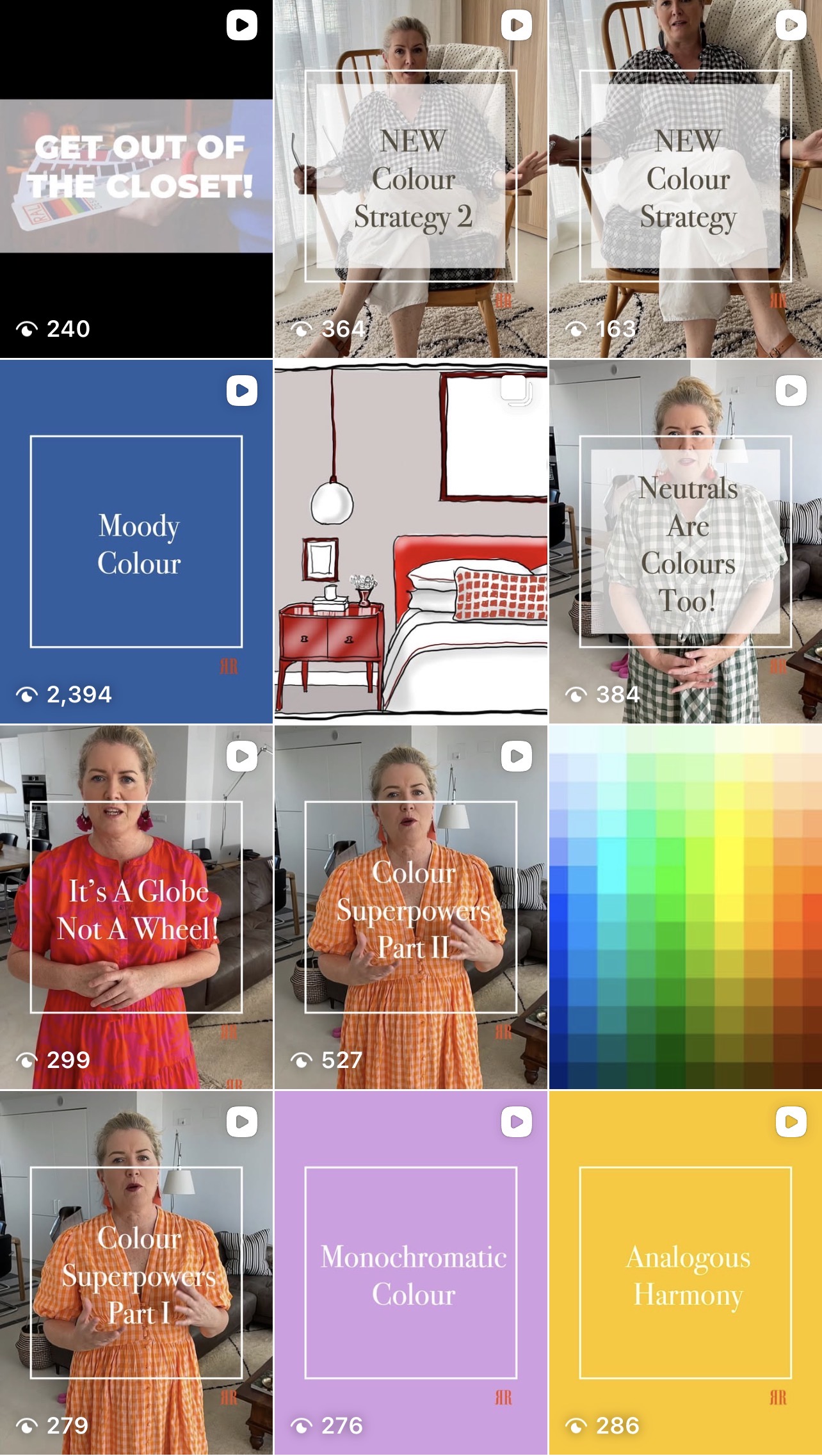
Some of those early versions felt promising. Others felt awkward, performative, or simply not quite right. Over time, with experience, feedback, and a deeper understanding of both the market and myself, a more settled presence emerged. I arrived, slowly, at a version of me that is a better fit for the role I need to play.
But it didn’t have to take that long.
Increasingly, in my work with established designers, I’ve come to see founder presence not as something you find, but something you can design intentionally - upfront - rather than discovering it by accident years down the line.
Founder presence is not personality, and it’s not ego
When people hear “founder presence” they often assume this is about confidence, charisma, or personal branding. Or worse, that it’s about becoming louder, more visible, or more self-promotional.
That’s not what I mean at all.
Founder presence is not about showing more of yourself.
It’s about designing the instrument through which your business expresses itself.
Your business has a voice, a temperament, and a way of moving in the world. As the founder, you are the primary conduit for that expression. The question is not “how do I show up more?”, but:
Who does my business need me to be, in order to do its work well?
This reframing matters because it moves the work out of the personal and into the professional. It becomes less about self-expression and more about stewardship.
The relief of thinking in the third person
One of the most striking responses I hear when working with designers on founder presence is relief.
Many describe how freeing it feels to think about “the founder” in the third person - almost as an alter ego - rather than as their whole, private self. This subtle shift creates distance. It reduces self-consciousness. It removes the sense that visibility is arrogant or self-indulgent.
Instead of asking:
“Am I being too much?”
they begin to ask:
“Is this aligned with the role my business needs me to play?”
That distinction is powerful.
It allows founders to be authentic without being exposed, confident without being performative, visible without being exhausting. Presence becomes something you step into, not something you bleed into.
Shortening the trust gap
There is always a time lag between putting your marketing out into the world and your business benefiting from it.
I often refer to this as the trust gap: the period it takes for people to move from noticing you, to feeling a sense of familiarity, to trusting you enough to buy, enquire, or recommend. No amount of clever messaging can eliminate that gap entirely. Trust takes time.
But founder presence can compress it.
When people see and hear the same founder, showing up in a consistent, grounded way, week after week, something subtle happens. A parasocial relationship forms. Viewers begin to feel as though they know you. They understand your values. They can predict how you’ll respond to certain situations. You become familiar, and familiarity breeds safety.
In practical terms, this means that when someone finally reaches out, the conversation starts further along the line. The ground is warmer. The trust gap is shorter.
This is not about manipulation. It’s about coherence.
Distinction in a homogenous market
The interior design market is crowded, and much of the language used within it is increasingly generic. Many designers offer similar services, described in similar terms, using similar visual cues. From the outside, it can be hard to tell one practice from another.
Founder presence is one of the few elements that cannot be easily replicated.
When designed with intention, it gives your business flavour (which, of course, must align with your business brand). Not in a loud or gimmicky way, but in a way that makes you feel distinct and recognisable. People may not remember every detail of what you said, but they remember how you made them feel: steadier, clearer, more confident about their next step.
In a noisy market, this kind of quiet differentiation is powerful.
The competitive landscape is changing fast
Increasingly, founders are not just competing with peers, but with digital services, AI-assisted platforms, and a growing number of technically competent but indistinct operators who can offer something quicker or cheaper. In that environment, your founder presence becomes the moat around your business.
An authentic, magnetic presence cannot be automated or undercut, and it gives clients a reason to choose you when alternatives abound. It’s not about being louder or more visible; it’s about being recognisable, trustworthy, and human in a way no system or shortcut can replicate.
What you don't say matters too
A client said something to me recently that I found both honest and illuminating. She told me she doesn’t want to hear that I’ve had a bad day, or that I’m feeling low or struggling. She prefers to think of me as someone who can always sort things out - someone steady, in control, able to see clearly when others can’t. And she was quite clear that if I broke that illusion, it might damage how safe she felt with me.
I don’t think this is about founders pretending to be superhuman. It’s about understanding the role you’re playing. Some designers wear their heart on their sleeve, have no off-limits, private thoughts. Others maintain a degree of formality and distance. This needs to be intentional as it will filter the clients who step forwards. Your client base is a self-selecting group attracted (or repelled) by the overt and subliminal messages you transmit.
When you design your founder presence intentionally, you also decide the things that version of you would never say publicly. That often means editing yourself as a whole person - not because those parts aren’t real or valid, but because they belong elsewhere. Restraint, in this context, isn’t inauthentic. It’s a form of care.
Founder Presence - Core Attributes to Resolve
1. Role Function - What job does the founder presence perform for the business?
2. Emotional Signature - What emotional state does the founder reliably transmit?
3. Authority Type - What kind of authority does the founder embody?
4. Distance & Boundary - How close does the founder stand to the audience?
5. Voice & Language Register - How does the founder speak?
6. Pacing & Energy - How quickly does the founder move, speak, decide, respond?
7. Visibility Cadence - How often does the founder appear, and in what form?
8. Visual Expression - What visual signals reinforce the role?
9. Relationship to Vulnerability - How is vulnerability used, if at all?
10. Relationship to Opinion - How strongly does the founder take positions?
11. Scope of Commentary - What does the founder comment on, and what do they ignore?
12. Promise of Proximity - What happens to someone who stays near this founder over time?
13. Founder–Self Boundary - What parts of the private self are not used by the business?
14. Consistency Rules - What must remain consistent no matter the platform or mood?
15. Evolution Path - How is this presence allowed to mature over time?
Why this matters?
When these attributes are unresolved, founders experience:
• discomfort with visibility
• exhaustion
• inconsistency
• fear of “getting it wrong”
• a sense of being on display rather than in role
When they are resolved, visibility becomes:
• calmer
• easier
• repeatable
• less personal
• more effective
The founder stops performing and starts inhabiting.
Designing the version of you you’d otherwise arrive at slowly
Given enough time, most founders eventually settle into a presence that fits them and their business. It’s shaped by experience, mistakes, confidence gained, and confidence lost. The work I’m increasingly drawn to is helping designers design that presence deliberately, getting there faster, rather than stumbling towards it.
This is not about inventing a new persona. It’s about editing, refining, and aligning the version of you that steps forward as the face of the business - so that it serves both you and the work you’re trying to do.
Founder presence, done well, doesn’t add pressure. It removes it.
And in a world that already asks founders to do far too much, that matters.
📍Founder presence is the Hothouse theme for February.
🗓️ Session One: 10am Tuesday 3rd February
🗓️ Session Two: 10am Tuesday 17th February
Receive my quick-to-read weekly newsletter...
Sign up for the Hothouse Newsletter: find out what's coming up, and keep up with recent webinars, blogposts, videos, and other events - all focused on excellence in interior design practice.
We hate SPAM. We will never sell your information, for any reason.
