Business Planning Is A Sexy Superpower!
Jan 17, 2026Most interior designers don’t resist planning because they’re disorganised.
They resist it because planning has been sold to them as something rigid, corporate, or joyless - a kind of spreadsheet-driven straightjacket that ignores the reality of creative work, human clients, and fluctuating energy.
And yet, the designers who appear most free (creatively confident, commercially grounded, and calm under pressure) almost always have one thing in common:
They are intentional.
They aren't frantic, reactive, guessing their way forward - they are intentional!
Over the past week in Hothouse, I’ve been guiding designers through a different way of thinking about planning, one that doesn’t ask you to predict the future or finish a perfect document, but instead helps you build a business that grows on purpose.
What follows is not a checklist.
It’s a philosophy, and a simple method you can return to year after year.
The First Shift: From Designer to CEO
The most important shift is not tactical. It’s psychological.
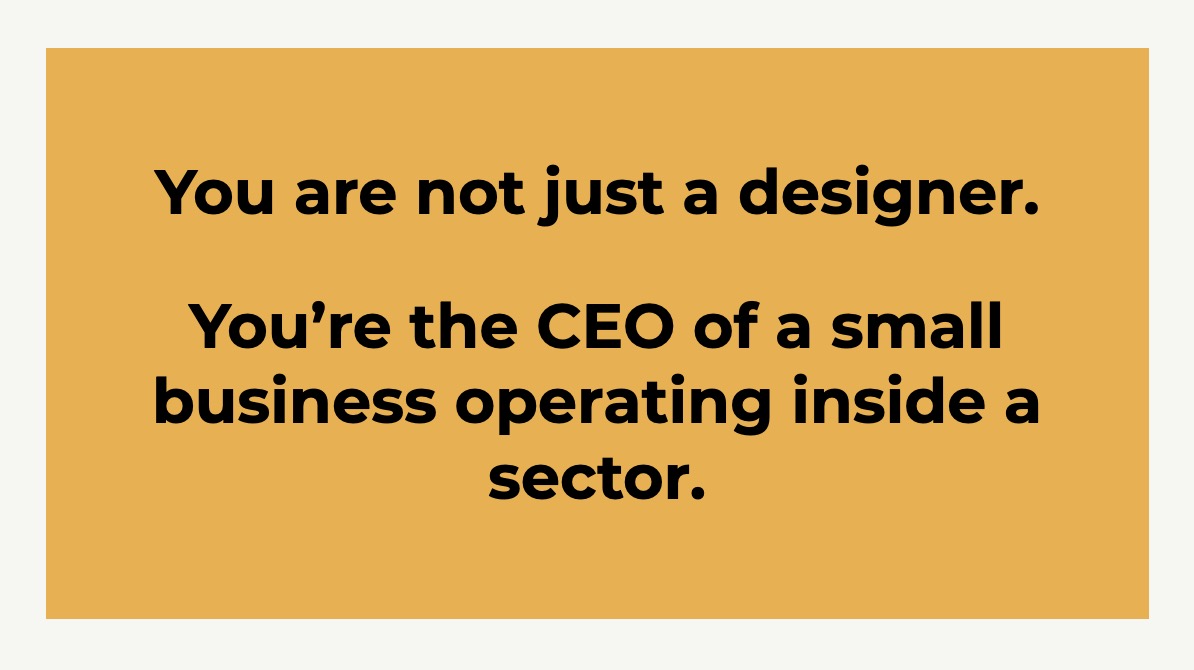
At some point, every interior designer who wants a sustainable practice has to stop thinking of themselves solely as a creative professional, and start thinking like the CEO of a small business operating in a specific economic sector.
That doesn’t mean becoming cold or commercial.
It means recognising that management quality matters. In buoyant times, many businesses survive on talent alone. In tougher climates, it’s the best-managed businesses that endure.
This is why planning isn’t about ambition - it’s about survival and stewardship.
Foundations Come Before Strategy
Before you decide what to sell, how to market, or how much you want to earn, there are two quieter questions that do most of the heavy lifting:
What do I value?
What am I moving towards?
Your governing values are not aspirational words for a website footer. They are the internal rules that determine what you say yes to, what drains you, and what quietly undermines your confidence. I’ve blogged about this here before.
When values are clear, decision-making becomes lighter.
When they are vague, everything feels harder than it needs to be.
Life looks a lot easier, calmer, in the values-led practices I work with. Values-led designers know their north star, and stick to plans long enough for them to come to fruition.
Vision works differently. It isn’t a promise. It’s a normalisation exercise.
By allowing yourself to imagine a larger, calmer, more confident version of your business, you reduce the shock when progress actually arrives. Success stops feeling destabilising, and starts feeling familiar, it becomes less likely that you’ll ‘choke’ or self-sabotage. I have also blogged about vision boards, read it here.
Not Every Business Is at the Same Stage (and That’s Fine)
One of the most liberating realisations for designers is this:
Not all advice is meant for you yet.
A start-up business does not need the same systems, services, or visibility strategy as a mature practice, and applying them too early can be actively harmful. Likewise, in order to soar, a mature business stepping up in visibility and exclusivity needs to jettison some of the messaging that served it well at tier three.
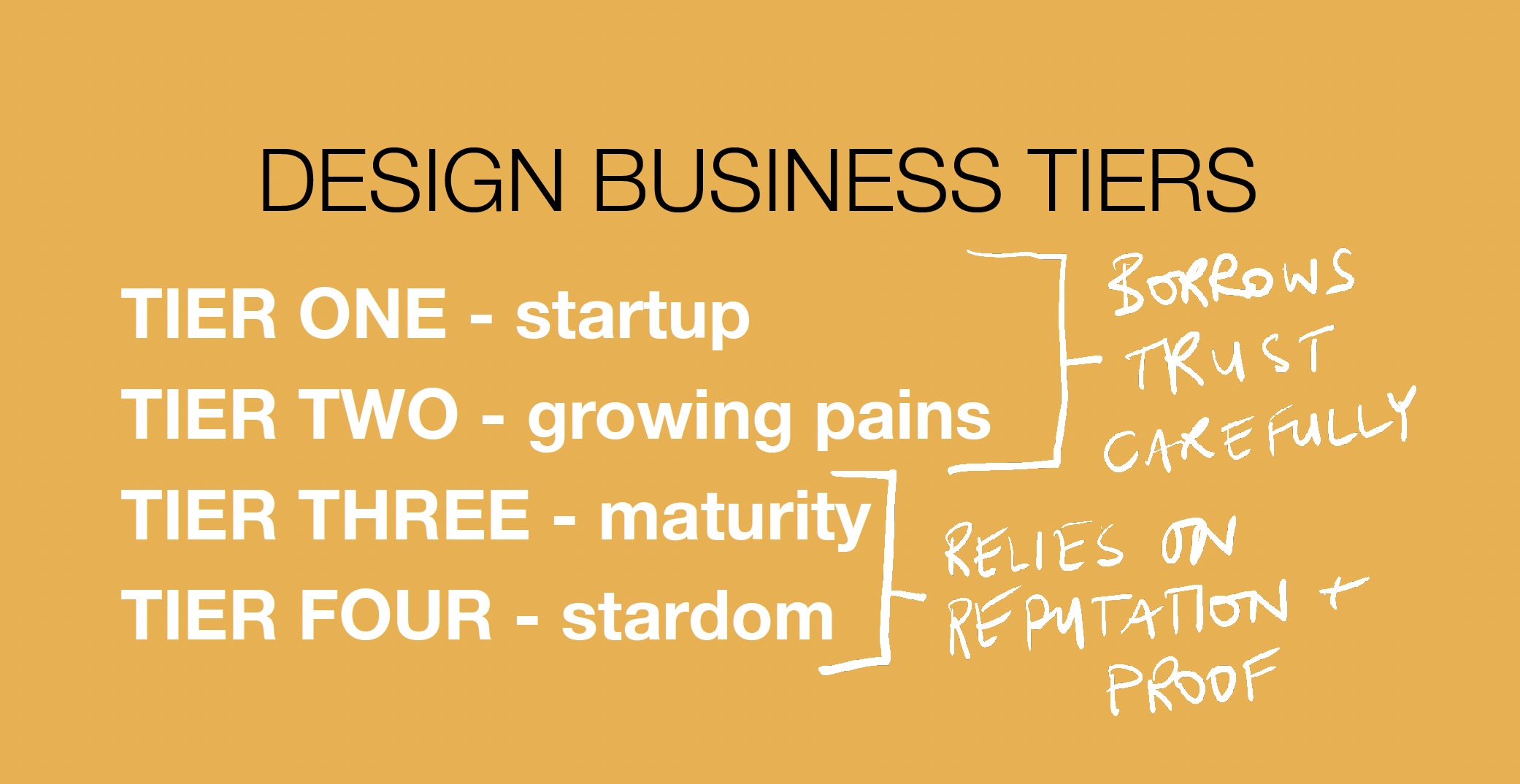
Interior design businesses tend to move through recognisable stages:
- Tier One - startup - tentative beginnings
- Tier Two - growing pains - outward competence with internal chaos
- Tier Three - maturity - an experienced and enviable business
- Tier Four - stardom - visible authority and renown
Here’s a longer article on stages of development within an interior design practice.
Planning works best when it respects where you are now, rather than where you think you “should” be.
A simple plan that matches your current capacity will outperform an over-engineered plan abandoned by March, every time.
Designing the Business Around the Client (Not the Other Way Round)
Many designers create services based on what they enjoy doing, or what they’ve seen others offer. What we expect an interior design practice to offer.
But the market varies enormously from one location to another: a more resilient approach is to start with the client.
Who are you best placed to serve at this stage?
What are they anxious about?
Where do they feel stuck, overwhelmed, or uncertain?
For most clients, interior design is a high-trust, high-emotion purchase. Trust must be earned in stages.
This is why well-designed businesses often have a gentle ramp: low-risk ways for clients to experience your thinking before committing to larger projects.
As trust grows, services can evolve up the value chain. But trying to skip steps usually creates resistance, from clients and from you.
A new practice needs ‘low risk’ services that clients are happy to gamble on before trust (aided by portfolio, testimonials, experience) is fully earned.
Money Stops Being Scary When It Has Shape
Money is stressful when it is abstract.
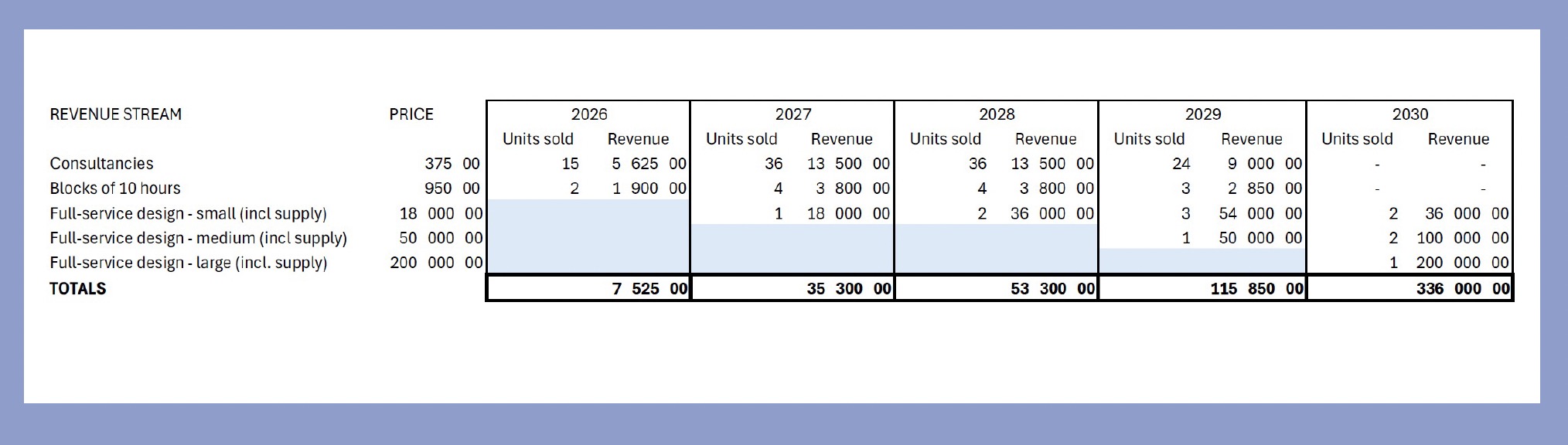
Planning doesn’t require certainty, only shape.
When designers sketch out how income might flow over time (when they take a moment to forecast the revenues they want each of our services to generate each year), something important happens: they realise growth is rarely random. If you plan for it, you're more likely to make it happen.
When we design our businesses, forecast our sales, engage our marketing, and measure the outcomes, we predispose our business to greater success.
Tracking a small number of meaningful metrics (enquiries, revenue, pipeline visibility, even confidence) turns the business from an emotional rollercoaster into something knowable and navigable.
Not controlled.
Navigable.
Marketing Is Not Noise. It’s Trust in Motion.
Marketing becomes exhausting when it’s disconnected from planning. There are no answers to your marketing questions.
Seen properly, marketing is simply the visible expression of what you already believe about design, quality, and service.
Trust builds through consistency, not novelty. Every unnecessary pivot resets the clock.
This is why it helps to think in modes:
- maintenance mode, when work is plentiful
- growth mode, when visibility needs deliberate investment of time and money
Founder presence matters here more than ever. In a world of automation and AI-generated sameness, your thinking, your judgement, and your humanity are not optional extras. They are competitive advantages. They are the moat around your business.
The Point of Planning Is Not the Plan
Here is the quiet truth: the value of planning is not the document, tt is the way of thinking it installs.
A good plan:
- fits on one page
- can be explained simply
- evolves without drama
It gives you something to return to when confidence wobbles, when ideas multiply, or when everything suddenly feels urgent. Small, intentional steps compound, and sophistication can be layered later.
A Final Thought
If this way of planning feels unfamiliar, that’s a good sign.
It means you are learning to see your business differently, with more distance, more authority, and more self-trust.
Planning, done well, doesn’t restrict creativity - it protects it.
The whole Hothouse 2026 Planning Event (all five sessions) is now free on YouTube.
Receive my quick-to-read weekly newsletter...
Sign up for the Hothouse Newsletter: find out what's coming up, and keep up with recent webinars, blogposts, videos, and other events - all focused on excellence in interior design practice.
We hate SPAM. We will never sell your information, for any reason.
