

Not More. Different. Why Everything You Think You Know About Selling May Be Working Against You
Apr 04, 2026There is a version of sales training that has been refined over decades into something close to a science. It has its frameworks (AIDA, SPIN, Challenger Selling) its metrics, its funnels, its conversion rates. It is built on a coherent theory of human behaviour:
- that people need to be persuaded
- that objections need to be handled
- that momentum needs to be created and maintained before the prospect has time to think themselves out of a decision
AIDA is the oldest, dating to the late 19th century. It describes the stages a buyer moves through: Attention, Interest, Desire, Action. The salesperson's job is to move the prospect along this sequence deliberately: catching their attention first, building interest through information, converting interest into desire through emotional appeal, and then closing. It is essentially a funnel, and it underpins most marketing thinking as well as sales.
SPIN Selling was developed by Neil Rackham in the 1980s from a large-scale study of what distinguished successful salespeople in complex, higher-value transactions. The acronym stands for Situation, Problem, Implication, Need-Payoff. The technique involves:
- asking the prospect a structured sequence of questions
- establishing their current situation
- identifying problems within it
- drawing out the implications of those problems, making the pain feel real and urgent
- surfacing the need for a solution in a way that makes the payoff obvious
The idea is that the prospect persuades themselves through the logic of their own answers.
Challenger Selling is the most recent of the three, emerging from research published in 2011. It argues, counterintuitively, that the most effective salespeople are not the ones who build warm relationships, they are the ones who challenge the client's thinking. A Challenger teaches the client something they did not know about their own situation, tailors that insight to what the client cares about, and then takes control of the conversation to drive towards a decision. It was a deliberate corrective to the over-emphasis on relationship-building, arguing that likability without insight does not close deals.
All three share a common assumption: the salesperson's role is an active, strategic one. They are working on the prospect, shaping perception, creating urgency, guiding the conversation towards a conclusion. This theory works. At a particular level of the market, it works very well indeed.
But psychology is different at the top. Strategic persuasion can be a mistake there. The techniques that help you win at one tier of the market will quietly repel clients at another. This is not a matter of degree; it is a threshold. Cross it without understanding what has changed, and you will find yourself working harder, pitching more carefully, following up more diligently, and losing more consistently than you did when your practice was younger and your clients less wealthy.
The answer is not to sell better. It is to unlearn first.
Why the rules change
High-net-worth and ultra-high-net-worth clients (broadly, those with investable assets of £10 million or more) do not have the same relationship with money that the standard sales process assumes. The standard process is designed around a client who is weighing cost against perceived value, who can be moved by a well-structured proposal or a timely discount, who experiences some degree of financial anxiety in the transaction.
The ultra-wealthy have a different set of concerns entirely. They are not worried about cost.
They are worried about:
- time
- discretion
- identity
- trust
They want to feel that they have found someone rare: a person of sufficient calibre to enter their environment, to understand them without being told everything, and to deliver something that could not have been produced by anyone else.
What they are acutely sensitive to (and will not necessarily tell you) is the smell of effort. Visible salesmanship reads, at this level, as a signal that you need the deal more than they need you. The harder you push, the further they move.
This is the paradox you have to sit with before anything else makes sense.
A different model
If conventional sales is built around persuasion, luxury sales is built around a psychological journey, one that unfolds over time and cannot be meaningfully accelerated.
It begins with presence. Not a portfolio or a pitch, but the quality of how you show up in a room. Calm, attentive, without visible appetite. At this level, expertise does not earn trust on its own; your attitude does. The client is reading your composure as evidence of whether you are the sort of person they can rely on in the high-stakes, emotionally loaded process of transforming a significant home.
From presence comes attunement - the capacity to read what is happening beneath the surface of a conversation. Emotional intelligence is not a soft adjunct to the business of design; it is, in this context, your primary commercial tool. The ability to hear what is not being said, to match a client's rhythm, to make them feel genuinely understood rather than efficiently processed, is the work.
When attunement is established, the client begins to experience emotional safety. They are sharing intimate things: how they live, what they value, the gap between the life they have and the one they want. This requires absolute discretion, a respectful distance, and a quality of attention that does not flinch or over-react. They need to feel that nothing they say will leave the room and nothing will be mishandled.
From safety grows trust - not the generalised trust of a good reputation, but specific reliance: emotional, logistical, and creative. The client begins to lean on your judgement. Critically, this kind of trust requires your ego to step aside. You are not demonstrating brilliance; you are serving a transformation. There is a significant difference.
Once trust is established, significance becomes the mechanism for maintaining it. The ultra-wealthy need to feel valued even when they are not actively spending. A thoughtful note, a timely observation, a proactive piece of information delivered without fanfare. These gestures signal genuine investment in the relationship rather than management of a transaction. An automated CRM email, however well-designed, cannot replicate this.
The sixth stage is identity resonance: the point at which your work begins to reflect not just the client's tastes but their aspirational self: who they are becoming, what they want their environment to say about them to those perceptive enough to notice. This requires you to understand them at a level that goes far beyond a design brief. The brief, at this tier, is a starting point for informed interpretation, not a specification document.
All of this, if sustained, produces the final stage: loyalty. Not the loyalty of habit or inertia, but the loyalty of genuine emotional attachment. A client who returns and refers others not because it is convenient but because they cannot imagine trusting anyone else.
The attitudinal frame
Japanese hospitality culture has a concept - omotenashi - that has no precise English equivalent. It describes a form of service that is selfless, anticipatory, and entirely without transactional expectation. The host does not serve in order to receive; the service is the point. It is considered an honourable, skilled, and demanding discipline.
This is the attitudinal frame that luxury sales requires, and that most Western sales training has not prepared anyone for. It asks you to redefine what a fee proposal is (information about the cost of a transformation, presented without flinching), what a follow-up is (a genuine expression of interest, not a chase). It asks you to think of your client relationship less like a transaction and more like a long-term collaboration between people who are, at their best, climbing a mountain together. (With one being the senior partner, obviously).
This does not mean subordinating your creative authority or absorbing unlimited scope creep with good grace. The Savile Row tailor does not apologise for what he charges or negotiate the cut. The confidence to hold your ground calmly, without defensiveness, is itself part of the signal you are sending.
A note on Will Guidara
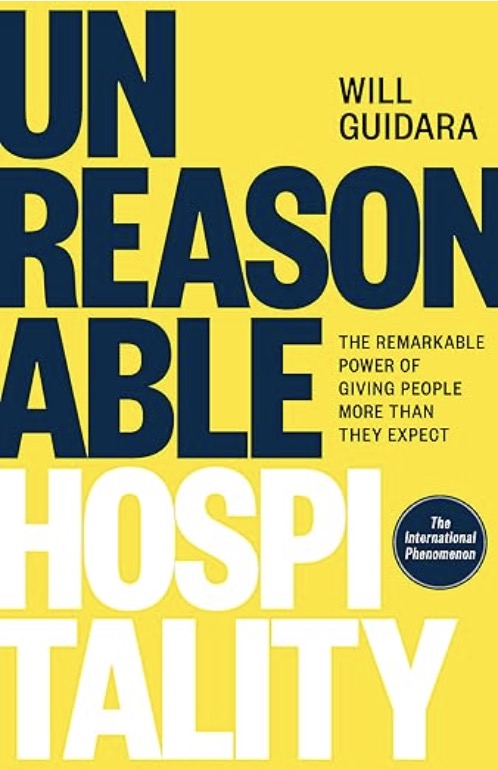
Unreasonable Hospitality (2022) is worth reading alongside this. Guidara's account of building Eleven Madison Park into the world's best restaurant arrives at something adjacent to omotenashi by a different route - the famous example being a staff member sent out mid-service to buy a street hot dog for tourists who had mentioned in passing that they hadn't had one yet, served to them as a final course.
The overlap is real: anticipate the unspoken need, reject the transactional. But the spirit differs. Guidara's model still has a story to tell about the gesture. Omotenashi would consider the telling of the story a slight corruption of the principle, because true selfless service neither performs nor records itself. It simply occurs.
Both are worth knowing. Both are legitimate. The question is which sits more honestly within your studio's values - and which your client actually wants. Some clients are drawn to the memorable flourish; others seek something quieter, a quality of attention so pure it bears the deepest scrutiny.
Unlearning before learning
None of this is instinctive if you have built your practice on a different model. The habits that worked (the follow-up cadences, the detailed proposals designed to pre-empt objections, the emphasis on value justification) can count against you once the client profile shifts. They signal the wrong things.
The work of moving upmarket is therefore not additive. You are not adding luxury-market techniques to an existing toolkit; you are examining what currently sits in that toolkit and deciding what no longer serves.
Last year I ran two webinars for designers on the subject of selling to high-net-worth and ultra-high-net-worth clients - covering the psychology of the market, the tier framework that determines how you should be presenting your practice, and the practical language of luxury sales. Both are available on YouTube if you would like to go deeper into the detail behind the framework above.
Later this month (April 2026) in Hothouse, I am running two further sessions under the title Sales and Client Acquisition for Interior Designers, a fresh look at the principles of sales theory for designers at all stages of business development, followed up with practical applications in the second.
Hothouse is the Facebook-hosted, free resource hub I run for professional creatives. Join now if this material sounds interesting.
Receive my quick-to-read weekly newsletter...
Sign up for the Hothouse Newsletter: find out what's coming up, and keep up with recent webinars, blogposts, videos, and other events - all focused on excellence in interior design practice.
We hate SPAM. We will never sell your information, for any reason.
