

The Founder Presence Moat: How Interior Designers Stay Valuable as AI Gets Smarter
Feb 27, 2026Why being visible isn’t optional - and why the designers who build it now will be very difficult to displace
There’s a particular kind of panic that arrives when you realise a piece of software can do, in 30 seconds, something that used to take you 30 minutes.
A moodboard. A colour palette. A draft scope of works. A pricing suggestion. Even a decent floor plan concept, if you feed it enough context.
The first reaction is usually: “Well then - what exactly am I for?”
The calmer, and more profitable, question is: what becomes ‘more’ valuable when outputs become cheap and plentiful?
Because that is where your strategy sits now. Not in resisting the tide, but in building the parts of your practice that are genuinely hard to replicate, and that clients will increasingly pay a premium for.
I call this your human moat. And here is the important thing about it:
A human moat doesn’t weaken when digital competition gets better. It strengthens.
Why?
Because when outputs become easy to obtain, people begin to buy what feels scarce: judgement, trust, standards, certainty, taste, and the support that actually changes what happens in a project.
There are several human moats worth building deliberately, and we will come to them. But I want to start with the one that underpins all the others, and that most designers underestimate.
The moat that makes the others visible
You can have exceptional judgement, impeccable standards, and a track record of extraordinary work. None of it functions as a moat if the people who need you cannot see who is behind the business.
Founder presence is the mechanism by which all your other advantages become legible to the market.
Without it, your expertise lives inside your projects. With it, your expertise compounds in public, attracting clients, justifying fees, and building the kind of trust that makes people feel they already know you before they have ever spoken to you.
That last point matters more than it might appear. There is a term for it: parasocial familiarity. It is the trust that forms when someone has spent time with your voice, your thinking, and your standards, without having met you. It is not manipulation. It is the natural result of showing up consistently, sharing your reasoning, and letting people see how you think.
And in a world where the internet is flooded with generic content and AI-generated ideas, that felt trust becomes genuinely scarce - and therefore genuinely valuable.
Why it matters right now, not eventually
The designers I work with who struggle most with client acquisition share a common problem: they look interchangeable. Despite having a strong portfolio, a well-designed website, and a list of services – they look pretty similar to the competition. That’s why prospects sit on the fence.
The fence is not a pricing problem. It is a distinctiveness problem.
A client who cannot tell you apart from three other designers cannot justify choosing you over them.
Founder presence is what tips that decision, not because it is flashy, but because it creates the sense that they are dealing with a specific, known, trusted person rather than a service category.
People buy people.
There is also a pricing dimension that is rarely named directly. When clients push back on your fees, it is almost never really about money. It is about insufficient confidence in your value.
Founder presence builds the authority that makes your fee feel proportionate before you have even sent a proposal. It pre-sells the premium.
And there is a third reason that is coming into sharp focus: referrals and word of mouth are amplified enormously when the founder is a recognised presence. People refer people, not companies. A business where the founder is invisible relies entirely on project quality to spread its reputation - a slow and fragile mechanism. A business where the founder is known in their market can grow on relationships and trust, which compounds far faster.
The other moats - and how founder presence activates them
Let me briefly name the other moats that matter in a world of increasingly capable digital competition, because each one is strengthened by founder presence.
These additional moats can be communicated as part of your founder presence positioning – these are messages you want your founder presence to convey:
Trust under uncertainty. Clients do not want more options. They want fewer regrets. Your ability to carry responsibility calmly - to make tough calls, hold supplier boundaries, and prevent expensive mistakes - is a significant moat. But it must be demonstrated publicly to be believable. Founder presence is how you show, rather than claim, that you are steady under pressure.
Taste and judgement. Good taste is not a colour palette. It is the ability to decide what matters and what does not - what to simplify, what to leave alone, which trade-off is worth making. In a world full of ideas, discernment is the rare skill. Founder presence is how discernment becomes visible; it lives in how you write, how you explain your decisions, how you respond to a brief.
Live presence. We are moving into an era of abundant content and scarce attention. The ability to hold a room, read a mood, adapt in real time, and give clients courage in difficult moments is a premium skill. This is not performance in an influencer sense. It is the quality of being genuinely present with a client or group - and right now it cannot be replicated by any digital tool.
Sharp diagnosis. One of the most valuable things an expert can say is: “That is not your real problem.” Clients frequently misdiagnose themselves. If you are known for seeing clearly and telling the truth kindly, you become very difficult to replace - but only if people know that about you before they hire you. Founder presence is what gets you there.
Finish quality. When everyone can reach 80% quickly, the premium shifts to the final 10–20%: the editing, the cohesion, the standard that holds up in real life. The internet is full of good. It remains hungry for truly finished. That distinction belongs to the founder who is willing to be seen standing behind their work.
The obstacle most designers don’t name
Almost every designer I speak to understands, on some level, that they should be more visible. The information is not the problem.
The problem is resistance. Something in the body that hesitates. A sense that showing up fully is somehow not quite professional, or that visibility is vanity, or simply a persistent unease with being seen that no amount of strategy addresses - because it was never a strategic problem to begin with.
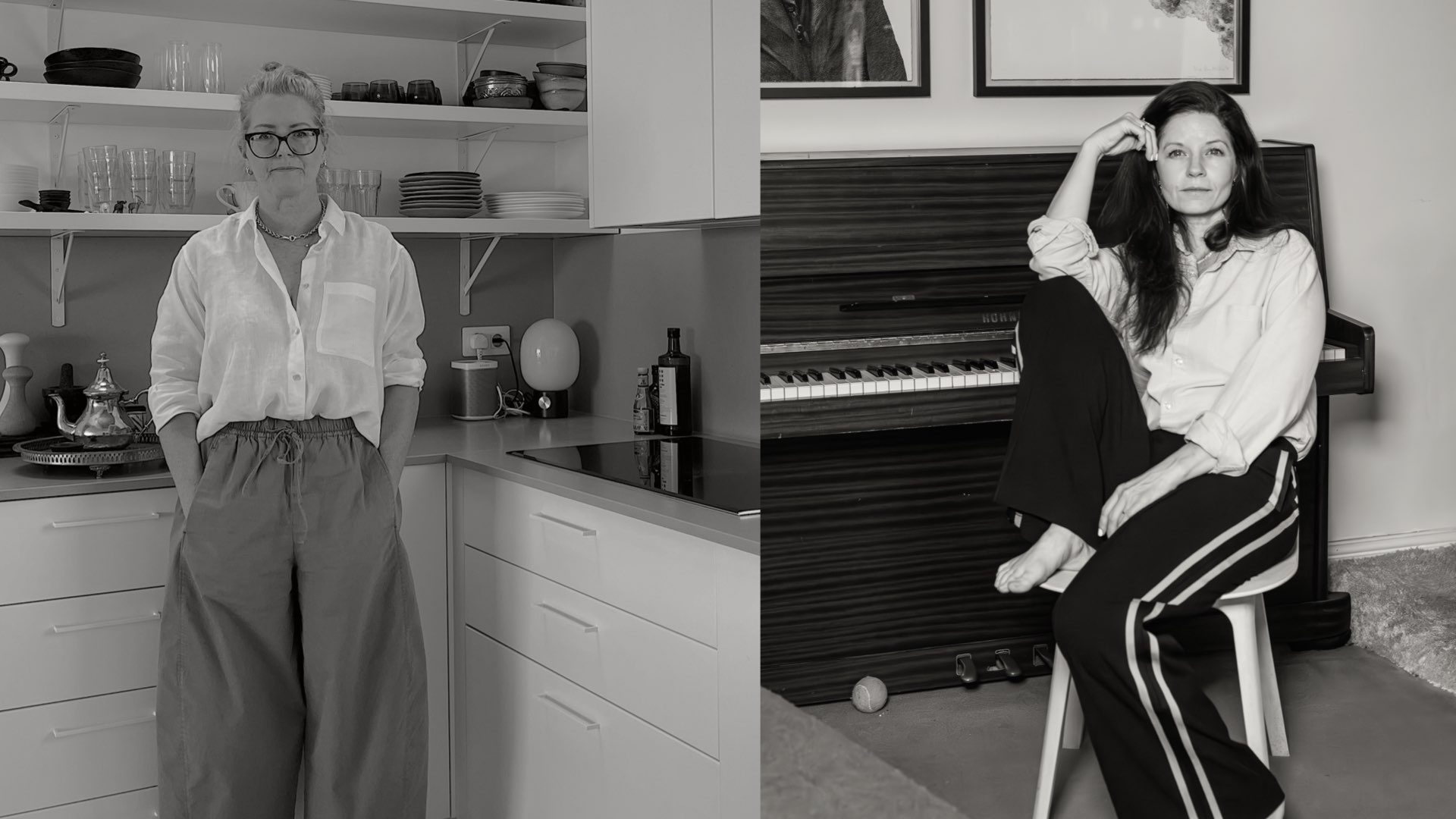
This is why I am running a retreat on 22 March with voice coach and embodiment expert Nicky Herrington. It is not a personal branding workshop. It is work at the level where the resistance actually lives.
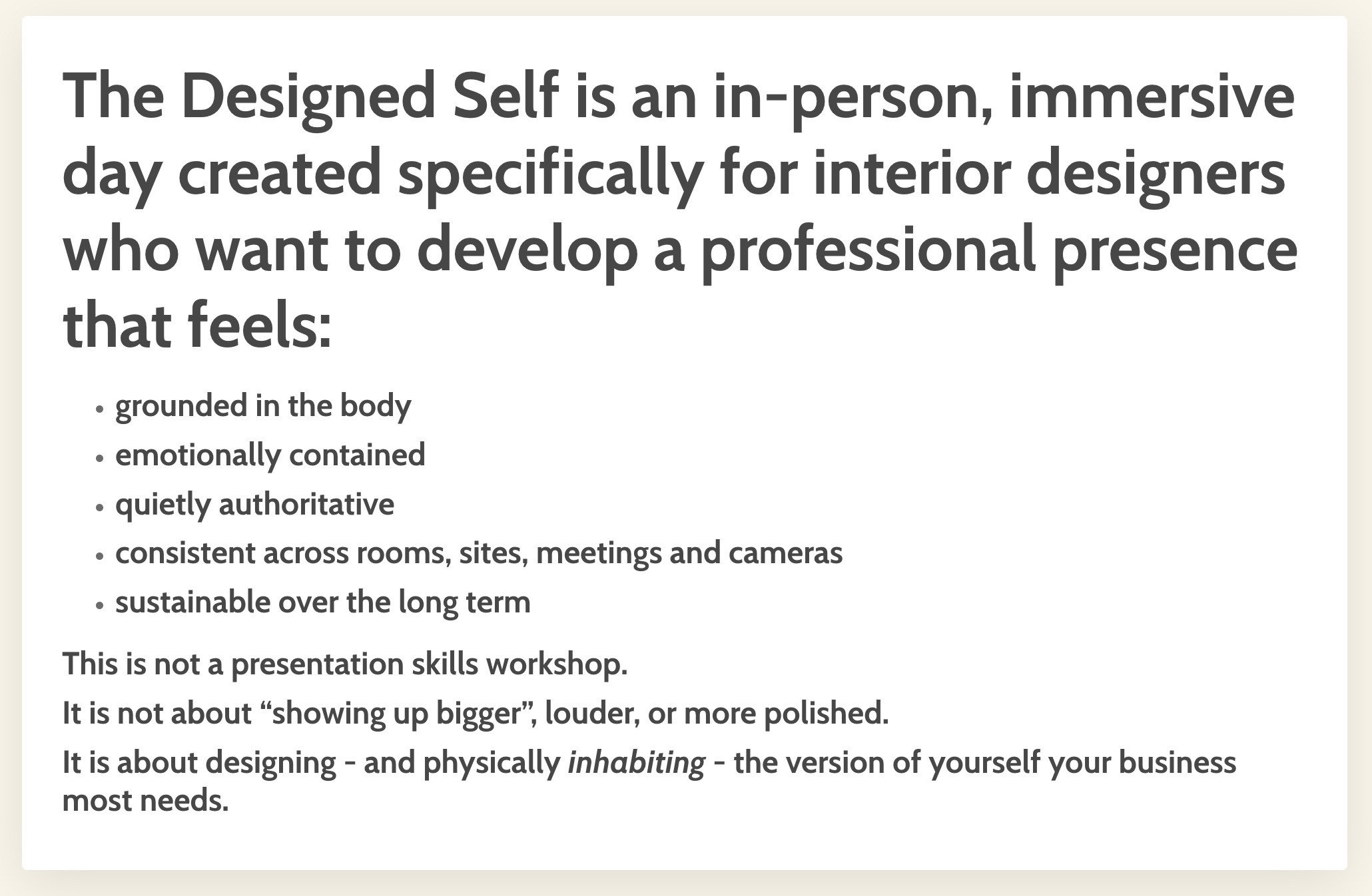
We will work with a very small group of designers - on the physical and psychological patterns that hold them back from being the founder their business needs them to be, and on the deliberate design of how they show up: what to make visible, what to keep private, and how to build a founder presence that feels genuinely theirs rather than a performance.
If the ideas in this post resonate, and you recognise yourself in the resistance, I would encourage you to look at the details.
A practical question to sit with
Which of your moats are currently invisible to the market?
You do not need to build all of them at once. But it is worth being honest about which advantages you have that nobody outside your existing clients can actually see - and what it would take to change that.
Digital competition will get more capable. The designers who are building their human moats now will find, in two or three years, that the gap has become very difficult for anyone else to close.
The Designed Self Retreat runs on Sunday 22nd March in West Sussex, find out more here.
Get clearer now. The compounding starts immediately.
Receive my quick-to-read weekly newsletter...
Sign up for the Hothouse Newsletter: find out what's coming up, and keep up with recent webinars, blogposts, videos, and other events - all focused on excellence in interior design practice.
We hate SPAM. We will never sell your information, for any reason.
