
Your Client Just Told You They Hate The New Sofa. They Don't.
May 23, 2026There is a discipline, used by everyone from hospital systems to global banks to Fortune 500 companies, whose entire purpose is to stop people from sabotaging something they actually want. It is called change management. And if you have ever had a client ring you in a panic three weeks before handover because suddenly they are not sure about anything, you have experienced precisely the problem it was designed to solve.
Change management is not for people who are bad at change. It is for everyone.
What change management actually is
Change management is the structured practice of preparing people (psychologically, emotionally, and practically) for significant alterations to their circumstances. It emerged as a formal discipline in the late twentieth century, largely because businesses kept failing to implement perfectly good strategic decisions. The plans were sound. The execution was competent. But the people whose lives would be altered by the change were not ready for it, and so they resisted, stalled, or simply reversed course the moment the pressure was off.
The field produced a number of frameworks to address this. One of the most useful, and the one most directly applicable to what we do as designers, comes from a consultant called William Bridges, who made a distinction that changes everything once you understand it.
Change, Bridges argued, is an external event. A new office layout. A rebranded product. A restructured team. Change happens to people, often quickly, often regardless of their feelings about it. Change can happen overnight.
Transition, however, is internal. Transition is the inner psychological process that people go through as they internalise and come to terms with the new situation that the change brings about. And transition, unlike change, does not happen quickly. It cannot be rushed, mandated, or managed away. It has to be moved through.
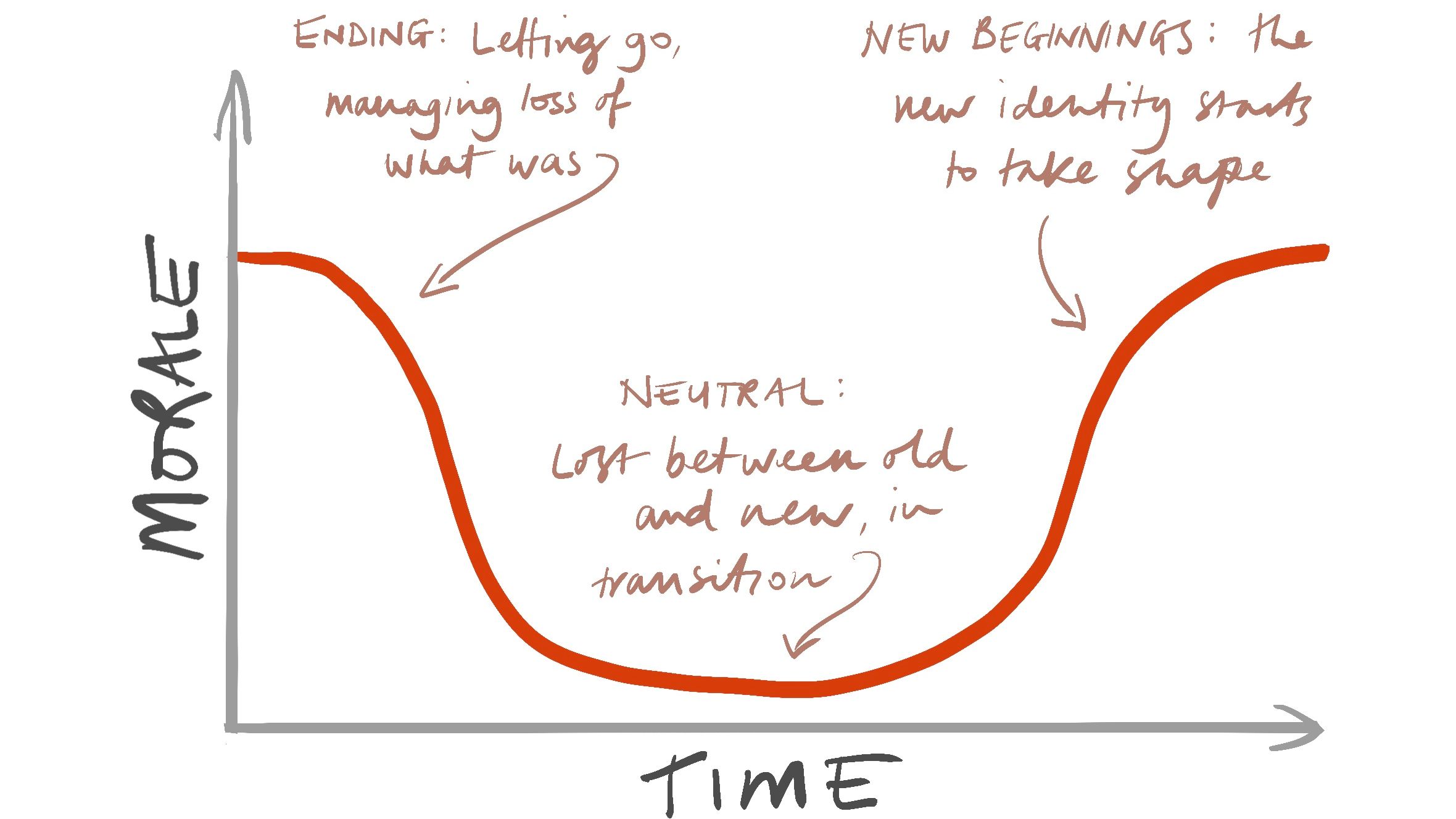
Bridges identified three stages that individuals experience during transition: Ending What Currently Is, The Neutral Zone, and The New Beginning.
The first stage - the ending - is paradoxical. Transition starts with an ending. People identify what they are losing and learn how to manage these losses. They determine what is over and being left behind, and what they will keep. This might involve relationships, routines, even identity. A person who has lived in the same home for fifteen years has not merely grown accustomed to it. They have built a self around it.
The second stage - the neutral zone - is uncomfortable and often misread. The neutral zone is where the critical psychological realignments and repatternings take place. People are in flux and may feel confusion and distress. They are no longer fully attached to the old reality, but the new one has not yet become theirs. This is, as Bridges observed, also where the richest transformation occurs...but it rarely feels that way from inside it.
The third stage is the new beginning: acceptance, ownership, and the gradual discovery that the new way of things is not just tolerable but genuinely good.
The critical insight from all of this is simple but powerful: most people cannot skip the first two stages. They cannot be argued out of loss. They cannot be reassured into acceptance before they are ready.
The job of a change manager is not to accelerate the process but to make it safe to move through.
What this has to do with your clients
It's easy to imagine that change management is for corporations, not for people who have just had their hallway redecorated. But consider what a serious interior design project actually involves.
A client commissions work on a space they know intimately: a home they have navigated in the dark, a kitchen that holds the particular smell of twenty Christmas mornings, a sitting room where the arrangement of every lamp and cushion is encoded in their muscle memory. They have approved your plans. They have chosen the colours, the materials, the scale of the new furniture. They are excited. They are ready.
And then the work is finished, and they stand in the room for the first time, and something is wrong. They cannot quite explain it. They feel, unexpectedly, as though the space no longer belongs to them. They miss the old version, the one they had complained about, the one they had been desperate to change. They wonder whether they have made a terrible mistake.
This is not unusual. It is, in fact, entirely predictable. And it has almost nothing to do with your work.
The 95% problem
There is a particular vulnerability in the final stages of a design project that deserves its own name. Call it the 95% problem, and let's be clear that it is a different beast from the transition anxiety described above, though the two can arrive simultaneously, which is where things get genuinely difficult.
At 95% completion, a project often looks worse than it did before you started. The budget has been substantially spent. The bones are all visible. The walls are painted, the floors are laid, the major furniture is in place. And yet the space has no soul, no warmth, no character. It looks like a show home that nobody wanted to buy. The client, who has been imagining the finished result for months, is standing in something that feels like a very expensive disappointment.
This is not a psychological response to change. It is a structural reality of how design schemes come together. The final 5% - the styling, the layered soft furnishings, the artwork, the lighting dialled to the correct warmth, the hundred small decisions that give a space its personality - is not finishing. It is the transformation itself. Everything before it is infrastructure. Without that last 5%, the infrastructure is all there is to look at.
The problem is that this moment arrives at the worst possible time. The money is gone, or nearly. The end is supposedly in sight. And the client is standing in a space that does not yet resemble what they were promised - and may be wondering, with some justification, whether it ever will.
Now layer the transition psychology on top of that. A client experiencing genuine, rational concern about an unfinished scheme is also, simultaneously, experiencing the mismatch signal of a changed familiar environment. The two feelings are indistinguishable from the inside. The client cannot tell you which part of their distress is "this room has no character yet" and which part is "my brain hasn't built its new map." Neither, frankly, can you, not with certainty.
What you can do is hold both possibilities at once: take the aesthetic concern seriously as a real and legitimate observation about an incomplete scheme, while not allowing it to trigger decisions before the final 5% has done its work. A space at 95% is not available for verdict. It is not finished. And a client who understands that the transformation lives entirely in that last stage is a client who can wait for it, rather than panicking in its absence.
Signs that your client is in transition, not crisis
Learning to distinguish normal psychological transition from a genuine design problem is one of the more valuable skills in a designer's toolkit. Here is what transition typically looks like.
The 11pm message. A client contacts you in the evening - not during working hours, when they are occupied and purposeful, but late, when the house is quiet and the new space is doing its unsettling work on them. The tone is apologetic but urgent. They are "not sure" about something. They cannot articulate what exactly.
The comparison to the old. They find themselves talking about the previous version of the space with unexpected warmth. The old sofa, which they had been desperate to replace for three years, is suddenly remembered as comfortable, familiar, right. This is the ending stage presenting itself clearly: they are grieving what was, which is a necessary precondition for accepting what is.
The displacement of anxiety onto detail. Rather than saying "I feel unmoored in this new space," a client will often fix on something specific: the cushion colour, the height of a shelf, the angle of a mirror as the apparent source of their discomfort. The detail may be entirely fine. It is standing in for the larger feeling they cannot yet name.
The sudden reversal on a previously confident decision. A client who was certain about the kitchen worktop, the bathroom tiles, or the bedroom wallpaper calls to say they have changed their mind. The timing - typically at the point when changes become either very difficult or impossible to make - is not coincidental. The approaching finality of the project makes the transition real.
The generalised withdrawal. Some clients go quiet during this phase rather than loud. They stop responding promptly to messages, become vague about site visits, seem to have lost the energy and enthusiasm that characterised the earlier stages of the project. This, too, is transition: they are processing something they cannot quite articulate, and engagement feels temporarily impossible.
What you can borrow from the change management world
The practice of change management offers several principles that translate directly to design work. The good news is, they are really easy to incorporate into your processes.
Name the transition before it happens. The single most powerful intervention available to a change manager is telling people in advance what they are likely to feel.
When clients know that a moment of disorientation at the end of a project is normal, predictable, and temporary, it loses much of its power over them. Frame it explicitly: "Many clients find the first week or two in a newly completed space a little strange. Your nervous system needs time to catch up with your eyes. If you feel uncertain, that is not a signal that something is wrong, it's a signal that you've achieved a real and significant transformation."
This reframing is not reassurance; it is information. It puts the client in possession of a framework for understanding their own experience, which is far more useful than being told not to worry (after the event!).
Give the ending its due. Bridges was clear that the first stage involves the emotional and psychological responses as individuals confront the loss of familiar routines. In a design context, this might mean acknowledging, in conversation, what is being left behind. Not dwelling on it, and certainly not second-guessing the brief, but recognising that a client who has lived with something for twenty years is allowed to feel its absence.
Note: at this stage I'm reminded of the KonMari Method (from Marie Kondo) and her small ceremony of release: thanking an item before discarding it provides closure and gratitude for its service. Before letting go of something that no longer sparks joy, Marie Kondo teaches you to physically hold the object and say, "Thank you for your service", or, "Thank you for giving me joy".
A brief acknowledgement of what the old space provided, followed by a clear articulation of how the new space honours or improves upon that, is worth more than a hundred photographs of how lovely everything looks.
Slow down at the finish line. Counter-intuitively, the moment a project is completed is the moment that calls for increased contact, not decreased. A handover meeting, a follow-up call three days later, a check-in at two weeks - these are not client service extras. They are structural support for the transition that is happening in your client's nervous system. The neutral zone tends to be at its most disorienting in the first fortnight. Your presence during that period, calm and confident and genuinely interested, is stabilising.
Separate the feeling from the decision. When a client contacts you in distress about a finished project, your first response should almost never be "let me look at whether we can change it." That framing confirms their anxiety as a design problem when it is almost certainly a transition problem. Instead: "Tell me what you are noticing. Walk me through the space. Let's talk about it in a few days and see how it feels then." You are buying the neutral zone its necessary time. Most clients, given three to five days and the knowledge that you are not alarmed, will find that the space has begun to become theirs.
Mark the new beginning. Bridges emphasised that new beginnings cannot be forced, they happen when people are internally ready. But you can create conditions that invite them. A small celebration of completion - even something as simple as a personally written note about what makes the finished space distinctive - signals to the client that a new chapter has started. Some designers send flowers on the day of completion. Others frame a photograph of a particular detail. The gesture matters less than its function: it marks the crossing of a threshold, and it gives the client something to feel good about at precisely the moment they are most likely to feel anxious.
This is not an afterthought. It should be a system.
The principles above are valuable in isolation. But their real power comes from being built into a project structure deliberately, not applied reactively when a client calls in a panic.
This is one of the foundational ideas behind the new programme that will launch from my website this summer (2026): the White Label Studio. Change management is not a separate module in that framework - a set of tips for managing difficult clients. It is woven into the process itself: how projects are communicated, how decisions are revisited, how completions are handled, how clients are prepared for the reality of transformation before they experience it.
What the change management literature understands - and what Bridges made explicit decades ago - is that the gap between agreeing to something and living with it is not a design problem. It is a human problem. And human problems, handled with knowledge and intention, are entirely navigable.
Human problems are fantastic - they keep you in business as AI encroaches - mastering this level of client management is a moat around your design practice.
Your clients do not need to be protected from change. They need to be accompanied through transition. Sophisticated design practices understand this and know the difference.
If you'd like to join the waitlist to learn more about the White Label Studio, sign up here.
Receive my quick-to-read weekly newsletter...
Sign up for the Hothouse Newsletter: find out what's coming up, and keep up with recent webinars, blogposts, videos, and other events - all focused on excellence in interior design practice.
We hate SPAM. We will never sell your information, for any reason.
