

The Client As Ming Vase
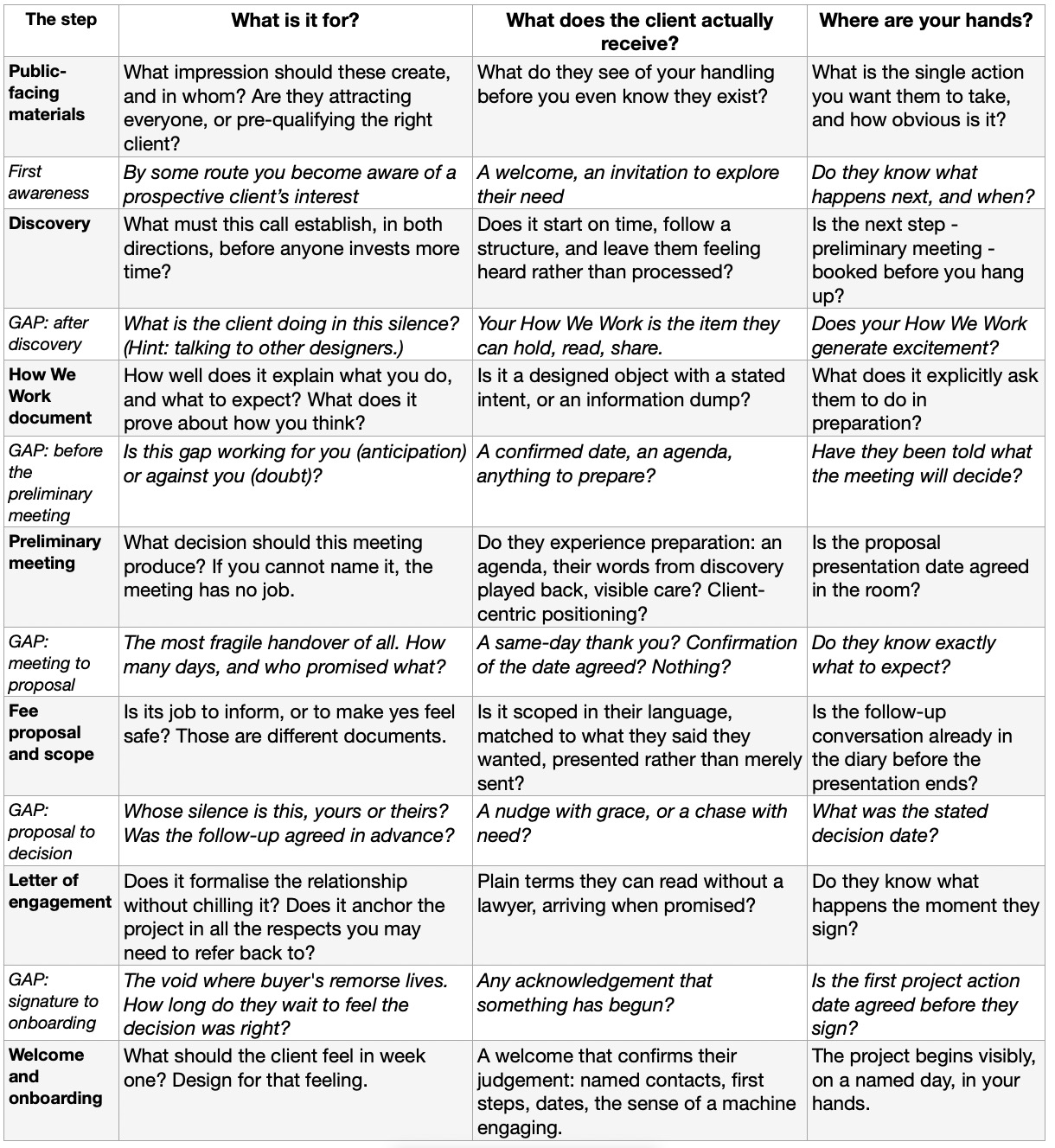
Jul 18, 2026Twice this summer, with one-to-one clients and quite independently, I have found myself working on the same stretch of a business: the front end. The carefully constructed path that carries a person from first noticing you all the way through to becoming a signed, onboarded client. In my Hothouse group, where the focus in June has been systems and processes*, we have walked this path deliberately: public-facing materials, discovery, the How We Work document, the preliminary meeting, presentation of the fee proposal and scope, letter of engagement, Welcome or onboarding materials.
It is a short stretch of the client relationship, measured in weeks, but it is arguably the most delicate and critical phase.
Performance improvement here has a transformational effect on a design business that improvement almost nowhere else can match.
Putting this short stretch of the design process under the microscope, to fine-tune and finesse exactly how you run it, could be the key to unlocking significant business growth.
*watch the full playlist of systems and processes webinars here.
What the client can and cannot judge
Economists sort what we buy into three categories:
Search goods can be assessed before purchase: you can sit on the sofa in the showroom.
Experience goods reveal their quality only after purchase: you discover whether the restaurant was good by eating there.
Credence goods, named by Michael Darby and Edi Karni in 1973, are purchases whose quality the buyer cannot properly judge even after the fact. The classic examples are surgery, car repair and legal advice. Was the operation necessary? Was the gearbox really failing? You cannot know. You take it on credence, on belief, because there is no evidence of any alternative outcome.
Interior design sits close to the credence end of this spectrum. Your client cannot judge, even after the final styling visit, whether the fee was proportionate, whether the specification was the best available at the budget, whether the layout you fought for was the right call, or whether another designer would have done it better. There were a thousand alternative outcomes, but only one was ever realised. The finished project is beautiful, usually, but beautiful compared to what? The client has no way of knowing, and never will.
Now follow that thought backwards to the beginning of the relationship, because this is where it bites. If the client cannot evaluate the product even after delivery, they certainly cannot evaluate it before. No portfolio image tells them what it will be like to spend eight months in a working relationship with you. Which leaves them with only one body of evidence they can assess with their own faculties: the experience of being taken through your front-end process.
The discovery call that starts on time. The How We Work document that answers the question they were embarrassed to ask. An exquisitely customised proposal delivered expertly on the agreed date, scoped in language they understand. These are not administration surrounding the work. As far as the client's available evidence goes, they are the work.
The front end is the only sample of your practice a prospective client will ever be able to judge for themselves, and they know it, even if only instinctively.
Very few designers turn the client experience of the front end of their offering into a business development project; a majority of designers I speak to are disappointed in their rate of conversion of prospects into signed-up clients.
A designer who fumbles this stage is not failing to sell good work. They are showing the client imperfect work, and the client is drawing the reasonable conclusion.
The vase and the handling
A fragile and valuable object passed from hand to hand rarely breaks while it is being held. It breaks at the handovers. In my experience the same is true of conversion. While it is important to polish the stages (the call, the meeting, the document), we absolutely mustn't neglect the gaps between them: the silence in the days after discovery, the proposal that takes a fortnight to arrive, the void between the signed letter of engagement and the first sign of onboarding. Each gap is a moment when the client is in nobody's hands, and each one is answering the client's unspoken question badly: how does this person handle precious things?
What this means in practice
Because this is a systems problem, the response is systems, not charm. Three changes follow directly from the argument.
1
Treat every front-end artefact as a designed object with a stated intent. This is exactly the premise of my White Label Studio programme. Your How We Work pack is not information; it is evidence of how you think, and it should be composed with the same intent you would bring to a client presentation. If you cannot say in one sentence what a given document is for, it is not yet finished.
2
Engineer the transitions, not just the stages. Every stage should end with the next one already scheduled: a named step, a date, and who moves next. "I'll send the proposal across next week" is a gap. "The proposal will be with you on Thursday the 10th, and I've held the following Tuesday for your questions" is a handover with both hands on the vase. It demonstrates a designer who can be trusted to deliver a process on time and on budget.
3
Audit the gaps before you redesign anything. Take your last five enquiries and write down the elapsed time between each stage, including the ones that went quiet. The pattern is usually visible within the hour, and the gaps are as important as the stages.
Because businesses at different stages need different strategies, regular readers know that I encourage designers to self-qualify as belonging to one of four tiers of practice:
Tier One: startup
Tier Two: growing pains - you look like you're up and running, but your systems and processes are patchy or rickety, still evolving
Tier Three: maturity - you are justly proud of your good-going business
Tier Four: stardom - you step forward and court the recognition of your peers, you are a visible leader of our industry
This front-end scrutiny is upper-tier work. It belongs to designers whose businesses are mostly under control, who have answered their own questions about marketing and know what they do for their clients, and who now have the time to bring specific segments of the process into the lab.
If you are earlier in the journey than that, this post is a marker to return to, rather than this month's project. In the autumn I'll be taking my accountability groups through this territory properly (there is a real appetite for this) and I suspect it will occupy all of us for a while. It deserves to. The client cannot see your talent from where they are standing. But they are profoundly aware of how well they are conveyed.
Receive my quick-to-read weekly newsletter...
Sign up for the Hothouse Newsletter: find out what's coming up, and keep up with recent webinars, blogposts, videos, and other events - all focused on excellence in interior design practice.
We hate SPAM. We will never sell your information, for any reason.
