
You Already Know When Your Client Will Panic. Are You Using That Knowledge?
Jun 13, 2026In the accountability groups I run with interior designers, tricky client interactions come up constantly. And there's a pattern in how those conversations go: the designer brings the challenge to the group, and more often than not, they already know exactly why the client is behaving as they are. They know because they've seen it before - on every project, at this same point.
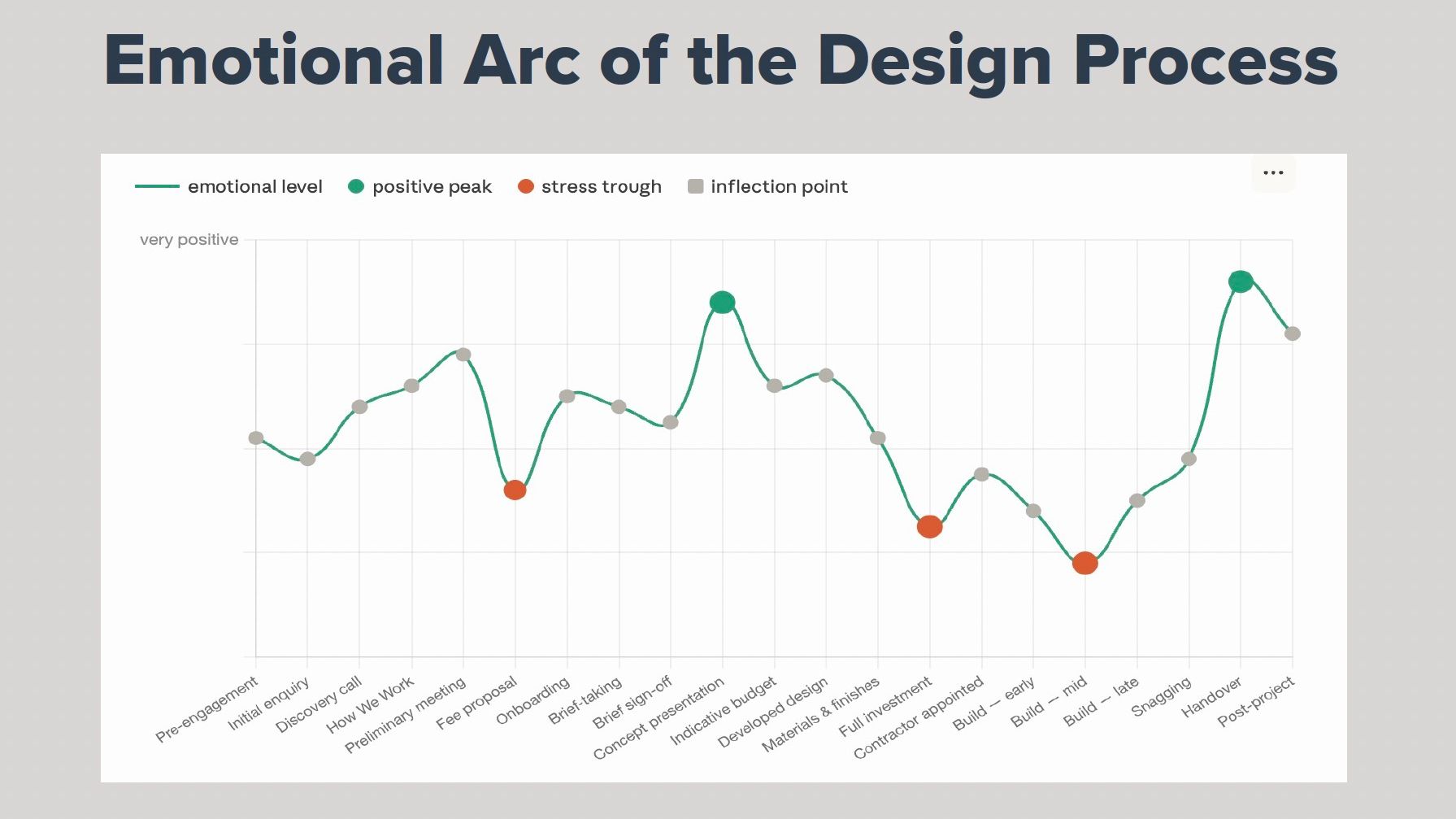
We all know, with reasonable predictability, when a client will feel most excited, when they will feel most exposed, when they will begin to second-guess decisions they were confident about three weeks ago, and when they will experience something close to grief - even on a project they love and cannot wait to complete.
This isn't intuition. It's pattern recognition, and it maps with striking consistency onto what behavioural science tells us about how human beings respond to change, uncertainty, and commitment. The emotional arc of a design project is well understood. We just haven't built our businesses around it.
Today I want to ask why - and what it would actually look like if we did.
The map we already have
The client's emotional journey follows a well-worn path. The details vary, but the broad shape is consistent enough to be predictive. Consistent enough that we should be designing for it.
Brief and early engagement is a period of high energy and high trust. The client is projecting their ideal outcome onto a process that hasn't yet made contact with reality. Psychologically, they are in what William Bridges called the "new beginning": energised, hopeful, and - crucially - not yet equipped to absorb warnings about what lies ahead. This matters for how we structure onboarding communications, and we'll come back to it.
Design development is where the first fault lines appear. As abstract preferences become concrete choices, loss aversion kicks in: the psychological pain of foreclosing an option is felt more acutely than the gain of the one being chosen. Kahneman and Tversky established that losses loom roughly twice as large as equivalent gains in human perception, which explains why clients who appeared decisive at brief stage begin to hesitate as choices become real. Indecision, over-questioning, and a sudden preoccupation with budget are the typical surface expressions of something more structural.
Procurement and specification is, for many clients, the emotional low point - and motivational science tells us why. Research by Bonezzi, Brendl and De Angelis (Psychological Science, 2011) established that motivation follows a U-shape across any goal-directed activity: high at the outset, low in the middle, recovering as completion approaches. At the midpoint, progress feels least significant: too far from the exciting beginning, too far from the finish line for either to provide pull. For a design project, procurement is precisely that valley: the creative conversation has given way to spreadsheets, the mood boards are in a folder, and the client can no longer see the thread connecting approvals to outcome. Cognitive load compounds the problem, impairing decision quality at exactly the point when decisions matter most.
On site is the peak anxiety point. The client's home is in a state of controlled chaos, their daily life disrupted, and what the designer can see - the emerging structure of a very good result - is completely invisible to someone standing in a space that appears to be getting worse. Bridges' "neutral zone" maps precisely here: the old space is gone, the new one doesn't yet exist, and anxiety fills the gap. This is when client calls spike, difficult conversations happen, and the most avoidable damage to the client relationship occurs.
Snagging and completion brings relief, but also a flatness that surprises both client and designer. The euphoria anticipated is frequently quieter than expected. Gilbert and Wilson's research on affective forecasting error explains why: we consistently overestimate the intensity and duration of future emotional states. Eighteen months of anticipation cannot be matched by the moment of arrival. This gap is not a sign that something went wrong - it is a predictable feature of human psychology, and it is very frequently misread by clients as dissatisfaction and by designers as failure.
Post-handover may be the most consequential phase we think about least. Referrals aren't made at handover; they are made during the weeks that follow, when clients re-process the experience and form the narrative they will tell others. Kahneman's peak-end rule is directly relevant here: we evaluate experiences not as a whole but by two moments - the emotional peak and the ending. A difficult on-site phase followed by a warm, attentive close will be remembered better than a smooth project that simply stops. The ending carries disproportionate weight.
What a practice built around this actually looks like
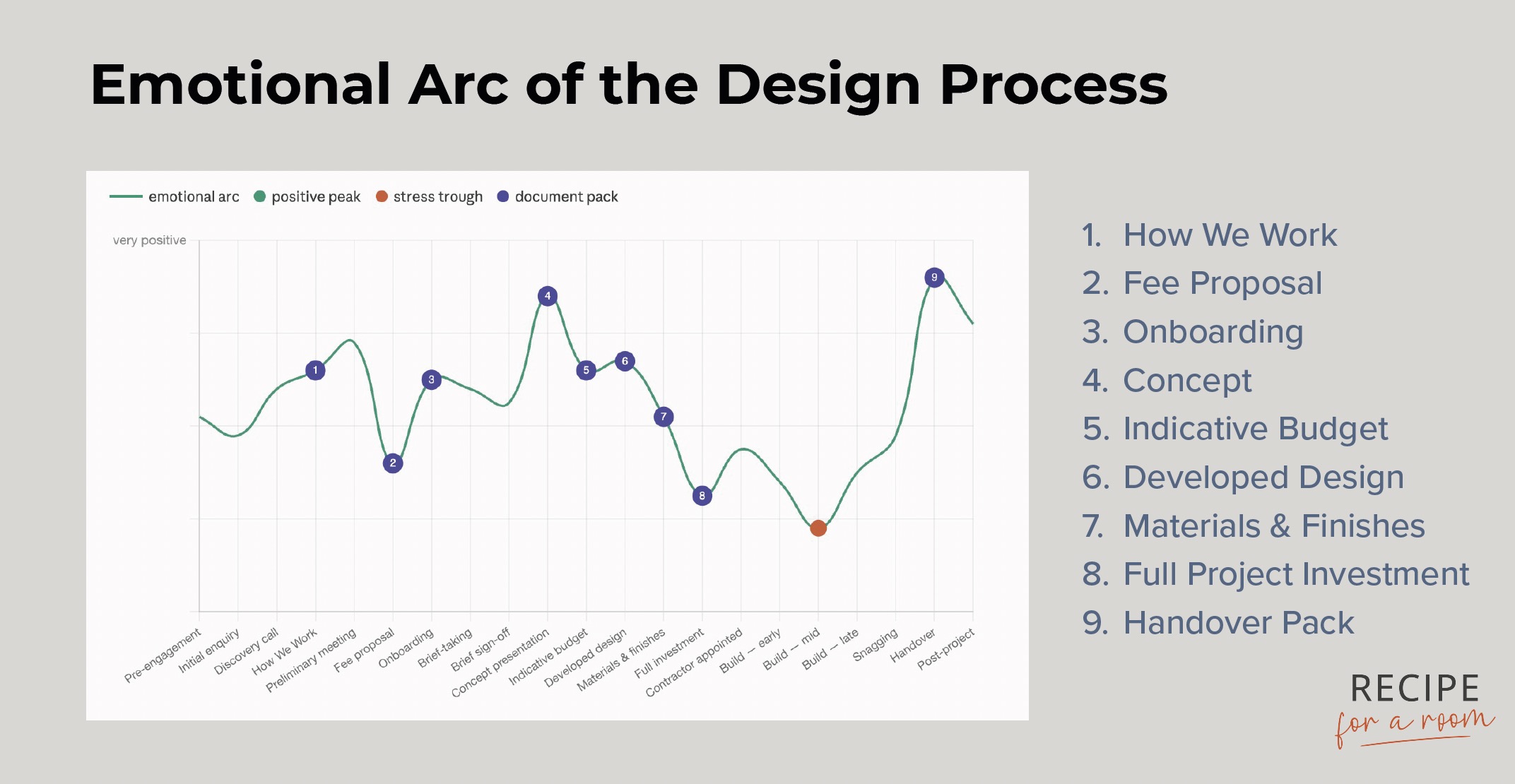
We discussed this in detail during the Systems & Processes webinars - watch again on YouTube.
Anticipatory communication is the most immediately valuable tool, and it works for a specific reason. Pre-exposure to a stressor - what researchers call inoculation - reduces its impact when the full experience arrives. Telling a client before they reach procurement that the phase tends to feel disconnected from the creative work, and naming that feeling as normal and temporary, reframes a predictable difficulty as structural rather than alarming. Clients who have been told "this phase often feels like the creative thread has gone" are significantly less likely to panic when they feel exactly that - because panic requires the additional belief that something has gone wrong.
Designed transition rituals acknowledge that Bridges' transitions fail not at the new beginning but at the ending - when people haven't been given space to process what they're leaving behind. Each phase transition is a small ending for the client. Acknowledging it explicitly, rather than moving briskly to the next deliverable - gives clients the processing space to move forward without residual anxiety.
Milestone markers through the middle address the motivational trough directly. The Bonezzi research points to the remedy: sub-goals place clients perpetually near either a beginning or a finish, rather than stranded in open water. Designing procurement as a series of discrete completions - fabrics signed off, furniture specified, lighting finalised - means the emotional experience of finishing something small interrupts the trough regularly.
In teacher training, I learned that a 12-week term is too long for students to maintain momentum without a dangerous slump that leads to avoidable drop-outs. 12-week terms should be subdivided in to two or three, so the start and finish of each subset is always within view. What if we engineered the delivery of a design project in the same way that teachers design curricula?
Post-completion follow-up as a structural commitment changes its character entirely when understood through the peak-end rule. A six-week or three-month check-in is not courtesy - it is an active intervention in how the project will be remembered, timed precisely when referrals are forming. This is not client care as a soft extra; it is a business development decision.
What this has to do with how you build your practice
The distinction between a reactive practice and a mature one isn't primarily about skill, taste, or experience. It's about whether the knowledge you've accumulated is embedded in how the studio operates - in your systems and processes - or whether it lives only in the designer's head and gets deployed case by case.
The knowledge is already there - in the industry's collective pattern recognition, in the behavioural science that explains why those patterns hold. The question is whether you've made it structural.
This is the work we do inside my new programme White Label Studio - taking what experienced designers already understand intuitively and building it into frameworks and processes that a practice can deliver consistently, at scale, without depending on a single person's presence or memory.
White Label Studio follows the design process chronologically, step by step, with clear instructions on how to deliver design services at each stage, and providing the templates you need to do this - both client-facing and behind the scenes in your business.
This course is available to pre-order at a founder price of £350 (a £150 discount) until 30 June 2026. You will receive access to the course in September 2026.
Receive my quick-to-read weekly newsletter...
Sign up for the Hothouse Newsletter: find out what's coming up, and keep up with recent webinars, blogposts, videos, and other events - all focused on excellence in interior design practice.
We hate SPAM. We will never sell your information, for any reason.
